

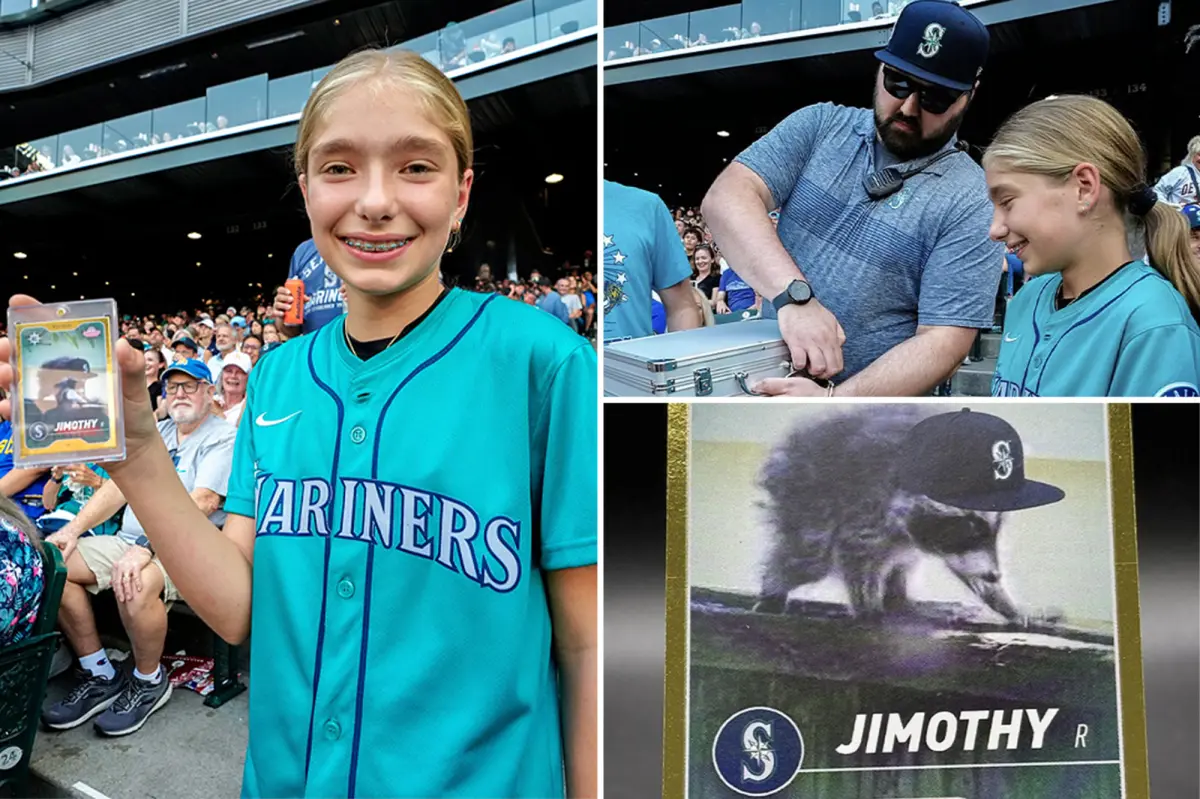
It began like any other summer night at the ballpark. A 13-year-old Seattle Mariners fan named Abby walked through the gates of T-Mobile Park on August 5, probably focused on nachos, home runs, and the strange little raccoon that had recently turned her city upside down. She was handed a free rookie card, the kind of promotional trinket that usually ends up in a drawer, forgotten. But Abby’s card was not ordinary. Hidden among the 20,000 giveaways was a single golden Jimothy rookie card, a one-of-one treasure made to honor the oddly shaped raccoon who had become an internet darling. Days after the promotion, Abby’s card ended up on eBay with a starting price of 99 cents. What happened next stunned everyone. Bid after bid pushed the price skyward, until Sunday night when the auction closed at $21,100 after 100 bids. For a teenager who had simply gone to cheer on her team, the free piece of cardboard became a five-figure payday—a real-life golden ticket story. The Mariners shared the news themselves, posting photos of Abby holding the prized card and writing, “Talk about a one-of-a-kind pull.” It was a moment of pure, joyful disbelief, and it showed how a quirky promotional idea could turn into an unforgettable memory for one young fan. While most of us will never see a giveaway turn into a college fund, Abby’s experience was a reminder that sometimes the most ordinary moments—a summer game, a free gift, a spontaneous decision—can lead to extraordinary outcomes. And in a city already enchanted by a viral raccoon, the news felt less like a random auction result and more like a fairy tale. The bidding had taken over family group chats, with Abby and her loved ones refreshing the page over and over, watching a 99-cent card transform into something beyond imagination. By the end, it wasn’t just a card. It was a symbol of hope, luck, and the wonderful unpredictability of being a sports fan. Each new bid seemed to carry a little more excitement, and when the final number appeared, the reaction was the same from Mariners fans everywhere: no way. But yes—the little gold raccoon card had done the impossible.
The story of Abby’s card started with a clever marketing idea. On July 29, the Mariners announced that Jimothy was “taking over” T-Mobile Park, promising a special night for the raccoon that had captured Seattle’s heart. When August 5 arrived, the first 20,000 fans through the gates received a Jimothy rookie card, but the team had secretly mixed in a series of “chase cards”—rarer versions of the card, each with different color schemes and limited print runs. At the top of the pyramid was the one-of-one gold card, a pristine, collectible piece that was the only one of its kind in existence. The Mariners later confirmed to Fox News Digital that Abby had somehow managed to find that single golden needle in a haystack of cardboard. “Among the 20,000 cards, we had collection of ‘chase cards’ which were headlined by the 1-of-1 gold card that Abby took home,” the team said. It was like finding a golden ticket in a chocolate bar, except the prize wasn’t a factory tour—it was a small fortune. For Abby, the evening started as a fun outing with her family. By the time she left the park, she was carrying something far more valuable than a freebie: a piece of Mariners history, a piece of Seattle’s viral moment, and, as it turned out, an asset that would soon attract bids from collectors who understood exactly how special it was. The team’s own social media account couldn’t contain its excitement, celebrating Abby’s rare find with photos of the teenager beaming as she held up the card. It was a moment that made everyone wonder: What if they had been the ones holding that gold card? But this time, the luck belonged to Abby, and the Mariners were clearly thrilled to be part of her story.
To understand why a piece of cardboard could be worth $21,100, you need to know about Jimothy. He is not your average raccoon. With a round, compact body and an unusually short spine, Jimothy looks like someone pressed a cartoon button on a real animal. Wildlife experts believe he may have Short Spine Syndrome, a rare condition that gives him his distinctive, almost bobblehead-like appearance. But that hasn’t slowed him down. In July, videos of Jimothy wandering through Seattle’s Ballard neighborhood began popping up online, and the internet immediately did what the internet does best: it fell in love. The small, sturdy raccoon was filmed scurrying across streets, marching through backyards, and making cameo appearances in residential driveways. Millions of people watched these clips, charmed by an animal that was both unusual and unbothered. Despite his condition, Jimothy appeared healthy and active, moving through his world at his own pace. One Ballard resident, Dmitriy Ishimskiy, captured footage of Jimothy visiting his property and told Storyful that the raccoon had become a local celebrity almost overnight. “Over the past week, Jimothy has become a local celebrity, and I feel lucky to have captured this moment on video,” Ishimskiy said. The videos did more than just rack up views; they turned Jimothy into a symbol of Seattle’s quirky, neighborly spirit. Strangers started sharing Jimothy sightings like weather reports. Some residents left out snacks, though experts would probably advise against feeding wild animals. The raccoon’s fame grew so quickly that it was only a matter of time before a major institution took notice. And in Seattle, there is no bigger institution for bringing people together than the Mariners. The team saw an opportunity to have a little fun, and the Jimothy-themed promotion was born. What might have been a one-day curiosity became an enduring baseball memory, all because a raccoon with a strange body happened to waddle through the right neighborhood at the right time.
The Mariners didn’t just hand out cards; they built an entire night around Jimothy. The July 29 announcement that Jimothy was “taking over” T-Mobile Park was playful and self-aware, promising a celebration of a viral sensation without taking itself too seriously. The Aug. 5 event was designed to connect the ballpark to the Ballard neighborhood where Jimothy had become a star. Beyond the 20,000 rookie cards, the team offered special ticket packages that included a Jimothy T-shirt, with a portion of the proceeds going to the Ballard Food Bank. It was an unusually wholesome way to capitalize on a raccoon’s fame: the team used Jimothy’s popularity to raise a little money for a good cause while giving fans a quirky piece of memorabilia they would actually treasure. For the people of Ballard, it was a validation of the weird, wonderful joy their local raccoon had brought them. For Mariners fans, it was a chance to own a piece of their city’s viral moment. The promotion worked almost too well. Fans showed up, grabbed their cards, and went home to discover they might be holding something special. Social media lit up as people compared card colors and print runs, speculating about who had found the gold version. Abby’s discovery was the jackpot, but the chase was shared by thousands. In a sport that loves its stats and traditions, this was a new kind of baseball card story—one that linked a 19th-century tradition to a 21st-century raccoon meme. And it all happened because the Mariners understood that sometimes the best stories are the ones you can’t script. Jimothy didn’t plan to become a celebrity, and Abby didn’t plan to become a five-figure winner. But on one August night, their paths crossed in a way that made perfect, improbable sense.
The real drama began when Abby decided to test the market. She listed her one-of-one gold Jimothy rookie card on eBay, and with a starting price of 99 cents, it was hard to ignore. The first bids probably didn’t seem like much—a few dollars, maybe a little more. But word spread quickly among Mariners fans, raccoon enthusiasts, and sports memorabilia collectors who recognized the card’s rarity. The auction steadily climbed into the thousands, and by Sunday night, it had turned into a full-blown bidding war. When the virtual hammer finally dropped, the winning bid stood at $21,100, with 100 bids placed in total. For a 13-year-old, the amount was life-changing in a small, heartwarming way. Multiple Jimothy and Mariners fan pages claimed the proceeds would go toward Abby’s college fund, which made the story even sweeter. It wasn’t a mansion or a sports car—it was an education, the kind of lasting investment that turns a lucky moment into a future opportunity. The “free” aspect of the card made the payday even more extraordinary. Abby didn’t buy a pack of cards or spend money on a rare collectible. She simply showed up to a baseball game, accepted a promotional item, and ended up with an asset that outperformed many people’s stock portfolios. It was also a reminder of why baseball cards have held their magic for generations: they carry stories. Abby’s card will now belong to a collector who wanted to own a piece of Jimothy’s legacy. But the story of the 13-year-old who pulled it, listed it, and watched it soar will always be part of the card’s history. In that way, the $21,100 wasn’t just a price. It was the value of a memory that Abby will carry with her for the rest of her life.
The astonishing auction was just the latest chapter in the unlikely rise of Jimothy. What began as a few stray videos of a strange raccoon waddling through Ballard has become a full-fledged Seattle phenomenon, complete with baseball promotions, charity tie-ins, and now a five-figure card sale. Jimothy himself, still roaming his neighborhood and looking like a woodland creature designed by a cartoonist, probably has no idea he inspired this much fuss. He is, by all accounts, a healthy and active raccoon, simply living his life in a body that makes people stop, smile, and pull out their phones. That charm is exactly what made the Mariners’ gamble pay off. They took a local oddity, built a night around it, and gave 20,000 fans a reason to feel connected to something silly and sweet. For Abby, the connection turned into more than a good memory. The money from the card sale could help pay for college, travel, or anything else she chooses. But the real takeaway isn’t just the money—it’s the idea that luck, community, and a dose of internet absurdity can combine to make the ordinary feel extraordinary. A 13-year-old went to a baseball game, left with a piece of cardboard, and came away with wealth and a fantastic story. That’s the kind of magic that sports marketers can’t manufacture, no matter how many giveaways they plan. Sometimes it just happens. And in Seattle, it happened because of a raccoon named Jimothy, a teenager named Abby, and a Mariners organization that knew a good thing when they saw it. The card is gone now, but the story will last a long, long time.