

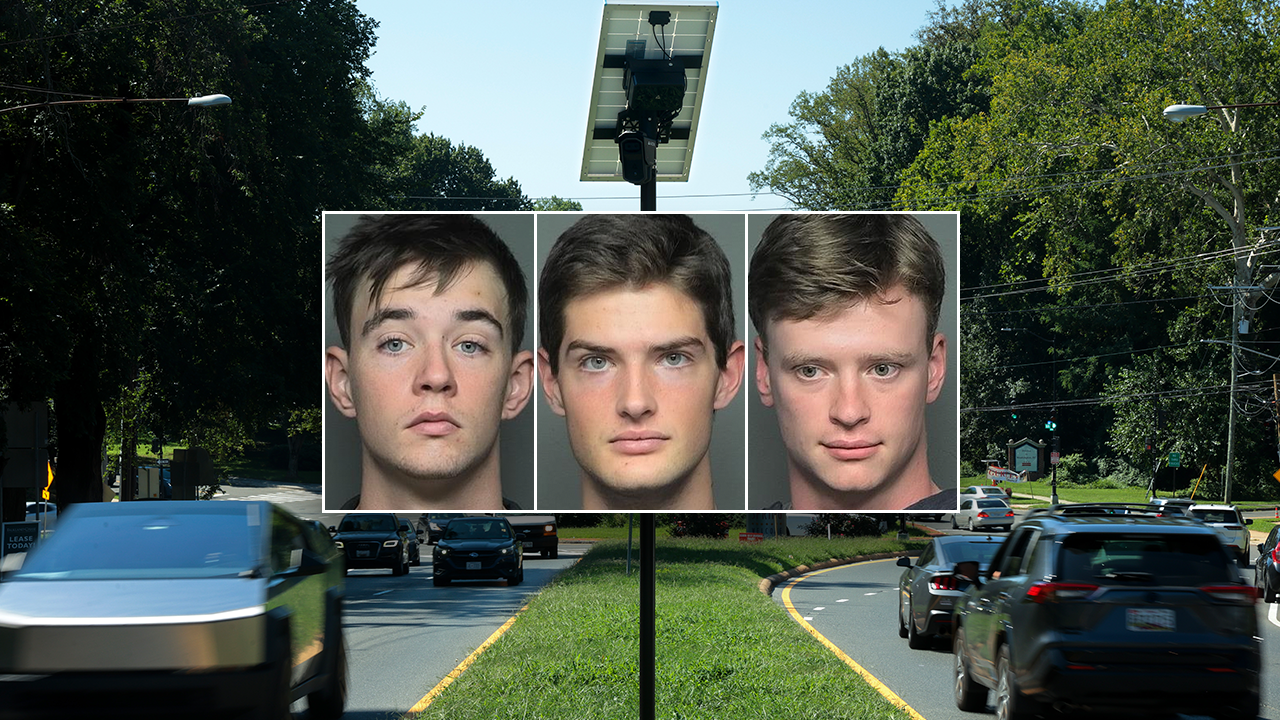
In the stifling, dew-laden darkness of an early August morning in rural Chester County, South Carolina, the placid silence of Harmony Church Road was violently shattered. It was just past 2 a.m. on the 15th, a time when the only sounds are usually the chirping of crickets and the distant hum of a highway, when three young men—barely out of their teens—descended upon the unassuming metal pole standing sentinel along the roadside. This was no abandoned utility post; it was a Flock Safety camera, a sleek, solar-powered sentinel equipped with automated license plate readers designed to log every vehicle that passed. But on this night, the three saw it not as a tool for public safety, but as an invasive eye that needed to be gouged out. With what investigators would later describe as premeditated intent, they hacked and sawed at the base of the pole until it toppled to the gravel, the lens that had once captured countless tags now staring uselessly at the wet earth. But their act of vandalism was not finished. Turning their attention to the battery pack that powered the device, they began striking it repeatedly with a hammer, a frantic, desperate assault. The internal lithium-ion cells, damaged and punctured, began to heat up, swelling and hissing before a sudden, violent, and terrifying climax: the battery burst into flames, shooting sparks and thick, acrid smoke into the humid Carolina air. The fire licked up the ruined machinery, threatening to spread to the dry brush and grass that bordered the road, dangerously close to the residential properties that dotted the landscape.
A few hundred feet away, the sound of metal striking metal and the subsequent crackle of fire pulled a local resident, David Cunupp, from his sleep. The immediate terror for Cunupp wasn’t the destruction of a security camera, but the catastrophic potential of what was happening right outside his bedroom window. As he looked out, he could see the orange glow of the fire illuminating the dark treeline, the flames licking dangerously close to his own property line. His mind raced with the catastrophic worst-case scenario: a single ember carried by the wind could ignite his home, engulfing his family, his possessions, and his entire world in a blaze that would take seconds to become uncontrollable. “My house is over here,” Cunupp later recounted to local news outlet WBTV, pointing a trembling finger toward his home. “Could’ve caught fire and burned if it wasn’t for the rain.” It was a sobering realization that saved the night from becoming a complete tragedy; a light drizzle that had begun earlier in the evening had dampened the ground enough to prevent the flames from spreading into a full-blown wildfire. But the incident left a deep scar of anxiety in the community. The teenagers had not just broken a law, they had jeopardized lives, and they had done so in a way that highlighted the deep, simmering frustrations, as well as the dangerous extremes, of modern surveillance culture.
The aftermath was swift. The Chester County Sheriff’s Office launched an investigation, identifying the three culprits as 19-year-olds Blaze Fuller, Samuel Carlisle, and James Ryerson. They were tracked down and arrested on August 18th, just three days after the attack, and subsequently charged with criminal conspiracy and malicious injury to personal property. The damage to the Flock camera system was estimated at over $5,000, a hefty price tag that reflected not just the physical hardware but the sophisticated electronics and the disruption of the data service to the community. The trio was booked into the county jail, their mugshots taken, their fingerprints rolled, and their futures suddenly clouded by felony charges. However, their time behind bars was incredibly brief. By the following day, August 19th, all three had been released after posting a $5,000 bond, returning to the same streets that were now missing a piece of their digital surveillance infrastructure. One can only imagine the emotional rollercoaster these young men faced—from the adrenaline-fueled bravado of smashing the camera in the dark, to the sudden, sickening realization that their actions had nearly caused a residential fire, to the stark humiliation of a jail uniform and the crushing weight of a criminal record that would follow them for the rest of their lives. Their act of defiance, whether born out of political conviction or simple teenage mischief, had escalated into a serious felony, transforming them into cautionary tales of how frustration with technology can boil over into dangerous, criminal conduct.
Yet, beyond the immediate legal consequences for these three individuals, their actions have unwittingly thrust them into the center of a raging national debate—a debate that was already gaining momentum before they picked up their saws. David Cunupp, while undeniably relieved that his house was safe, expressed a sentiment that resonates with a growing segment of the American public. “I was not necessarily opposed to the cameras for safety,” Cunupp admitted, showing a nuanced position that transcends simple anti-technology sentiment. Rather than condemning the concept of surveillance outright, he articulated a more profound and unsettling concern about the actors behind it. “But I don’t see where a private company’s got access or running it instead of the DMV or the government,” he questioned. This is the crux of the controversy. Flock Safety is not a local police department; it is a private, for-profit company that operates on a subscription model. Local law enforcement agencies pay a yearly fee to install these cameras, and the company captures massive amounts of data—every license plate that passes, along with timestamps, locations, and vehicle descriptions. This accumulation of data, stored on private servers, then becomes a searchable goldmine, not just for the local police who “own” the camera, but potentially for other agencies and entities across the country. The idea that a private corporation holds a vast trove of data about the movements of private citizens, without a warrant, and outside the traditional checks and balances of government oversight, is a violation of the foundational principles of privacy for many.
The national significance of this incident was not lost on lawmakers. On the same week the teenagers were arrested, Senator Josh Hawley, a Republican from Missouri and the chairman of the Senate Judiciary Subcommittee on Crime and Counterterrorism, fired a warning shot directly at Flock Safety. Hawley launched an official investigation into the company, sending a scathing letter to its CEO, Garrett Langley. In his letter, Hawley painted a stark picture of an “unprecedented national surveillance network” that had quietly woven itself into the fabric of American life. The numbers are staggering: Flock boasts over 120,000 cameras installed across 49 states, and they claim to process over 20 billion vehicle scans each month. That is twenty billion data points indicating where citizens are, when they are there, and where they are going. Hawley’s argument is not that all surveillance is inherently evil—indeed, many communities value these cameras for solving crimes and locating missing persons—but rather that the architecture of this system breaks with constitutional norms. “Instead of serving discrete local investigations, as contemplated by our constitutional processes and safeguards,” Hawley wrote, “these camera networks harness artificial intelligence to pool what they capture into a national database that customers can search.” This is the critical distinction. A camera that captures a tag and alerts local police to a stolen car is one thing. But an AI-powered network that pools data from thousands of jurisdictions into a single, searchable repository—accessible to law enforcement and potentially other contractors—allows for the reconstruction of an individual’s entire week, month, or year, without a single warrant being issued. Hawley called this a threat to Fourth Amendment protections against unreasonable searches and seizures.
The opposition to Flock is not confined to the halls of Congress; it is playing out in local governments across the country, where residents are making their voices heard through democratic processes. In Hood County, Texas, the tension reached a boiling point, resulting in a decisive action that directly parallels the emotions that drove the South Carolina teens, but channeled through legal means. The Hood County Commissioners Court voted to sever their relationship with Flock Safety, deciding to end the contract and remove the three cameras that were operational in the county. Constable John Shirley, a vocal critic of the surveillance network, took the physical action to ensure compliance with the court’s decision. In a poignant and highly symbolic act, Shirley personally covered the cameras with black bags—effectively blinding the electronic eyes—until they could be permanently disconnected and removed. Shirley then took to Facebook to explain his actions in his own words, capturing the grassroots fury that is sweeping the nation. “It’s a good day for the Freedom of the people of Hood County,” he wrote, his post reflective of a deeply held Jeffersonian belief in the sanctity of private life. He elaborated, stating, “These cameras were constantly scanning and recording regular folks just going about their day. That kind of permanent, warrantless tracking doesn’t belong in a free society.” But Shirley was careful to distinguish his lawful, civic protest from the destructive actions of the teenagers in South Carolina. “Privacy isn’t optional, and mass surveillance isn’t how we do things here,” he said, while also acknowledging his support for innovative policing. “We can have good policing and still insist on boundaries. We can use technology without giving government unlimited surveillance capability.”
This convergence of events—the destructive backlash in South Carolina and the lawful backlash in Texas—illustrates a profound cultural schism regarding the role of surveillance in modern America. The debate, as Senator Hawley’s investigation underscores, is set to intensify, with communities in Texas, Arizona, and nationwide re-examining their contracts with Flock, citing concerns over data sharing, potential misuse, and the chilling effect that constant monitoring has on civil liberties. The story of those three teenagers is a tragic microcosm of this larger conflict. Their violent reaction to the camera is undoubtedly a crime, and the danger they posed to David Cunupp’s home was very real. However, their anger is a distorted reflection of a legitimate existential angst that many citizens feel—that they are being watched, cataloged, and judged by a faceless private corporation whose incentives are profit-driven and whose oversight is opaque. The challenge for American society is to navigate this complex terrain, finding a way to harness the undeniable crime-solving benefits of modern technology, as Constable Shirley acknowledges, while erecting guardrails that protect the fundamental human right to move through the world without leaving a permanent, searchable digital footprint. As David Cunupp stood in his yard looking at the scorched earth and the mangled remains of the camera, he embodied that conflict perfectly—grateful for the safety that such tools can bring, yet uneasy about the impersonal data collection that powers them. The answer lies not in wielding a hammer, but in the deliberate, painful, and essential democratic process of drawing the line between security and freedom, ensuring that the guardians of our safety don’t become the trespassers of our liberty.