

Paragraph 1: The Nightmare in the Maternity Ward
In the sultry pre-dawn hours of Wednesday, as the city of Islamabad lay wrapped in a thick, enveloping silence, the Pakistan Institute of Medical Sciences (PIMS) hummed with its usual, fragile rhythm of life. Within the maternity wing, nurses whispered to one another, the soft bleats of newborn infants punctuating the darkness, and for the exhausted mothers, joy and anticipation for the day ahead were palpable. But at precisely 6:45 a.m., that fragile peace was shattered with a thunderous, percussive crack that echoed down the sterile corridors. An aging air conditioning unit, its compressor working overtime against the relentless humidity of the Pakistani summer, detonated in a sudden burst of electrical fury. The explosion ripped through a wall in the nursery, sending sparks and shards of metal flying before the sleeping infants. Within seconds, thick, acrid smoke began to pour into the room, greedily wrapping itself around the towering rows of tiny incubators and the small, metal cots lined in neat rows. In a space designed for the most delicate kind of care, the environment turned into a furnace of panic. The single room—a confined, windowless nursery attached to the bustling gynecology ward—was suddenly filled with the terrifying sound of sirens, screaming staff, and the desperate clatter of feet. Hospital rescue officials said the fire was contained solely to this nursery and did not spread to other adjacent wards like the operation theaters or the general recovery rooms, yet the focal point of the blaze could not have been identified in a crueler location: a sanctuary meant for the most vulnerable humans alive. Doctors raced in, attempting to pull out as many infants as they could, but the superheated gases and thick smoke moved faster than human arms. By the time the fire was extinguished, a terrifying count was established. Fourteen babies, each weighing just a few pounds, each one having taken their first breaths mere hours or days ago, had been asphyxiated or burned in the blaze. In the mirror of time, only fifteen potential lives existed; one precious child was pulled out, breathing, by a doctor whose courage cut through the flames, but fourteen hopes were extinguished in a furious, unforgiving flash.
Paragraph 2: The Unbearable Weight of Emptiness
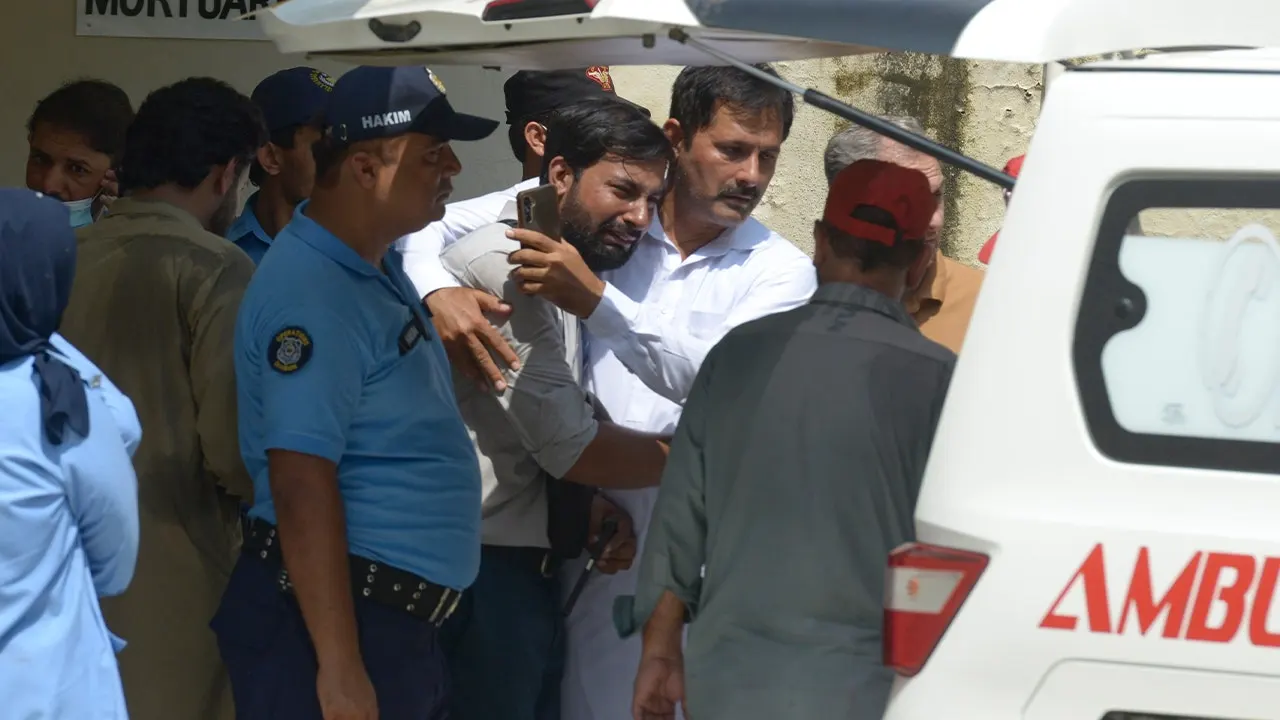
For the mothers and fathers who had come to PIMS seeking the miracles of modern medicine, the morning of Wednesday transformed their joy into a visceral, nauseous hell. A woman identified by the Associated Press as Mrs. Mohammad Sami stood outside the sealed doors of the ward, her hands trembling as she spoke to reporters. Only three days prior, she had given birth, her body still sore, her heart still full of raw joy for the child she planned to bring home. Now, she searched through the broken glass and blackened window frames for answers, her voice rising into a hoarse scream, “I don’t know what to say or whom to blame. I have lost my child.” In the background of this anguish, grieving families began to gather in the usually sterile lobby, their faces a mosaic of disbelief and sobs. Some fathers, dressed in simple shalwar kameez, clutched locked funeral papers, unable to comprehend that the cradles they had carefully prepared were now empty. The hospital had arranged a temporary morgue, but the traffic of grief moved slowly; grief is never punctual. Dr. Aneeza Jalil, the official spokesperson, emerged intermittently, her voice strained, to deliver the devastating inventory: fourteen dead, one rescued, and the process of handing over six of the small shrouded bodies had begun to devastated relatives. But for every body given to a wailing mother, the remaining eight waited in a sacred silence, pending hull. The “gynecology ward” is usually a place of noise—people yelling for blood transfusions, the sound of newborn squalls, the hurried feet of doctors—but that day, it fell into a confounded quiet, interrupted only by the wailing that is so raw, so primal, that it makes an entire city pause. The fire had not just destroyed a room; it had ruthlessly ripped at the maternal heartstrings of an entire nation in the news of its fragments.
Paragraph 3: The Systemic Rot Catalyst of the Disaster
The initial investigation into the incident pointed towards the sudden explosion of the air conditioning unit’s compressor. However, such a diagnosis lets other deep, meticulous infrastructure failures feel triggered. In the stark reality of Pakistan’s public health sector, hospitals like PIMS are trading under the weight of overhaul of decades of neglect, often overcrowded and starved of proper maintenance. To the average observer, a compressor exploding feels like a freak mishap, yet engineers and public safety experts will tell you that these units are mostly old, poorly serviced, and vulnerable to blowing out under high RPM strain. Adding to the inherent mechanical risk, the nursery lacked modern electrical surveys, smoke extraction vents, and automatic fire-suppression systems—common fixtures in any modern maternity center—leaving only a handful of wiry old fire extinguishers to battle the rapid Plutonian flames. Moreover, the placement of flammable material—shelving, plastic tubes in intravenous lines, and dense fabrics—within the confines of the nursery was a testament to the urgent implementation. As the families mourned the private tragedies on that Wednesday, the public sphere interjected a completely bitter reflection: This was not an accident entirely , but perhaps a “time bomb” awaiting its final detonation. Pakistan’s public health sector is historically troubled by skyrocketing patient numbers, constant power outages from load-shedding, and washed-out electric wiring that struggles to keep up with the load of medical machines. This loss of 14 young lives is, therefore, not just a solitary bolt of malevolence; it is a searing indictment of an institutional culture that has tolerated safety standards, a culture that often prioritizes exotic new equipment over the necessity of a smoke detector. The tragedy at PIMS forces a chilling recognition that the price of systemic apathy is being paid in the very breathe of the children we once swore to protect.
Paragraph 4: The Thunderclap of Political Accountability
The news of the fire spread like a monsoon reached through the political strata of Pakistan, shaking the highest echelons of the capital with long echoes of fury and grief. Issuing forth from his office, Prime Minister Shehbaz Sharif was initially characterized as distraught by the “irreparable loss” for the infants and channeling his rage through the mechanism of the state. In a swift and remarkable form of punitive action, just hours after the smoke cleared, the Prime Minister invoked his executive power to order the immediate removal of Health Secretary Aslam Ghauri—the highest-ranking civil servant overseeing health resources for the country. Sharif, visibly shaken and affecting the gravity of a lifetime, subsection of every major hospital Facilities in Pakistan, ordered a high-level emergency meeting, condemning the hospital’s directive and demanding a transparent investigation that would identify “the surprising failures” which allowed this deplorable event to unfold. The Pakistani President, Asif Ali Zardari, likewise stepped forward with public condolences, which continued to fall into shifting now beyond the horror of politics, stating that providing the deaths as a “heartbreaking and irreplaceable loss.” Such fast removal of a cascading bureaucrat signals exactly how the state apparatus seeks immediate scapegoating, especially when the visceral emotional distress of the entire population turns into a surrogate for criminal wrongdoing. Within the broader context, the removal of a secretary cannot bring breath back into the tiny lungs; it smelts of reflexive governmental function. The press releases served as a temporary balm to an outraged public, but serious questions linger pressing deeper: Who signed off on the hospital’s last safety inspection? Which auditors failed to notice the overheating compressor? And where viable civilian requests was the sound? The thirst for the truth, of disruption and transparent investigation, now begins a greater, more intricate battle than the extinguishing of the flames.
Paragraph 5: The Singular Heroism and the Harbingers of Hope
Within the ultimate darkness, the human spirit was bound to refuse flash, and in the chaos of the nursery’s reopening, mercy appeared in the form of a single, unnamed doctor. Amidst the blazing heat, the toxic smoke swallowing the light, this physician, clearly called upon by the deepest of instincts, reached through the maw of the inferno and clutched a singular, swaddled infant. Emerging with singed clothes and adrenaline racing through her veins, she held a valiant breathing baby close to her chest, an image presumably etched in the minds of the survivors that witnessed the rescue. This one act of pure medical courage—this defiance against the Fourteen who perished—held the essence of humanity’s capacity for unwavering minute in the face of calamity. For the parents of that solitary child, relief was all instantaneous, but the rescue brought a complex spiraling of emotions: the luxury of holding a now-saved daughter or son contrast to the overwhelming racket of guilt and grief of the other parents who receive a coffin instead of a blanket. In this sobering dyad—fourteen dead, one alive—doctors and nurses remaining in the hospital, broken with exhaustion and trauma, must tamp down their prevailing sorrow to assisting the grieving relatives. The unnamed doctor’s heroic intervention, applauded by hospital administrators to news reports, offers a glimpse of survival, yet the psychological aftermath is a sword: a senior nurse, standing idly by the hospital entrance, repeated 14 times to a reporter, “We could have done more, we could have done more.” This record that the bad passes on, rewrites the pain of a loss felt by all those who bear witness. The 15th baby, alive, becomes a fragile, slippery anchor for the hospitals to grip upon, a tiny emblem of hope against suffocation.
Paragraph 6: The Broader Tapestry of Grief and the Future’s Promise
As the sun rose high over the capital, casting heavy, unwelcome light on the shattered windows of the PIMS nursery, the full psychological impact of this event began to sink into the collective Pakistani consciousness. This tragedy is not an isolated anecdote in the history of healthcare; similar disastrous fires in India’s pediatric neonatal wards, Brazil’s critical hospitals, and Romania’s infectious disease facilities serve as reminders of the same deadening systematic patterns of neglected safety protocols. Yet, for the small, claustrophobic room in Islamabad, the horror remains profoundly personal for the nation. The loss of an infant is considered a sweep from the Egyptian scale—a scale that carries potential, laughter, dusty consequences, poetry, and uncharted dreams. We will never know the adult these infants would have become—whether one carried the light of a physician, one the lyrics of a painter, one the ans used for our future engineers. Their presence lingered only days; their absence will now ache for decades. Absolute anger brew in the families, but also the slow, persistent burn of accountability from the entire world. The Prime Minister’s promise must not wither; the removal of the Secretary can be only the first step—the government must ensure robust across underfunded hospitals, mandatory historical blitz of fire audits, and the worker of fail-safe measures. A failure in the Karachi’s fire cannot be erased by administrative. In the waning silence of the day after, as the hospital moves to repair its thrusted doors and the flashes of press cameras retreats, the grieving relatives begin to carry their past to their native. The mass funeral prayers will take place and temporary ranasfloat; but within, each mother will find a quiet must, carrying the shroud of the smallest hands. It is the singular responsibility of the nation to honor these 14 innocent souls, not merely with platitudes of sorrow, but with a rigorous, uncompromising promise of reconstructing public health to be a sanctuary—ever safe, ever vigilant—for the fragile gifts it exists to cradle. The ashes must give a rise to a phoenix of accountability, for the children who are gone deserve nothing less than a mutable and transformed world from the cold, indifferent mechanisms of man.