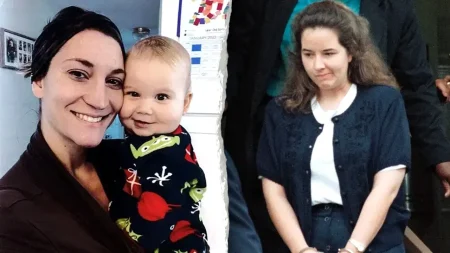




It was a scene that defied the grim holiday that surrounded it, a tableau of domestic horror that would forever fracture a family and the public’s perception of a once-familiar face. In the week leading up to Halloween’s chaos of goblins and ghouls, the violence that unfolded in a quiet Wichita, Kansas home was no playful fright, but a brutal and deeply tragic reality. Angelynn “Angie” Mock, a woman who had graced the morning television screens of St. Louis and Oklahoma City years prior, was led away in handcuffs. The initial whispers of a fatal and grisly stabbing at the home she shared with her elderly mother and stepfather slowly solidified into a monolithic, devastating truth, one born from mental illness, twisted delusion, and a maternal love gone dark. While the neighborhood was preparing for a night of trick-or-treating, a family was being shattered by a murder that would leave investigators, colleagues, and family members grappling with an act of violence so gratuitous and heartbreaking against a victim so defenseless.
Anita Avers, 80 years old, a mother and wife, had not been the victim of an attempted holiday home invasion or a random act of street violence; it was the deliberation and proximity of the act that struck the deepest chord of fear and disbelief. The case, which seemed to hover in a nebulous space of symptom diagnosis and legal pre-trial deliberation, reached its initial resolution with a plea of guilty from the 48-year-old Mock. It was a single admission of guilt that solidified the sequence of events of that final day of October last year into an immutable legal record. Mock implicated herself to the court that her mother, the woman who brought her into this world, was a demonic entity and a threat to her. The dry factual announcement from the Sedgwick County District Attorney’s Office containing the first-degree murder charge, carrying with it a life sentence with the possibility of being heard “no earlier than after 25 years,” only scratched the surface of a woman haunted by a pathological interior world. For the public, Angie Mock was transitioning from a media personality into the terrifying embodiment of a mental health system failing both her and her elderly victim.
As the months passed between the initial grisly discovery and the eventual indictment, the details that emerged from the probable cause affidavit painted a harrowing portrait of a mind steeped in apocalyptic paranoia. The tragic string of events reached fever pitch just before 8 in the morning of the last day of October. Upon arrival at the home she and her family shared, police found her mother display, laid on a bed, pierced by a cryptic dish of sharp objects that lined the space. Citing records, the scene looked less like a struggle of survival and more like a bizarre and macabre ritual. The specific unimpeded interplay in that bedroom was detailed by Mock’s own recollection, and it was a narrative directly molded by her mental illness. She claimed that her 80-year-old mother, preparing for some sort of confrontation, had brandished a blade on that morning. Yet she claims her mother began to speak, focusing vitriol on her. The positions reversed in that small bedroom as a struggle broke out. Despite being the younger and physically stronger, but gripped by her delusions, she claims she was saving herself from “the Devil.” Her subsequent chilling and starkly clear statement to investigators, “I had to kill her, she wasn’t going to stop,” was the confession of a daughter whose comprehension of her mother’s being had been warped beyond recognition.
For those who knew her in her professional capacity as a former morning anchor, the narrative of a criminal was unimaginable. She was accustomed to bright lights, delivering the news with a conventional smile, all while presenting a personable and aware face to the world. That polished presentation had protected a life eroded from the inside by a severe schizoaffective disorder. Her stepfather, Barry, a constant presence in her life, provided key insight into the heartbreaking world of her psychosis, describing his stepdaughter’s delusional states that teetered between apocalyptic rhetoric and a strained grasp on reality. In his character testimony to the court, he had trouble accessing her true unpredictability. He recounted episodes where she would claim people were “robots,” and expressed a chilling and rampant ego in which she self-identified as the Anti-Christ. His recollection of a previous outburst, which led to a two-week stay in a state psychiatric hospital, highlights a missed opportunity for sustained collective care that could have leveled the tide of this tragedy. The case amplified the whisper of the immense and often understaffed chasm of the national mental health infrastructure, where a daughter could be returned to her elderly mother’s care despite a documented history of violence.
Her stepfather’s description of their relationship revealed the most intimate dichotomy: that of a mother and daughter with the baseline of their interactions rooted in a close bond, but with a volatile foundation of anger and delusion mentally mangled. Angie’s final months in the home had been a downward spiral of careers, professional identity, and a movement toward returning to her hometown and family. Her attempt to discuss an upcoming interview at a local station, Kansas’s most famous landmark, KSN, was not the gateway to a new beginning but the prelude to her murder. In those final moments, her love for her mother was entangled in a disconnect that her view had twisted into a malevolent confrontation in which she was the sacrificial victim. When she was seen by police talking to herself, her ambiguous statements about wanting her mom back served as a poignant and chilling embodiment of her mental fracture. She knew intellectually that her actions were a criminal offense but was somehow psychologically certain that the object of that crime was a monster to be defeated, not the flesh-and-blood mother she loved.
Now, with her guilty plea accepted, a final curtain begins to close on this grim saga. The legal system has temporarily paused to commit her for evaluation and treatment, highlighting the impossible bifurcation between punishment and rehabilitation for someone who is a criminal and a patient. For the stepfather, who lost the woman he loved on that bed, the victory of a legal conviction offers minimal comfort; the ghost of the daughter remains. The community, generations removed from her tenure in the Missouri newsroom, watches the progress and thinks of the fleeting October anxiety and the ulcers of a daughter who couldn’t decipher her own soul. It’s a tale that serves as a challenging and difficult reminder that when the human condition cracks, the harm inflicted spreads physically beyond the immediate victim, impacting colleagues, old acquaintances, and the fabric of normal neighborhoods. The date of sentencing, set for October, rings in the crucible of what should have been a hallowed time of family and togetherness. The case of Angie Mock will forever be a harbinger not only of the tragedy of mental illness but of the too-frequent grim reality that for some, the threats they see in the eyes of those they love are shadows of the very fight that has stagnated in themselves.