



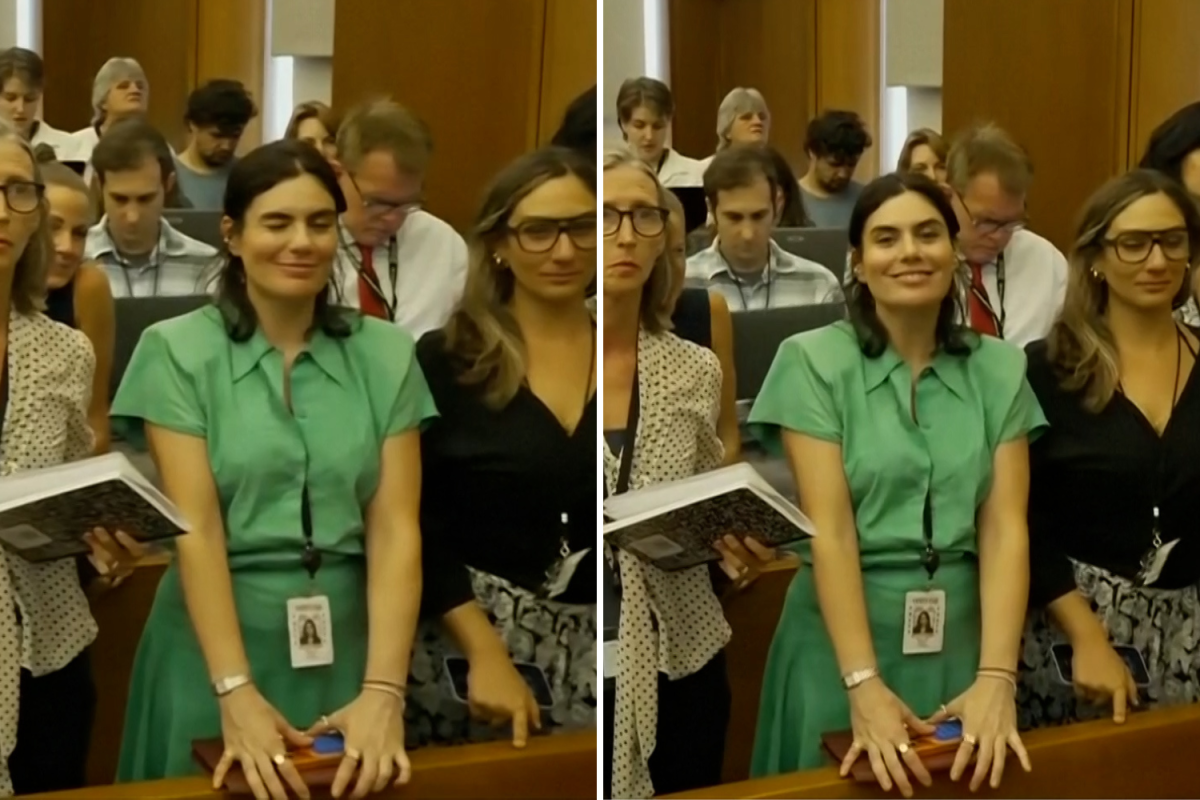
The Lindsay Clancy murder trial in Massachusetts has taken a curious turn, with the focus in the courtroom shifting from the grim testimony of psychiatric experts to a seemingly innocuous woman seated in the public gallery. Brittany Romano, a New York-based writer and editor, has unwittingly become a central figure in an online firestorm after a courtroom camera captured her appearing to smile and wink during the proceedings. The brief, silent moment was amplified across social media, transforming Romano from a spectator into a subject of intense public scrutiny. Viewers, many of whom are closely following the harrowing case of a mother accused of killing her three young children, interpreted her expression as deeply inappropriate, sparking a wave of criticism that quickly escalated into a campaign of online harassment directed at Romano. The incident has created a secondary narrative to the trial, raising questions about the ethics of public behavior in high-stakes legal settings and the unforgiving nature of internet judgment.
To understand the controversy, it’s helpful to know who Romano is outside of this viral moment. According to her professional profiles, she is a seasoned editorial professional with over a decade of experience in the media industry, having contributed to prominent outlets like Forbes, Glamour, and USA Today. Her background is in sociology, a field that lends itself to observing human behavior, which makes her current entanglement with a criminal trial all the more ironic. Recently, Romano had begun cultivating a following among true-crime enthusiasts by posting her own commentary and observations about the Clancy trial on social media. This pre-existing engagement with the case meant that when her face appeared on the livestream, she was not an anonymous face in the crowd but a known entity to many viewers. This familiarity likely intensified the backlash, as followers felt a sense of betrayal seeing someone they perceived as a fellow observer appear to treat a somber legal proceeding as a source of entertainment or personal promotion.
The backlash against Romano was swift and brutal, reflecting the often-unforgiving nature of online outrage. The clip of her smiling and winking was dissected endlessly on platforms like X, with users accusing her of being disrespectful and seeking attention in the presence of profound tragedy. Comments ranged from expressions of disgust to direct attacks, with one user sarcastically noting, “Imagine going to a murder trial for three children and treating it was some sort of promotional event.” Romano did not remain silent in the face of this criticism. She took to her own Instagram Stories to fight back, sharing screenshots of the abusive messages she was receiving, including one telling her to “Shame on you.” In a pointed response, she framed the trial’s core issue as one of mental health, questioning the vitriol she was facing. She also adopted a defiant, almost flippant tone in another post, sarcastically thanking her critics for “boosting my analytics.” This response—a mixture of defiance, sarcasm, and a plea for understanding—further fueled the debate, with some seeing her as an attention-seeker and others believing she was being unfairly targeted by a digital mob.
As the online debate raged, it naturally evolved into speculation about Romano’s relationship with the defendant, Lindsay Clancy. Social media users, acting as amateur detectives, circulated a childhood photograph purportedly showing Romano and Clancy together and suggested the two were lifelong friends. This theory would provide a more complex and sympathetic context for Romano’s presence and demeanor in the courtroom. In a livestream video addressing the controversy, Romano appeared to confirm this connection, stating she had “grew up with Lindsay.” She explained that her laughter was a reflexive reaction to seeing her old friend in such a surreal setting and that her father had previously warned her she looked “bad” on camera, making her more conscious of her expressions. However, this purported link remains unconfirmed. Newsweek could not independently verify the identities in the photograph, and neither Romano nor Clancy has formally acknowledged a friendship. The unverified nature of this claim highlights the dangerous game of speculation that often occurs in high-profile cases, where online theories can quickly gain traction without solid evidence.
While the internet’s focus was fixated on Romano, the actual legal proceedings in the Duxbury, Massachusetts courtroom were moving toward a critical juncture. With the defense resting its case on the claim that Clancy was in the throes of postpartum psychosis, the prosecution used its rebuttal witnesses to dismantle this narrative. Dr. Avram Mack, a prosecution psychiatrist, testified that while Clancy suffered from severe depression, he found no evidence of psychosis during the time of the killings. This testimony was a direct challenge to the defense’s core argument. A second expert, Dr. Kirk Heilbrun, offered a different diagnosis, suggesting Clancy had bipolar II disorder, but he too rejected the notion that she was experiencing an acute psychotic break. The trial even saw a brief and tense moment when Dr. Heilbrun mentioned Clancy’s Catholic faith, prompting a mistrial request from the defense, which was denied but resulted in the judge instructing the jury to disregard the religious testimony. These expert disagreements underscored the complexity of the case, leaving the jury to ultimately determine whether Clancy’s mental state met the legal threshold for criminal responsibility.
The Lindsay Clancy murder trial, therefore, stands as a grim intersection of mental health, law, and the digital age. While the legal proceedings inside the courtroom inch closer to a verdict, the saga of Brittany Romano serves as a stark reminder of the court of public opinion’s power and its potential for cruelty. Romano’s brief, misconstrued facial expression has overshadowed the gravity of the case for many, turning a murder trial into a battleground for online virtue-signaling and speculation. Her story humanizes the often-impersonal nature of true-crime consumption, reminding us that real people are seated in those gallery seats, and their actions are now subject to impossible levels of scrutiny. As the jury begins its deliberations on the fate of a woman accused of an unspeakable act, the parallel narrative of a woman accused of a socially unacceptable expression raises profound questions about empathy, judgment, and whether we, as a society, are capable of separating the gravity of a crime from the fleeting, human reactions of those who witness its legal aftermath. The trial’s conclusion will offer a legal resolution for the Clancy family, but the digital footprint of this secondary controversy will linger as a cautionary tale of our times.