


Headline: The New Tech Clash: Peter Schiff Warns AI Poses a Greater Threat to Bitcoin Than Gold
By [Staff Writer], [Publication Name]
Date: [Current Date]
The battle for the future of finance is no longer just between traditional assets and digital currencies; it has expanded into a high-stakes clash between the two most dominant technological narratives of the decade. In a fiery exchange over the weekend, economist and notorious gold advocate Peter Schiff ignited a fresh debate within the cryptocurrency community by declaring that the rise of Artificial Intelligence (AI) represents a mortal threat to Bitcoin, rather than a tailwind. His provocative statements challenge the popular notion that these two sectors are natural allies in the quest to disrupt legacy systems, suggesting instead that they are locked in a zero-sum competition for the very resources that power the modern economy.
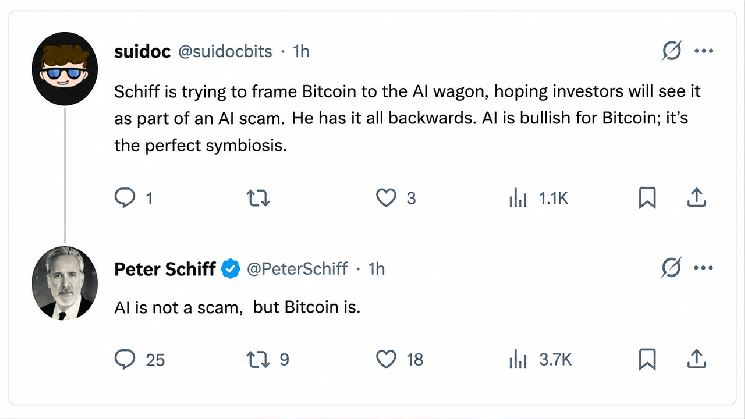
Schiff, who has long been one of the most vocal critics of the leading cryptocurrency by market cap, took to social media platform X to pour cold water on the idea that Bitcoin is poised to benefit from the AI boom. He argued that enthusiasts are attempting to “hitch Bitcoin to the AI wagon” to create a false sense of synergy, but in reality, the two industries are fundamentally at odds. “Bitcoin pumpers are trying to hitch Bitcoin to the AI wagon, hoping investors will see it as part of the AI trade,” Schiff wrote. “They have it backwards. AI isn’t bullish for Bitcoin; it’s a threat to it.” This stark assertion sets the stage for a deeper conflict over energy consumption, capital allocation, and the future utility of blockchain technology.
The Scramble for Energy and Capital
The core of Schiff’s argument rests on the pragmatic intersection of resources. He posits that AI and Bitcoin are not complementary but are instead direct competitors for two critical inputs: electricity and speculative capital. As the world witnesses an unprecedented build-out of energy-hungry data centers designed to train and run large language models, the finite supply of cheap power has become a fiercely contested commodity. Schiff points out that this competition has already begun to impact the mining sector, which relies on vast amounts of electricity to secure the network. “AI competes with Bitcoin for speculative capital, electricity, and infrastructure,” he argued, noting that the economic calculus for miners is shifting as AI companies, backed by the likes of hyperscalers and venture capital, are willing to pay a premium for power.
This pressure has forced adaptation within the mining industry. In recent months, a significant number of publicly traded mining firms have pivoted their business models, striking multi-million-dollar deals to convert their existing high-voltage infrastructure into AI data centers. This transition offers a dual revenue stream, mitigating the risk of Bitcoin price volatility, but it also signals that the industry is responding to a market reality where AI is a wealthier neighbor. Schiff contends that while this pivot is rational for individual companies seeking survival, it is fundamentally bearish for the Bitcoin network, as it diverts attention, investment, and physical resources away from the primary goal of hashing, thereby potentially leading to a temporary reduction in network security and hash rate.
The Network’s Self-Correcting Design
However, the economic rebuttal to Schiff’s doomsday scenario lies in the elegant, self-regulating architecture of the Bitcoin protocol. The network is designed with a built-in mechanism called “difficulty adjustment,” which recalibrates the energy required to mine a block based on the total computational power on the network. If a significant portion of miners were to unplug their machines and pivot to AI, the network would simply adjust the difficulty downward. This would make mining easier and cheaper for the remaining participants, ensuring that block production—and the settlement of transactions—continues regardless of the hardware churn. “If substantial computing power leaves Bitcoin, mining eventually becomes easier for the remaining participants,” a counterpoint to Schiff’s narrative highlights, emphasizing that the network can shed its skin and still maintain its integrity. This resilience is a fundamental feature that has kept the network alive through multiple market crashes and hardware bans.
Furthermore, analysts argue that the energy discourse is often oversimplified. Bitcoin miners are increasingly seeking out stranded or surplus energy—sources that would otherwise be wasted—while AI data centers require ultra-reliable, always-on power. While there is overlap, the mining industry’s ability to act as a flexible buyer of last resort for energy grids makes it a different beast than the rigid demands of AI. The adaptation by mining companies to host AI hardware may actually provide them with economic stability, allowing them to subsidize their Bitcoin mining operations during lean periods. This synergy, while seemingly counterintuitive to Schiff’s thesis, suggests that the two industries can co-exist, with the financial strength of AI accidentally bolstering the balance sheets of Bitcoin miners.
The Unbreakable Nature of the Blockchain
Beyond the energy debate, Schiff escalated his critique to the security of the network itself. He posited that the exponential growth of Artificial Intelligence could eventually lead to the discovery of critical vulnerabilities in the cryptographic foundations of the blockchain. He warned that AI could find bugs in the code, break the encryption securing wallets, or even overwhelm the network’s consensus mechanism. Yet, this “AI attack” narrative often overlooks the fact that the security of Bitcoin rests on centuries-old mathematical principles that are not easily brute-forced by current quantum or AI capabilities. Moreover, the defense of the network is a decentralized effort; as AI improves offensive capabilities, so too do the open-source developers and cryptographers who are actively using AI to scrutinize the codebase for weaknesses.
Perhaps the most powerful retort to the fear-mongering regarding a crypto-apocalypse is the “gold standard” comparison that Schiff himself employs. In a moment of intellectual consistency, a respondent in the thread deployed Schiff’s own logic against his preferred asset. If AI is capable of discovering flaws in SHA-256 encryption, it would also be capable of finding massive new gold deposits, creating robots to mine them at negligible costs, and ushering in an era of hyper-efficient asteroid mining. In a world where AI conquers scarcity, gold loses its intrinsic value, whereas Bitcoin’s utility as an immutable, mathematical ledger of transactions might actually grow. As one user fired back, “AI is a threat to gold more than it is to Bitcoin… 1. AI finds huge gold deposits… 6. More supply + less scarcity → gold prices fall.”
The Verdict on the AI and Bitcoin Intersection
In the end, the debate highlights a shifting paradigm. While AI is undeniably a disruptive force, the idea that it will destroy Bitcoin is a projection of traditional economic fears onto a system that operates on different principles. The finite supply of 21 million coins is a social contract enforced by decentralized nodes spread across the globe—a protocol that no AI is likely to alter as long as incentives remain aligned. The immediate battle is not between the technologies themselves, but for the attention of the institutional investors who control the flow of capital. While Peter Schiff sees AI winning the race for resources and leaving a hollowed-out crypto industry in its wake, the data suggests otherwise: we are merely witnessing a maturation phase.
The mining sector is not collapsing; it is evolving. The competition for electrons will force the Bitcoin ecosystem to become more efficient, greener, and more resilient. While AI certainly competes for a share of the speculative dollar, its dominance does not preclude a simultaneous rise in digital assets. As the dust settles, it seems the market will ultimately judge these two giants on their utility—AI for its productivity gains, and Bitcoin for its monetary sovereignty. In this high-stakes game, it is not a zero-sum outcome that we should expect, but rather a complex, intertwined future where each groundbreaking technology is forced to sharpen the other, a reality that the “digital gold” narrative is well-equipped to survive.