

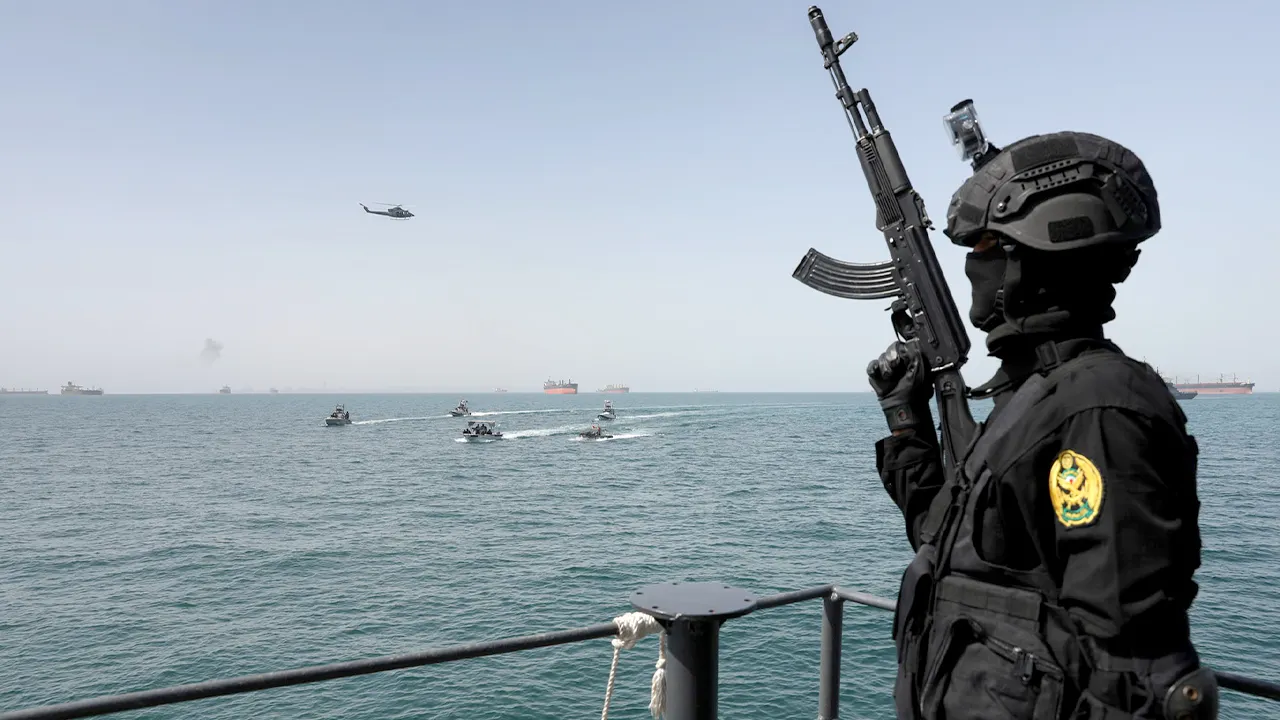
The world has spent months watching the Strait of Hormuz, counting tankers, and speculating about how many millions of barrels of oil are still slipping through one of the planet’s most critical maritime choke points. But according to Art Berman, a veteran petroleum geologist with over forty years in the energy industry, that focus, while understandable, may be missing the deeper and far more lasting story. Berman warns that the truly consequential damage from the Persian Gulf conflict is happening thousands of feet below the Earth’s surface, inside the oil fields themselves. While politicians and analysts obsess over whether four, six, or nine million barrels a day are moving through the strait, Berman argues that those tankers are only the midpoint of a much longer chain. The oil has to come out of the ground first, and right now millions of barrels of Gulf production remain shut in. According to Berman, about eight million barrels of Persian Gulf production are currently offline, and global oil supply has fallen by roughly ten million barrels a day. The International Energy Agency’s August 2026 report largely backs this up, noting that Gulf output had recovered somewhat to 23.9 million barrels a day in July but was still 8.3 million barrels a day below pre-war levels. The U.S. Energy Information Administration offers a slightly more conservative estimate, putting July’s shut-in production at about 5.5 million barrels a day, while warning that August could be even worse due to ongoing transit constraints. Whatever the exact number, Berman insists that getting that oil back is not a simple matter of reopening a waterway. “We can move tankers around and we can obsess about, you know, are there 4 million barrels getting through or are there 6 million or 9 million or whatever the right number is,” he said. “But eventually, those tankers have to be filled with oil.” That oil has to come from wells that may have been silent for months, and bringing them back to life is a complicated, high-risk, slow process that no political deal alone can fix.
The technical challenge of restarting shut-in oil wells is something most people never think about, but it is at the heart of Berman’s warning. Oil does not simply sit in a pipeline waiting to be turned back on like a faucet. When a well is shut in, the delicate relationship between surface equipment and the reservoir thousands of feet underground is disrupted. Pressure changes, fluids shift, and the rock itself can behave differently over time. Berman described the process in starkly practical terms: “This is not like turning on a switch for a light bulb. It’s a complicated, high-risk, relatively long-term process, and we don’t know the outcome.” He estimates that roughly eighty percent of affected wells might eventually return to close to their previous production levels, but that could take weeks or months, even under the best conditions. The remaining twenty percent could need significant engineering interventions, and some wells may simply never produce the same again. “Some of that production will never come back,” he predicted. Other analysts are somewhat more optimistic. Wood Mackenzie, for example, projects that Gulf fields could recover to about seventy percent of their pre-conflict production within three months and ninety percent within six months, assuming a controlled and safe restart process. But even in that best-case scenario, the final million barrels a day could take considerably longer to restore, and that assumes everything goes smoothly, which is rarely the case in a region as volatile as the Persian Gulf. Berman’s point is not that recovery is impossible, but that it will be slow, uneven, and uncertain. The longer wells remain shut in, the harder the restart becomes, and every month of conflict adds to the technical difficulty. The public conversation has focused on the “midstream” problem of transporting oil, but Berman insists the “upstream” problem of producing it is the one that will define the long-term economic fallout.
There is also a dangerous assumption embedded in the hope that a ceasefire or political agreement will immediately restore pre-war energy flows. Berman is blunt about this: even if governments reach a deal, the oil will not magically start flowing. Before tankers can safely move through the Strait of Hormuz again, shipowners, insurers, and crews will all need to be convinced that the waterway is secure. That confidence builds slowly, especially after months of military confrontation, mines, drone attacks, and naval blockades. And even with the strait open, there are logistics, repairs, security assessments, and infrastructure checks that have to happen first. “A simple political agreement doesn’t mean the problem’s over,” Berman said. The White House has pushed back against the more dire warnings, pointing to the sharp decline in oil prices following the signing of a Memorandum of Understanding and insisting that the Strait of Hormuz is open with the U.S. naval blockade in effect. Officials also emphasize record American oil and gas production, arguing that U.S. energy independence and national security have been strengthened under President Trump. That may be true from a domestic policy perspective, but Berman argues it misses the global nature of the market. The United States may be the world’s largest oil producer, but American refineries are not built to run solely on domestic crude. They require a variety of grades and qualities to produce the right mix of gasoline, diesel, jet fuel, and other petroleum products. When global supplies are disrupted, international buyers scramble for alternative sources, and those ripple effects reach American shores in the form of higher prices and tighter margins, regardless of how much oil the U.S. produces. “The problem for the U.S. isn’t that we don’t have enough oil, we almost do,” Berman explained. “It’s that the oil we have isn’t the right kind” for everything American refineries need. The EIA already reported that Hormuz disruptions have pushed international buyers toward alternative petroleum products, raising U.S. refinery margins and exports. So while Americans may feel insulated by domestic production, the global market quickly punishes that illusion.
Berman’s larger argument is that this is not just another supply shock or a temporary blip in the news cycle. He compares the scale of the disruption to the biggest economic events of recent memory, including the COVID-19 pandemic, which caused unprecedented demand destruction and supply chain chaos. But this time, the shock is on the supply side, and it is happening in one of the most strategically important oil-producing regions on Earth. “This is not just a news cycle,” Berman told Fox News Digital. “This is potentially a kind of a world-changing event, even if we resolve the political issues.” That is a strong statement, but it reflects a deeper reality: the global energy system is not infinitely flexible. It is built on decades of infrastructure, investment, and operational knowledge, and it cannot be reorganized overnight. When eight million barrels a day of production disappear, the effects cascade through every economy, every industry, and every household. Prices rise, inflation follows, central banks tighten, and the most vulnerable people around the world suffer the most. Even if the conflict ended tomorrow, the long tail of this disruption would stretch for years. The physical work of restarting wells, repairing damaged infrastructure, rebuilding trust among shippers and insurers, and rebalancing global supply chains would continue long after the cameras left the region. Berman’s warning is essentially a reminder that energy is not an abstraction. It is a physical process, rooted in geology and engineering, and political solutions cannot override the laws of physics. You can sign an agreement, but you cannot force a reservoir to behave as if nothing happened.
There is also a geopolitical dimension that complicates any recovery scenario. The conflict has drawn in major powers, reshaped alliances, and created new fault lines in global energy trade. The article notes that Iran has turned to Russia as U.S. talks collapse, and that China has reportedly ordered its firms to ignore U.S. sanctions on Iran, daring Washington to enforce its crackdown. These dynamics mean that even if a formal peace is reached, the underlying tensions that caused the disruption will not simply disappear. Sanctions, distrust, and competing interests will continue to influence who buys what oil, from whom, and on what terms. The global oil market is not just a matter of supply and demand; it is a web of political relationships, and those relationships have been badly damaged. Berman’s point about the “world-changing” nature of the event is not just about barrels and prices. It is about the fundamental reordering of energy security. Countries that once relied on Persian Gulf oil are now scrambling to find alternatives, and those alternatives take time, money, and political will to develop. The United States is pushing allies to invest in reliable, affordable, and secure energy sources and to form new partnerships with Washington. But these are long-term strategies, not quick fixes. In the meantime, every month of uncertainty makes the eventual recovery harder and more expensive. The article also highlights a key discrepancy in official assessments: the IEA says Gulf production is still 8.3 million barrels a day below pre-war levels, while the EIA estimates shut-ins at 5.5 million barrels. That gap is not just a statistical quibble. It reflects deep uncertainty about what is actually happening on the ground, and it underscores just how little is truly known about the condition of the wells, the infrastructure, and the ability of producers to ramp up again. In such an environment, hope is not a strategy.
Ultimately, the question Berman raises is not whether tankers will return to the Strait of Hormuz. They surely will, at some point. The deeper question is whether the global energy system that emerges afterward will ever operate quite the way it did before. Some wells will come back, but some will not. Some trade routes will reopen, but the trust and certainty that made them efficient may take much longer to restore. The world may learn to live with higher energy prices, more volatile markets, and a new map of alliances and dependencies. Or it may finally take seriously the need for diversified energy sources, strategic reserves, and resilience rather than just efficiency. Berman’s warning is a sobering one, but it is also a call to pay attention to the things that are easy to ignore in the heat of a crisis. The surface drama of tankers, missiles, and negotiations is compelling, but the real story is underground, in the silent wells that may never flow again, and in the millions of barrels that are not being produced. That is the story that will shape the global economy for years to come, no matter which headlines dominate tomorrow. The White House can tout record American production, and it is true that U.S. output is a stabilizing force in a turbulent world. But no single country can replace eight million lost barrels from the Persian Gulf overnight, and American consumers are not as insulated as they might think. As Berman put it, the U.S. has almost enough oil, but it does not have the right kind for everything its refineries produce. And even if it did, a global market means global consequences. The challenge ahead is not just political, and it is not just technical. It is a test of how the world manages the transition from a crisis that has already changed everything to a future that no one can fully predict. For Berman, the answer is not optimism or pessimism, but realism: restoring what was lost will be slow, difficult, and incomplete, and the sooner the world understands that, the better prepared it will be for what comes next.