


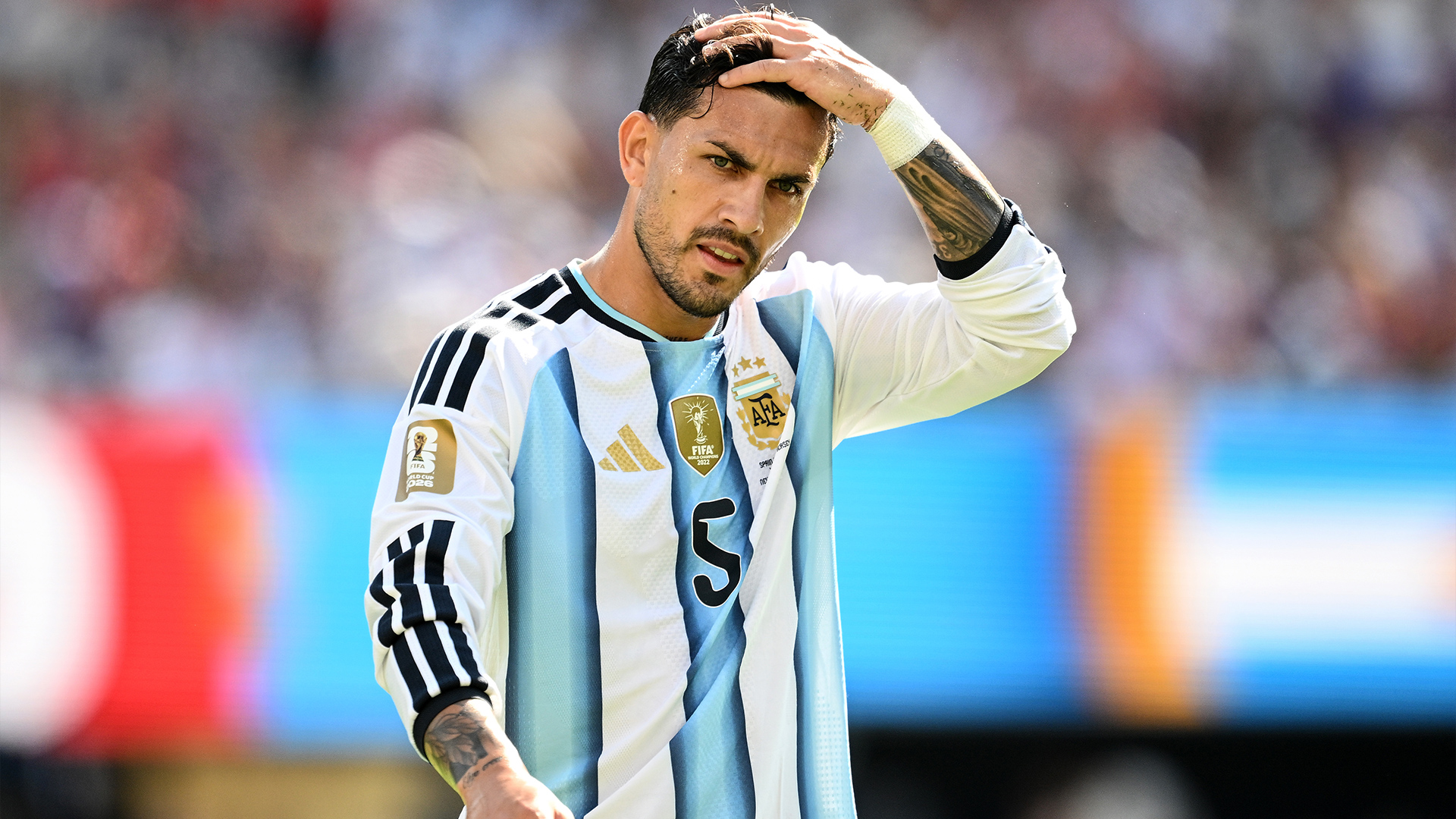
In the cold, sterile language of a disciplinary committee, the numbers tell a story of anger, shame, and consequences: ten matches, seven matches, one match, fines totaling more than two hundred thousand dollars, and a stadium that will be half empty for Argentina’s next home fixture. But behind those figures lies a human drama that unfolded under the lights of a World Cup final in East Rutherford, New Jersey, where the tension was as thick as the summer haze and the beautiful game turned ugly. FIFA’s decision to ban three Argentina players on Friday was not just a bureaucratic formality. It was the official record of a moment when elite athletes, consumed by defeat, let their frustration boil over into violence. For Leandro Paredes, the midfielder whose hands wrapped around the throat of Spain’s Eric Garcia, it was a ten-match ban—a penalty so severe that it effectively removes him from international football for the next year, assuming every match is a friendly, which is all that currently dots the calendar through June 2027. For Nahuel Molina, a seven-game suspension; for Thiago Almada, a single match. The fines—$90,000 for Paredes and Molina, $30,000 for Almada—serve as a reminder that even millionaires must pay for their fury, but the emotional cost cannot be measured in dollars.
To understand the weight of Paredes’s punishment, one must picture the scene in that frantic, feverish final on the last day of the tournament. Argentina had been outplayed, outmuscled, and ultimately undone by a Spain side that seemed to dance around their despair. Ferran Torres scored the only goal in the second period of extra time, after the Argentine midfielder Enzo Fernandez had been sent off, reducing his team to ten men and leaving them gasping for air. When the final whistle came, the disappointment was not merely a sporting defeat; it was a crushing blow to national pride. In that haze of humiliation, Paredes lunged at Eric Garcia, grabbing him by the throat, and then shoved Gavi to the ground—a moment of pure, unthinking rage that the cameras captured for the world to judge. FIFA’s disciplinary judges called these “assault cases,” a legal term that strips away the heat of the moment and leaves only the cold fact of violence. The ten-match ban for Paredes ranks with some of the harshest sanctions in World Cup history, alongside the infamous 2014 suspension of Uruguay’s Luis Suárez for biting Italy’s Giorgio Chiellini, and the 2013 ban of Croatia’s Josip Simunic for leading fans in a Nazi-era chant. This is not just a slap on the wrist; it is a statement that football’s governing body will not tolerate the spark of violence, no matter how immense the provocation of losing a world title.
But the ripple effects of that night go far beyond the three players named at the top of the list. Spain’s Gavi, who might have been seen as the victim after being shoved to the ground, was himself banned for one game—a Nations League clash against England at Wembley on September 26—because FIFA’s investigators found that he had not exactly been an innocent bystander. An Argentina coach, Roberto Ayala, also faces a three-game ban and a $30,000 fine, a reminder that the chaos on the pitch was not limited to those wearing the shirts. The Argentine Football Association, known as AFA, was hit much harder: $110,000 in fines for a range of incidents that included players carrying a political banner about the Falkland Islands after their semifinal victory over England, and discriminatory chants by fans that echoed in the stands. There is a human irony here, because the Falklands banner was a matter of national sovereignty for Argentines, a wound that never fully healed, while the anti-English sentiment was seen as a way to rally a nation. But FIFA did not see it that way; it saw politics and prejudice seeping onto the field, and it demanded not just a fine but a commitment to betterment. AFA was ordered to spend $100,000 on anti-racism projects, a line item in the disciplinary report that feels almost like a penance, a quiet admission that football’s passion too often bleeds into something darker. And all of this comes in a tournament where Argentina collected $34 million in prize money—a windfall that makes the fines sting more as a matter of principle than of pocketbook.
The Argentine federation’s response is predictable, but human: defiance wrapped in legal language. In an official statement, AFA said its legal department would “in a timely manner request from FIFA the grounds for the reviewable rulings in order to file appeals with the governing body’s appeal committee, while retaining the future option of appealing to the CAS as a final recourse.” That sentence, full of legal terminology, is actually a cry of frustration from an institution that feels singled out, humiliated again on a global stage. They will argue, as they always do in such cases, that the punishments are disproportionate, that the players were provoked, that the chants in the stands cannot be the responsibility of the team. And behind all that, there is a deeper emotional current: Argentina has always believed that the world’s football establishment looks down on them, that their fiery style and fierce pride are misunderstood as aggression. The appeal process will drag on for months, with lawyers and arbitrators, but the truth remains that Paredes, Molina, and Almada will not be wearing the blue and white stripes for a long time. For Ayala, the coach who has been a symbol of Argentine football since his playing days, the three-game ban is a personal stain that he must carry. And for the fans who packed the stadium in New Jersey, hopeful and loud, the aftermath is a bitter taste left in the mouth—a tournament that was supposed to be a celebration of Latin American football ending in a humbling defeat and a wave of punishments that will be remembered for years.
The historical comparisons are unavoidable, and they show just how seriously FIFA has taken this case. In 2014, Luis Suárez was banned from all football—not just international matches—for four months after biting Chiellini, and he also missed eight competition games for Uruguay. That ban extended to his new club, Barcelona, which meant he could not even train with his teammates for a period, a punishment that was as much about public shaming as preventing him from playing. In 2013, Josip Simunic of Croatia received a ten-match ban after using a megaphone to lead fans in a chant used by the pro-Nazi regime during World War II, a political poison that FIFA sought to purge from the game. Paredes’s ban joins that company, and it is telling that his offense was not ideological but physical—a violent outburst against another human being. The fact that FIFA chose to make an example of him suggests a growing intolerance for on-field assault, especially in the era of VAR and ubiquitous camera angles where no gesture goes unnoticed. But humanize this: Paredes is not a monster; he is a competitor who lost his mind for a few seconds. He will wake up in the months ahead with the weight of what he did, the memory of Garcia’s face under his hand, the instant replay of his own fall from grace. And for Molina, the seven-match ban is not just a number; it is seven chances to represent his country stolen from him, seven national anthems he will have to watch from the stands.
Yet perhaps the most poignant part of the entire saga is the broader context of the match itself—a final that was billed as the ultimate clash between talent and tactics, but which degenerated into a series of ugly incidents that overshadowed the football. Spain won the match with a single goal from Ferran Torres, a player who had not been the star of the tournament but who found himself in the right place at the right moment. Argentina, for all their reputation as South American warriors, barely created a scoring chance, and their frustration grew into the explosive anger that we now see in the disciplinary reports. FIFA’s judges did not stop at bans and fines; they also ordered Argentina to play its next home game in a stadium limited to 50 percent of capacity, a sentence that will be felt by an entire team forced to perform in front of nearly empty stands, and by fans who will have to apply for a ticket no one knows if they will get. Two further sanctions—another stadium limitation and a $100,000 fine—were deferred with probationary periods, hanging over Argentina’s head like a sword of Damocles. What does all this mean for the human heart of the sport? It means that passion, when left unchecked, can turn a World Cup final into a courtroom. It means that the joy of victory and the agony of defeat are not just poetic ideas but real, powerful forces that can lead to terrible mistakes. And it means that even as we love football for its intensity, we must also hold it accountable for its failures. The players will serve their bans, the federation will pay its fines and file its appeals, and the fans will move on to the next match, the next hope, the next chance to sing. But the lesson of that night in New Jersey—that the beautiful game has a shadow side, and that the shadow must sometimes be named and punished—will linger far longer than any trophy.