



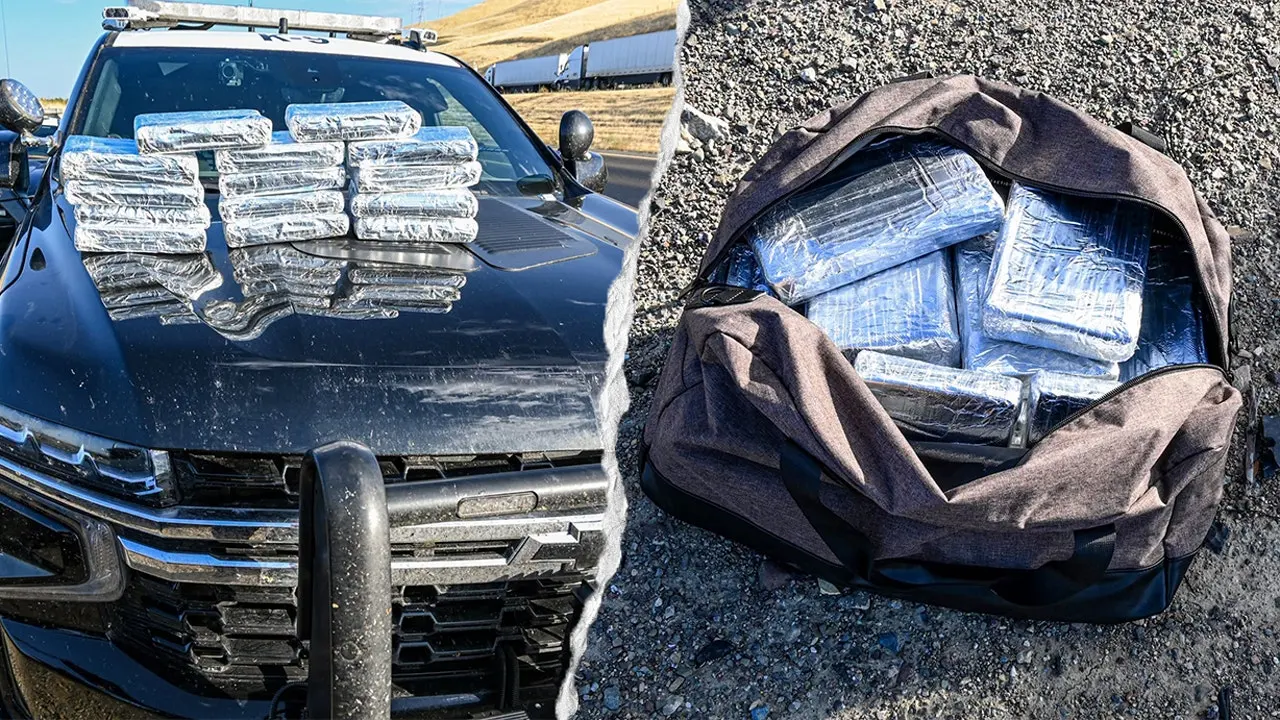
In the quiet, sun-drenched expanse of California’s Central Valley, a routine Tuesday morning took an unexpected and dramatic turn. It was August 12th, and a canine officer from the California Highway Patrol’s Central Division was on standard patrol duty in Merced County. The officer’s attention was drawn to a 2025 Honda CR-V, a vehicle that, on its surface, was just another car on the road. The reason for the initial stop was a simple, alleged traffic violation, the kind that happens hundreds of times a day across the state. However, what began as a mundane interaction on the asphalt would quickly unravel into a major narcotics investigation, revealing a hidden cargo of staggering value and potency.
As the officer approached the vehicle and began the standard procedure of a traffic stop, the situation quickly evolved. The driver’s demeanor and the details presented during the conversation raised subtle, yet significant, red flags. These were not overt signs of guilt, but rather the “several indicators of possible criminal activity” that CHP officials would later cite. These are the nuanced cues that experienced officers are trained to observe—the nervous glances, the inconsistencies in a story, the overall body language that suggests a person is carrying a secret much heavier than the contents of a glove compartment. Recognizing these signals, the officer’s traffic stop transitioned from a simple citation check into a more probing inquiry, setting the stage for a discovery that would ripple through the local community and beyond.
The subsequent search of the vehicle proved to be anything but routine. Hidden within the confines of the 2025 Honda CR-V, the officer’s diligent search uncovered a single, unassuming bag. But its contents were anything but unassuming. The bag contained approximately 30 pounds of a white, powdery substance that field-tested positive for cocaine. The sheer volume of the narcotics was staggering, but it was the calculated street value that truly underscored the scale of the operation. According to the California Highway Patrol, the seizure was estimated to be worth a colossal $817,200. The discovery transformed the moment from a standard enforcement action into a significant blow against the drug trade, a single stop that pulled nearly a million dollars worth of illicit product off the streets and out of the hands of the community.
With the discovery of the narcotics, the scene shifted from the roadside to the processing of a major arrest. The driver, whose identity has not been released to the public, was immediately taken into custody without further incident. The driver was subsequently booked into the Merced County Main Jail, facing felony charges that reflect the serious nature of the alleged crime: possession of cocaine for sale and the transportation of cocaine across non-contiguous counties. The latter charge is a critical legal distinction, suggesting that the drugs were not intended for local, small-scale distribution, but were part of a larger supply chain moving product across significant geographic boundaries. This indicates that the driver was not just a street-level dealer, but potentially a crucial link in a more extensive trafficking network funneling narcotics through the state.
The case has now been handed over to the Merced Area Gang Narcotics Enforcement Team, a multi-agency task force commonly known as MAGNET. This specialized unit is well-versed in untangling the complex web of drug trafficking organizations. Their investigation will likely focus on tracing the origin of the cocaine, identifying the intended destination, and working to dismantle the network that facilitated its transport. The involvement of MAGNET signals that this is more than a single arrest; it is a link to a much larger chain that law enforcement intends to pull. This bust is a testament to the proactive work of patrol officers who are often the first line of defense against the flow of narcotics, and their ability to spot the unremarkable vehicle carrying remarkable illegality. It is a stark reminder that the war on drugs is fought in moments like these—on quiet highways, during routine stops.
This significant seizure in Merced County, however, is not an isolated incident, but part of a concerning and larger pattern of major narcotics interdictions across California. Just weeks prior, in July, federal authorities announced the discovery of an astonishing amount of cocaine hidden beneath the floorboards of a commercial truck as it attempted to cross the U.S.-Mexico border. The vehicle was stopped at the Calexico Port of Entry, and a search revealed more than half a ton—over 1,000 pounds—of cocaine meticulously concealed within the structure of the truck and its flatbed trailer. That particular bust was described as one of the largest in Southern California this year, with a projected street value that eclipsed $20 million. The sheer scale of this discovery highlights the immense volume of narcotics attempting to permeate the border and the sophisticated methods traffickers employ to move their product.
The battle against this influx of drugs is being fought on multiple fronts, including at points of entry far from the roadside stops of the Central Valley. In a separate, but equally alarming, operation, U.S. Customs and Border Protection officers uncovered a novel concealment method hidden in plain sight. A month ago, at the Pharr International Bridge in Texas, a canine inspection and advanced nonintrusive imaging scan detected anomalies within a tractor-trailer that was ostensibly transporting a shipment of cucumbers. A thorough search of the vehicle revealed 112 packages cleverly stashed among the produce, containing nearly 279 pounds of cocaine. The estimated street value for that load was over $3.7 million. These cases underscore the relentless creativity of drug cartels, who exploit every avenue and commodity, from legitimate produce to the floorboards of commercial trucks, to push their product across the border.
Taken together, these three significant busts paint a vivid picture of the ongoing challenge facing law enforcement agencies at all levels. From the county roads patrolled by the CHP to the nation’s ports of entry guarded by federal agents, the fight against drug trafficking is a constant, high-stakes game of cat and mouse. The seizure in Merced County is a victory, a clear disruption of a criminal enterprise, but it is also a poignant illustration of the scale of the problem. The 30 pounds of cocaine found in that Honda CR-V is a tangible, devastating substance that could have wreaked havoc on countless lives and fueled further crime. The $817,200 price tag attached to it is not just a financial figure; it represents the potential for addiction, violence, and the erosion of community safety. Each seizure, no matter the size, is a small but crucial success. Yet, the concurrent discoveries of massive loads in Calexico and Texas serve as a sobering reminder of the immense resources and determination of the criminal organizations behind this trade. As the investigation into the Merced County driver continues, the seizure stands as a powerful testament to the vigilance of the men and women in uniform who, on any given day, might just pull over the wrong car and uncover something that makes a difference.