


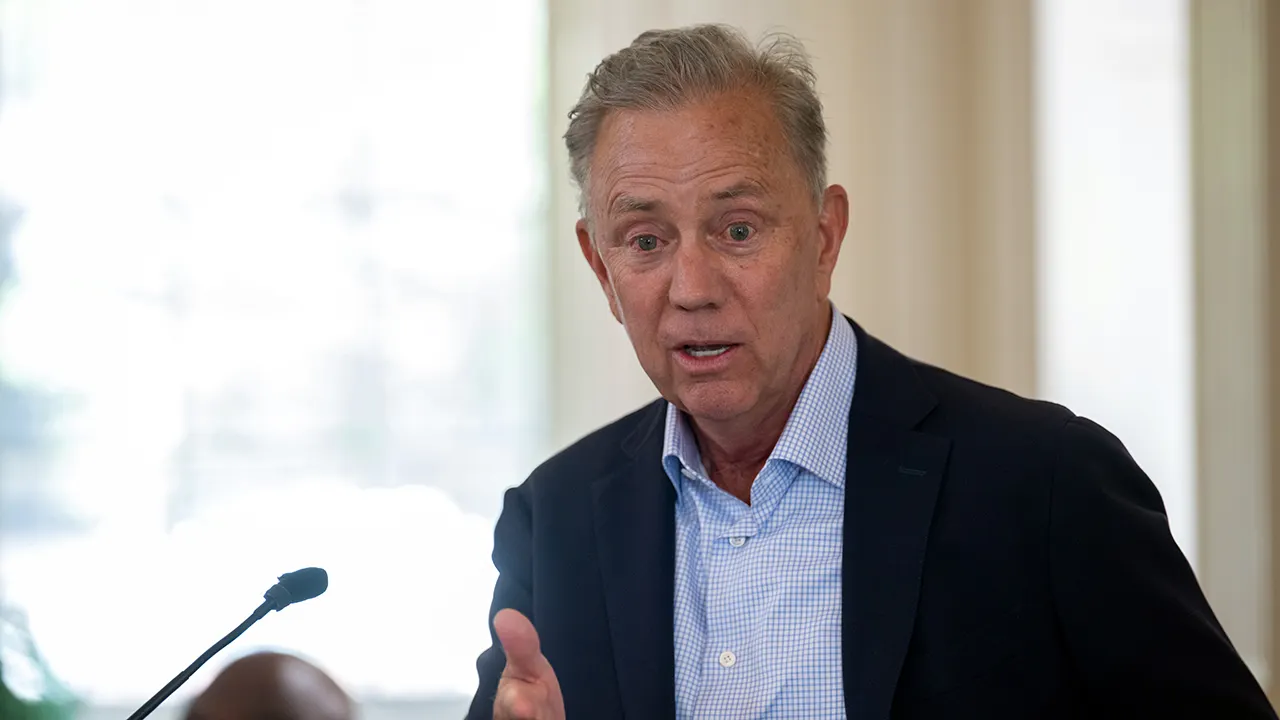
The political landscape of Connecticut, a state that has transformed from a bellwether of moderate Republicanism to a staunchly Democratic stronghold, is the stage for a generational and ideological clash. This conflict, playing out within the Democratic party itself, pits the calculated pragmatism of an incumbent governor against the fiery urgency of a progressive challenger. At the heart of this battle is a fundamental question that resonates far beyond the state’s borders: in an era defined by political turbulence and the forceful return of Donald Trump, is it more effective to be a steadfast, transactional leader or a combative, outspoken fighter? The recent primary election offered a resounding, if complex, answer, exposing the deep fissures within the party’s base and setting the stage for a general election that will test the very definition of Democratic leadership in the age of Trump.
The protagonist of this story, Governor Ned Lamont, represents a certain kind of New England Democrat. A wealthy cable television entrepreneur who first gained political fame for his long-shot, anti-war primary victory over Senator Joe Lieberman in 2006, Lamont has since evolved into the establishment figure he once challenged. His political persona is one of moderation, fiscal responsibility, and a somewhat patrician air of civility. For nearly eight years, he has governed Connecticut with a steady hand, navigating the state through financial crises, the COVID-19 pandemic, and the complex needs of a population increasingly composed of commuters to the major metropolitan hubs of New York City and Boston. His approach is one of quiet competence, preferring bipartisan deal-making to fiery rhetoric, and viewing his role as a steward of the state’s long-term health rather than a warrior in the culture wars. He believes his record—managing budgets, fostering economic development, and investing in key areas—is his best argument for reelection, and that the state’s residents, weary of instability, value this dependable, if unexciting, approach.
Enter Josh Elliott, the challenger, a state representative from Hamden who embodies the restless energy of the party’s left wing. Elliott’s campaign was not built on a critique of Lamont’s policy specifics but on a fundamental indictment of his political temperament. His central argument was that Lamont’s signature “niceness” is a dangerous liability in the current political climate. In Elliott’s view, the existential threat posed by Trump and his allies requires an equally forceful and unyielding opposition. He argued that being polite to a political adversary who disregards democratic norms is not a sign of strength but of weakness, and that it fails to protect the state’s residents from the national wave of conservative policy and rhetoric. Elliott’s language was sharp and uncompromising, accusing the governor of prioritizing personal comfort and professional courtesy over the urgent need to fight for the state’s values. He painted a picture of a leader who was more concerned with maintaining decorum than with fighting back against “fascism,” a term he used unflinchingly to describe the current national political movement. For Elliott and his supporters, the primary was not about who could manage the state better, but about who would mount the most robust resistance to the Republican agenda emanating from Washington.
The response from the Lamont camp to this existential challenge was a masterclass in political dismissal wrapped in a narrative of tangible accomplishment. Lamont’s message was direct and pragmatic: “Talk is cheap.” He positioned Elliott’s impassioned appeals as empty rhetoric, devoid of the substance or experience required to govern a complex state. By pointing to his nearly eight-year record, Lamont made the case that beyond the anger and the slogans, real governance demands a steady hand, deep institutional knowledge, and the ability to get things done. He framed his administration’s focus on affordability, early childhood education, and growing the state’s economic base as the true, lasting way to improve lives, far more effective than shouting from the sidelines. This was a classic incumbent strategy: to shift the debate from the abstract realm of ideological purity to the concrete realm of legislative wins and budget numbers. He effectively asked voters if they wanted a manager who could navigate the treacherous waters of state politics or a revolutionary whose passion might not translate into practical solutions. In the end, the Connecticut electorate, even in the throes of a leftward shift, chose the manager.
The outcome of the primary, a decisive victory for Lamont, provides a clear, if sobering, data point for the state’s political trajectory and the national Democratic party. It signals that while the progressive wing’s energy is potent and its voices loud, the party’s broader electorate—at least in a state like Connecticut—still prioritizes competence and stability over confrontation. This isn’t to say the progressive message was rejected; rather, it suggests that voters are making a more nuanced calculation. They may sympathize with the anger and the desire for a more aggressive fight against Trump, but they also recognize the value of an experienced executive who has navigated them through recent crises. In this sense, Lamont’s win is a pragmatic choice, not a repudiation of the left’s values. The primary revealed a party that is profoundly conflicted, wanting both an effective administrator and a passionate advocate, and deciding that, in this cycle, the former was the safer bet. The electorate’s choice underscores the complex dynamics at play: the fear of Trump is real, but it doesn’t automatically translate into support for the most radical or most confrontational challenger.
Looking towards the November general election, where Lamont will face Republican state Senator Ryan Fazio, the primary battle offers a critical preview of the arguments to come. For Fazio, the Democratic infighting provides a golden opportunity to paint Lamont as a politician who is out of touch with the state’s needs, pointing to the challenge from his left as evidence that even his own party sees him as insufficiently responsive on issues like affordability. The general election will now be a test of a more traditional, center-left versus center-right dynamic. However, the ghost of Elliott’s campaign will linger, as Fazio will attempt to use the progressive anger against Lamont to his advantage, perhaps suggesting Lamont will be forced to cater to the left to shore up his base, thereby alienating moderate voters. For Lamont, the strategy will be to frame Fazio as a far-right ideologue and himself as the only experienced, moderate choice for the state, a contrast that was less sharp in the primary but becomes paramount in a general election where independent voters will be the deciding factor.
In the final analysis, the Connecticut primary was more than a local political scuffle; it was a microcosm of a national identity crisis within the Democratic party. It laid bare the eternal tension between the politics of persuasion and the politics of resistance, between the incrementalist who believes in the power of governance and the activist who demands a more radical transformation. Governor Lamont’s victory underscores that a significant portion of the Democratic electorate views effective, stable management as an essential form of resistance in itself. They believe that by making a blue state work well—by providing good services, managing finances prudently, and creating a haven of progressive policy—they are offering a powerful counter-narrative to the chaos of the Trump era. Josh Elliott’s campaign, though unsuccessful, succeeded in forcing a conversation and articulating a passionate vision that will not be easily silenced. The “nice” governor won the day, but the battle over the soul of the party, and the most effective way to confront the challenges of the modern political landscape, is far from over. The voters of Connecticut have chosen their leader for now, but they, like Democrats everywhere, are still wrestling with what it truly means to fight, and how that fight should be waged.