


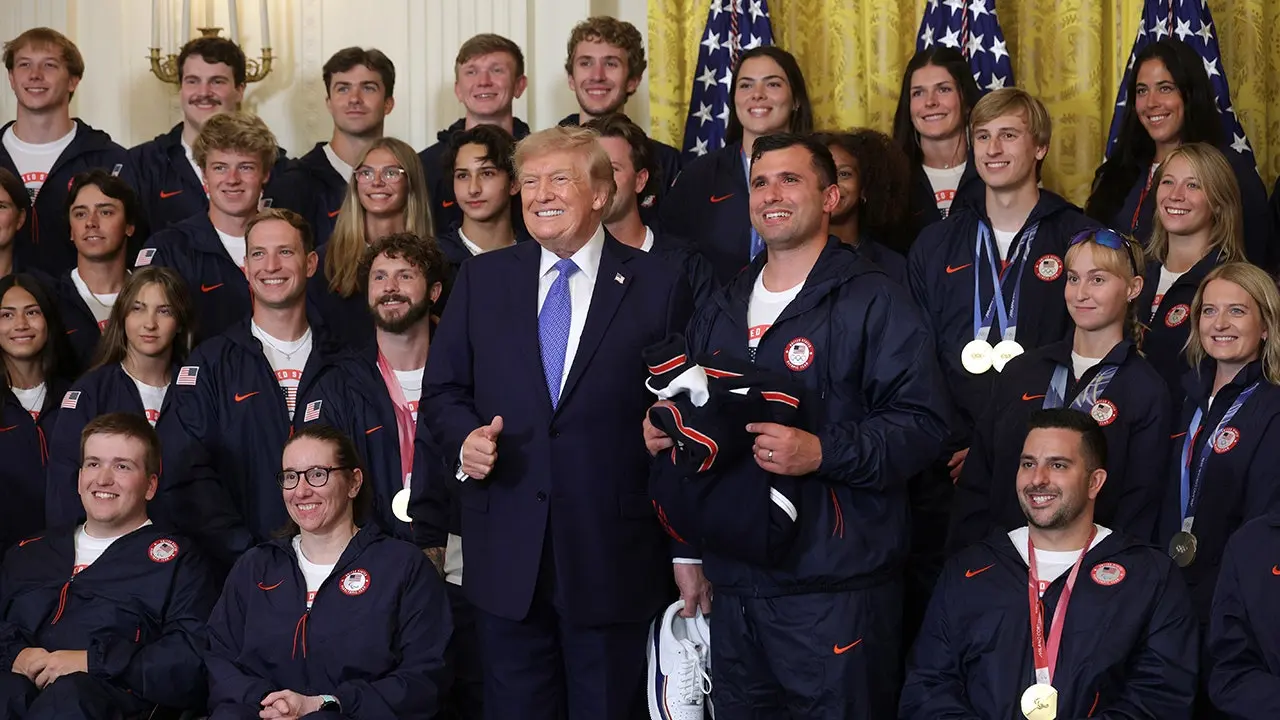
The historic, light-filled rooms of the White House were alive with an infectious, youthful energy as President Donald Trump stood before a distinguished assembly of more than 120 of America’s finest Winter Olympians and Paralympians. Hosting these elite competitors to celebrate their monumental, life-changing achievements at the Milano Cortina Games earlier this year, the President frequently looked over his left and right shoulders, visibly moved by the quiet strength and proud posture of the young men and women standing behind him. The East Room, normally a place reserved for serious diplomatic affairs and statecraft, was momentarily transformed into a hall of triumph, filled with the warmth of shared laughter, quiet whispers, and the proud chatter of teammates who had spent years enduring the absolute limits of human endurance together. For these athletes, walking through the doors of the executive mansion was the ultimate culmination of a long, grueling, and often lonely journey defined by pre-dawn training sessions in the dead of winter, freezing temperatures that stung the lungs, agonizing physical rehabilitation, and the heavy emotional weight of representing the United States on the global stage. As Trump surveyed both the impressive lineup behind him and the supportive crowd gathered before him, the entire room seemed to vibrate with a profound sense of national unity and relief, marking the end of a high-stakes competitive chapter and the beginning of a well-deserved celebration. Every single athlete in attendance carried a deeply personal story of sacrifice—parents who spent countless hours driving to remote ice rinks at four in the morning, coaches who refused to let them settle for anything less than perfection, and an inner voice that kept them moving when their muscles screamed for rest. This special White House reception was far more than a routine political obligation; it was a deeply human celebration of resilience, passion, and the extraordinary heights that can be reached when raw talent is forged in the fire of an unrelenting work ethic. It allowed the nation to collectively express its gratitude to these individuals who wore the Stars and Stripes not merely as a uniform, but as a lifelong promise of athletic excellence.
While the sheer statistics of Team USA’s performance at the Milano Cortina Games are mathematically stunning, behind every medal lies an intricate human story of grit, determination, and recovery. In total, the 300 athletes representing the United States brought back a remarkable 57 medals, including 12 gold medals, establishing these Winter Games as a historic milestone by securing the most-ever U.S. gold medals in a single winter competition. Furthermore, the 33 medals won by Team USA in the Olympic events marked the most successful performance by American athletes in a Winter Games held outside of North America, proving that this generation of competitors could overcome foreign time zones, unfamiliar high-altitude mountain ranges, and passionate international crowds. Not to be outdone, the nation’s 72 paralympic competitors delivered an equally jaw-dropping and emotionally stirring performance across all five sports, bringing home 24 medals of their own, including 13 prestigious gold medals. Among these incredible achievements, none was more legendary than the fifth consecutive gold medal secured by the U.S. sled hockey team, a feat that cemented their status as a global powerhouse. President Trump took a special moment during his address to laud this incredible achievement, calling it “one of the greatest dynasties in all of international sports” and emphasizing that “nobody’s ever done anything like it” before warmly acknowledging the individual team members in attendance. To understand the true depth of this sled hockey dynasty is to understand the profound power of the human spirit; these are athletes who have navigated life-altering physical trauma, combat injuries sustained in service to their country, or congenital conditions to master a sport that requires immense upper-body strength, lightning-fast reflexes, and a relentless willingness to clash on the ice. When Trump pointed to these athletes, the applause that filled the room was not just polite recognition of a sporting victory, but a standing ovation for the indomitable human will that refuses to be sidelined by adversity.
Among the many dramatic narratives that captured the imagination of sports fans around the globe, the intense, decades-long rivalry between the United States and Canada on the ice provided some of the most heart-stopping moments of the entire Winter Games. Both the men’s and women’s Olympic hockey squads managed to defeat their Canadian counterparts in nail-biting, high-stakes overtime thrillers, a feat that President Trump eagerly and colorfully highlighted during his celebratory address. “The 2026 men’s Olympic hockey team—we celebrated together and it was really an incredible time,” Trump recalled with genuine enthusiasm, before turning his gaze toward the women’s team to add, “We can’t forget and never would—and nobody would have the courage to forget either because they are amazing. The history-making women’s hockey team. This team left everything on the ice.” The emotional and psychological gravity of these victories cannot be overstated, as matches against Canada are historically steeped in intense national pride, personal rivalries, and the weight of public expectation. For the men’s team, the sweet taste of victory was elevated even further when their star goaltender, Connor Hellebuyck, was awarded the Presidential Medal of Freedom earlier that day, a prestigious honor recognizing his status as a barrier-breaking athlete and an impenetrable wall of defense on the ice. Hellebuyck’s journey to the White House, which also included a special invitation to sit in the House chamber for the State of the Union address just days after securing the gold medal, represents the absolute pinnacle of an American athlete’s career. The immense pressure of playing goal in an overtime gold-medal match against a fierce rival is a psychological burden that very few human beings will ever have to bear, making Hellebuyck’s calm under fire and subsequent national recognition a deeply moving testament to individual excellence and mental fortitude.
Yet, the path leading to this grand White House celebration was not entirely free of minor public controversies and logistical hurdles, illustrating the complex, sometimes delicate intersection of professional sports, modern media, and presidential politics. Following the men’s dramatic overtime victory, Trump had made a joking comment during a celebratory phone call with the team, suggesting he would face immediate “impeachment” if he did not extend an equally enthusiastic invitation to the women’s team—a lighthearted remark that nonetheless sparked some media debate and public scrutiny. Following the call, USA Hockey released a clarifying statement explaining that while the female athletes were incredibly grateful for the President’s warm invitation, the grueling, overlapping demands of their active collegiate and professional playing schedules made it logistically impossible for the entire roster to attend the Thursday event. This reality highlights the intense, year-round commitment required of elite female hockey players, many of whom must constantly balance demanding academic course loads at top-tier universities with exhausting training regimens and professional league games, leaving almost no room for spontaneous cross-country travel. However, the spirit of unity, celebration, and mutual respect ultimately triumphed on Thursday afternoon, as star forwards Joy Dunne and Abbey Murphy were both able to make the trip to Washington, standing proudly among the sea of Olympians and Paralympians gathered behind the podium. Trump took a deliberate moment during his speech to individually recognize and praise Dunne and Murphy, shining a well-deserved national spotlight on their contributions to the gold-medal victory and proving that despite scheduling conflicts or political chatter, the shared pride of athletic triumph remains a unifying force. Seeing these two young women standing tall in the White House, representing their teammates who were back home studying or practicing on the ice, served as a poignant reminder of the everyday sacrifices made by female athletes who continue to inspire the next generation of young girls nationwide.
As the formal speeches drew to a close, the ceremony transitioned into an intimate and heartwarming exchange of mutual respect, highlighting the genuine personal connections that can form between a nation’s leader and its sporting heroes. To commemorate this unforgettable afternoon and express their gratitude for the White House’s recognition, the athletes presented President Trump with two highly cherished mementos: a custom, beautifully crafted Team USA varsity jacket and a brand-new pair of athletic shoes. The varsity jacket, a timeless symbol of American youth, hard work, and schoolyard triumphs, seemed especially fitting for a President who has long championed the virtues of competition, strength, and victory. Slipping into the jacket, Trump beamed with genuine joy, momentarily bridging the vast, serious gap between the complicated world of global governance and the pure, simple pride of athletic achievement. These gifts were far more than mere promotional souvenirs; they represented the collective gratitude of 300 unique individuals who had spent years training in relative obscurity, often in empty ice rinks, lonely gymnasiums, and isolated mountain trails, only to find themselves celebrated in the grandest house in the land. The shared laughter, handshakes, and casual conversations that took place during this gift exchange humanized the high-stakes world of elite sports and the presidency alike, showing that beneath the medals and the political titles, there lies a shared pride in the country they all represent. It was a moment of true warmth and celebration, a vivid visual of a grateful nation symbolically wrapping its leader in the very red, white, and blue colors that these young men and women had defended so passionately on the global stage.
While the festive afternoon at the White House provided a brief, shining moment for reflection, applause, and celebration, the relentless nature of elite international sports means that for these athletes, the climb is never truly finished. Many of the competitors who were unable to attend the Thursday ceremony were already back in their natural elements, enduring punishing physical workouts, strict diets, and exhausting training runs as they begin the multi-year process of preparing for the 2030 Winter Olympic and Paralympic Games, set to take place amidst the breathtaking, snow-covered peaks of the French Alps. The life of a professional winter athlete is defined by this constant, demanding forward momentum; the brief euphoria of a gold medal quickly fades into the background as the physical body demands immediate preparation for the next grueling cycle, driven by the intense desire to defend a title or redeem a past loss. Looking even further into the future, President Trump spoke with palpable excitement about the 2034 Winter Games, which will see the global athletic community return to American soil in Salt Lake City, Utah—a city with a rich, historic Olympic legacy of its own. The prospect of competing in front of a home crowd on American snow offers a powerful beacon of hope, motivation, and inspiration for both the seasoned veterans who stood in the East Room and the young children currently strapping on their very first pair of skis or skates in local parks across the country. This endless, generational pursuit of excellence, passed down from one set of champions to the next, remains the true beating heart of the Olympic and Paralympic movement—a beautiful testament to the universal human desire to constantly push beyond existing limitations, to run faster, jump higher, and stand stronger together, no matter what challenges lie ahead.