



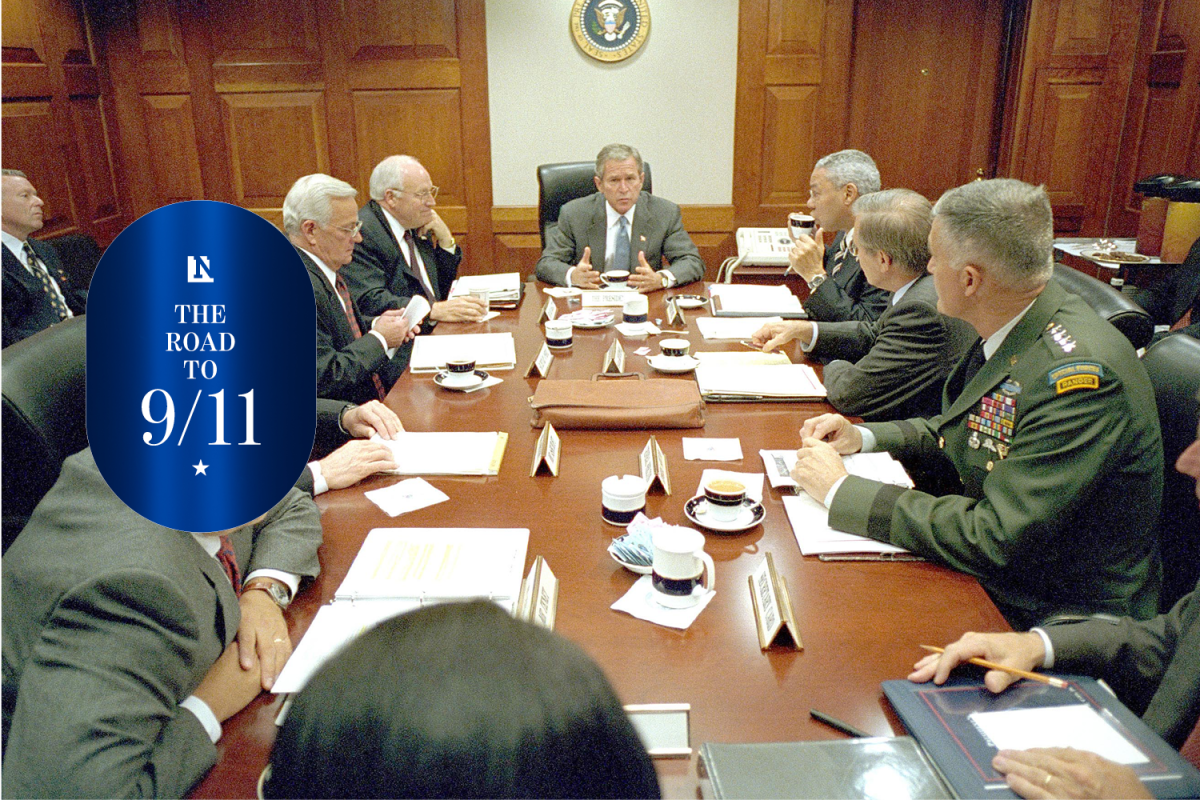
The sweltering August heat of 2001 had settled heavily over Crawford, Texas, where President George W. Bush was enjoying an extended working vacation, far removed from the suffocating, hyper-partisan political atmosphere of Washington, D.C. On the morning of August 6, amid the lazy, sun-drenched rhythm of summer ranch life—where the President’s days were filled with clearing brush, running, and enjoying the quiet of the countryside—he sat down for his daily intelligence briefing. This briefing was presented by CIA Deputy Director John McLaughlin, who had drawn the short straw of handling the summer vacation rotation. Among the papers delivered that morning was an article destined for historical infamy, bearing the stark and ominous title, “Bin Laden determined to strike in U.S.” In the tumultuous years that followed the tragedy of September 11, this document would become a lightning rod for critics, fueling accusations that the administration had willfully ignored a clear, explicit, and present danger. However, the reality on the ground was far more complex, nuanced, and deeply human. The Presidential Daily Brief (PDB) was never designed as an active, tactical siren warning of an imminent, specific attack; rather, it was a background summary of a long-standing threat, compiled specifically because President Bush had repeatedly pressed his briefers for information on whether Al Qaeda posed a domestic threat. With a quiet global news cycle and a temporary decline in the intense, white-hot panic that had characterized the intelligence channels throughout July, the CIA saw an opportunity to answer the President’s questions by repackaging their historical knowledge of Osama bin Laden’s ambitions. It was a moment of bureaucratic routine masquerading as a warning, delivered to a president who was actively seeking clarity but was instead handed a retrospective history lesson rather than the actionable, real-time intelligence he needed to defend the country. Rather than a negligence of duty, the briefing represented a classic disconnect between what a leader was asking and what an overstretched intelligence apparatus was capable of providing, setting a tragic stage where both sides believed they were doing their jobs while the clock was ticking down.
When one looks closely at the declassified text of that infamous brief, it reads less like a modern threat assessment and more like a tragic mosaic of past anxieties, historical footnotes, and missed connections. The article traced Osama bin Laden’s hostility toward the United States back to 1997, recalling television interviews where the Al Qaeda leader praised Ramzi Yousef, the mastermind of the 1993 World Trade Center bombing, and publicly vowed to “bring the fighting to America.” It detailed how the 1998 U.S. cruise missile strikes against Al Qaeda training camps in Afghanistan—launched in retaliation for the devastating, near-simultaneous bombings of American embassies in Kenya and Tanzania—had only deepened Bin Laden’s resolve to strike back directly inside Washington itself. The document also cited intelligence from a spy working for Egyptian services, who warned that Al Qaeda intended to exploit the United States’ relatively open borders and easy domestic access to mount a spectacular terrorist assault. Yet, despite these alarming historical references, the brief was riddled with analytical gaps that highlighted the limits of human intelligence at the time. Most notably, the CIA identified Abu Zubaydah as the primary operational mastermind behind domestic plotting, pointing to his role in facilitating Ahmed Ressam’s failed millennium plot to bomb Los Angeles International Airport. The agency remained entirely oblivious to the true architect of the impending catastrophe, Khalid Sheikh Mohammed, demonstrating how the intelligence community was looking at the threat through a cracked mirror, missing the real hand guiding the conspiracy. This profound blind spot meant that even if the President had ordered a full-scale offensive based on this brief, the intelligence community would have targeted the wrong suspects, chasing shadows while the real threat remained invisible, undisturbed, and on track to execute their deadly plan.
Perhaps the most misleading and ultimately damaging aspect of the August 6 brief was its reassurance regarding domestic defense, particularly its assertion that the FBI had approximately seventy active field investigations underway related to Bin Laden. To a president reading this in the quiet of his Texas ranch, seventy investigations would have sounded like a robust, proactive domestic dragnet keeping watch over the nation, a comforting shield against any potential infiltrators. In reality, this number was a tragic bureaucratic illusion born of institutional vanity. The FBI had never been asked to verify, clarify, or contextualize this statistic, which was heavily padded with minor cases of radical fundraising, investigations into individuals who had been in long-term custody, and even one file concerning a person who was already deceased. Senator Bob Graham, who later chaired the Senate Intelligence Committee, would reveal that many of these investigations should never have been included in the tally, as several had already been closed and archived. This inflation of numbers pointed to a deeper, more cynical human dynamic within the intelligence community: the CIA, acutely aware of its lack of domestic jurisdiction, was subtly shifting the future burden of blame to the FBI. By framing the domestic threat as something the Bureau was actively investigating, the CIA was quietly building a paper trail of self-preservation, while the FBI itself remained fragmented, underfunded in its counterterrorism departments, and unable to connect the few genuine clues hidden within its vast, disorganized filing systems. This tragic internal division prevented the two agencies from sharing critical data, ensuring that the homeland was left defended by a hollow statistic rather than a unified, vigilant national security front, leaving field agents to work in isolated silos while the threat grew closer.
The human cost of this fragmented national security system was compounded by a tragic misallocation of focus, where speculative phantoms were chased while genuine, radioactive leads were systematically ignored. The brief warned of Al Qaeda cells operating inside the United States, raising the dark specter of radicalized American citizens actively aiding the terrorists—a domestic threat that ultimately played no role in the actual 9/11 attacks, yet would later be used in the immediate aftermath to justify sweeping, warrantless domestic surveillance and the dramatic expansion of the surveillance state. Meanwhile, the intelligence community chose to look away from a much more tangible, documentable, and politically sensitive threat: the active support network operating right under the noses of federal authorities. The FBI possessed mounting intelligence and open files suggesting that Saudi embassy personnel and other Saudi government operatives within the United States were providing financial, logistical, and social assistance to the radical Islamic community. However, because of the delicate, high-stakes nature of the U.S.-Saudi diplomatic alliance, this was a political third rail that top decision-makers simply chose not to touch, fearing the geopolitical fallout of accusing a close ally of complicity. Lower-level agents who desperately tried to sound the alarm on suspicious flight school students or highly irregular wire transfers found their warnings tied up in red tape or ignored by a headquarters that prioritized diplomatic pleasantries over counterterrorism surveillance. The result was a devastating, systemic blind spot; while intelligence analysts and political leaders worried about hypothetical domestic recruits, they remained paralyzed when it came to investigating well-connected foreign operatives who were actively moving within American cities and assisting the hijackers, illustrating how political convenience, diplomatic sensitivity, and institutional hesitation can blind even the most sophisticated defense systems to the dangers hiding in plain sight.
As the lazy days of August continued, the perceived urgency of the Al Qaeda threat seemed to dissipate rather than intensify, lulling key figures into a false sense of security. On August 17, CIA Director George Tenet made his very first trip to President Bush’s Crawford ranch, an occasion that in hindsight might seem like a critical, high-stakes moment to sound the alarm on the impending crisis. Yet, according to Tenet’s own memoirs, the visit was casual and routine, aimed primarily at keeping the President updated on general global events during a quiet vacation. There is no evidence that terrorism or the August 6 briefing was even discussed during their meetings, as the frantic, high-alert status that had characterized the intelligence community during the early summer had given way to what Tenet described as a temporary “lull” in threat reporting. This quiet period fostered an illusion of security, convincing leadership that they had successfully navigated the storm of the previous months, unaware that the plot had simply moved into its final, silent operational phase. This quiet period reinforced the administration’s belief that the immediate danger had passed, and that the August 6 brief had served its purpose as a general update. Far from the retrospective myth of a “hair on fire” warning, the August 6 document was merely the thirty-sixth Presidential Daily Brief item concerning Al Qaeda that Bush had received since taking office—averaging just over one item per week. To the decision-makers of that era, the brief was not a sudden red alert, but part of a familiar background hum of a complex and noisy world, easily set aside as the summer sun began to dip and other geopolitical concerns reclaimed the spotlight. It was a classic tragedy of normalization, where constant, repetitive warnings about a distant threat eventually became background noise, diluting the sense of urgency and creating an atmosphere of complacency just weeks before the storm broke.
The ultimate tragedy of the road to September 11 was not a single, catastrophic failure of intelligence, but a series of deeply human miscalculations, institutional rivalries, and a fatal lack of imagination. The very next day, on August 7, the focus of the national security apparatus shifted back to familiar territory, as analysts and policymakers turned their attention to debating Iraq’s rumored weapons of mass destruction—another profound misreading of intelligence that would go on to define the foreign policy disasters of the coming decades. This rapid shift in attention underscores the fragility of human focus in the face of overwhelming information; it was easier and more comfortable for the administration to engage with established, nation-state adversaries like Iraq than to grapple with the elusive, asymmetric threat of a stateless terrorist network. The events of August 2001 reveal a profoundly human story of leaders and agencies operating within the rigid constraints of their own bureaucracies, unable to see the looming storm because they were looking at the world through the comfort of old paradigms. They were trapped in a system that valued bureaucratic self-preservation over creative problem-solving, and political convenience over uncomfortable truths. In the end, the system didn’t fail because it lacked the pieces of the puzzle, but because those holding the pieces were too busy protecting their own turf, chasing historical ghosts, and looking toward the next geopolitical distraction to realize the picture they were assembling was a map of their own destruction. As the month drew to a close, the warnings of the August 6 brief remained unheeded, quieted by the distractions of statecraft and the false comfort of a quiet summer, leaving the nation utterly unprepared for the day the world would change forever, a stark reminder of the cost of complacency in a rapidly changing world.