


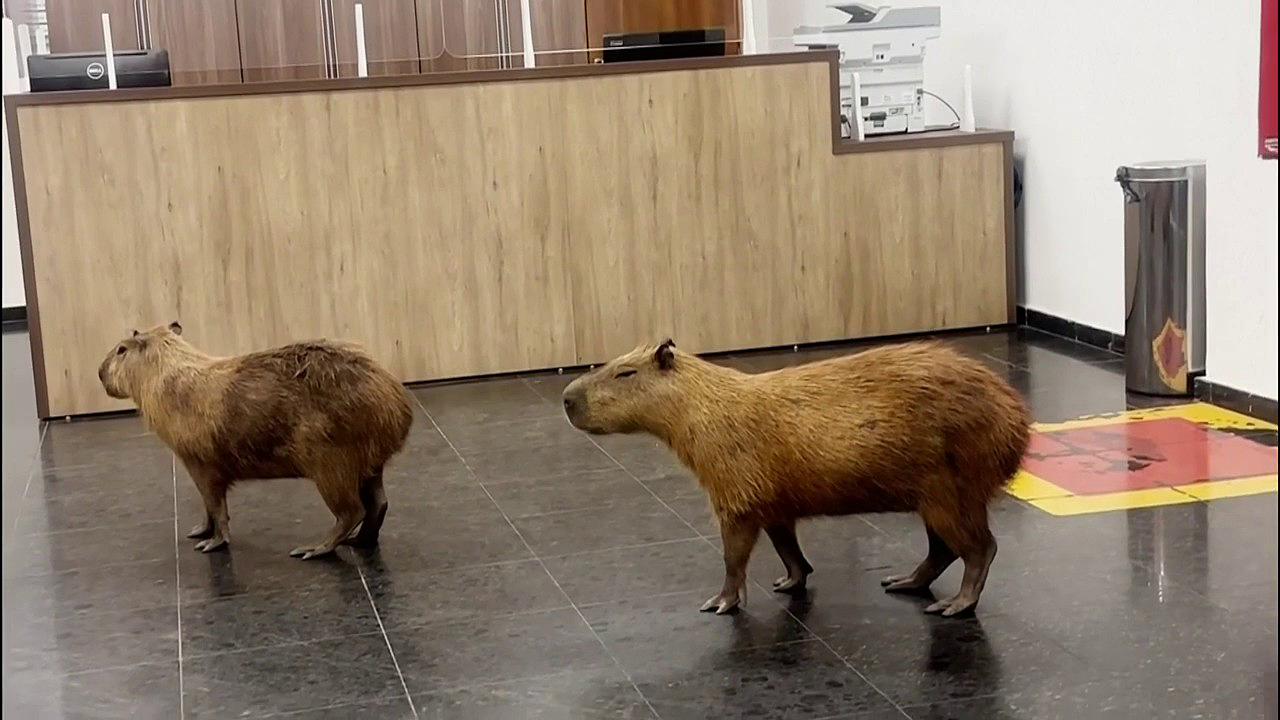
In the high-stakes corridors of governance, where laws are debated, policies are forged, and the atmosphere is typically charged with political tension, a group of highly unusual—and incredibly relaxed—lobbyists recently made an unexpected appearance. On what began as a routine Tuesday at the Mato Grosso Legislative Assembly in Cuiabá, Brazil, lawmakers and administrative staff found their daily schedules delightfully disrupted by several large, semi-aquatic visitors. Instead of the typical flurry of suits, briefcases, and hurried whispers preparing for an upcoming vote, the building’s sleek, modern lobby suddenly played host to a small, wandering herd of capybaras. The uninvited guests strolled through the entrance with an air of complete nonchalance, momentarily halting the wheels of democracy and instantly shifting the focus of everyone in the building from complex legislative agendas to the sheer, endearing absurdity of the natural world gently reclaiming a bit of human-dominated space. It was a beautiful, lighthearted reminder of the vibrant, wild landscape that continues to thrive just beyond the concrete structures of the state capital.
This charming scene was captured on video by legislative staffer Nayara Bueno, who, like many of her colleagues, could not resist documenting the heartwarming invasion on her phone. The footage reveals the giant rodents moving with a steady, unhurried grace across the polished, reflective floors, seemingly unimpressed by the grand architecture, the bright lights, or the hum of human activity surrounding them. Rather than causing panic, their presence prompted a coordinated, incredibly gentle effort by the legislative staff to softly guide the animals back toward the safety of the outdoors. The capybaras cooperated with their trademark, easygoing temperament, showing absolutely no signs of distress, fear, or aggression as workers calmly steered them toward the exit doors. Remarkably, despite their impressive size and the potential chaos that wild animals can cause indoors, the gentle giants left absolutely no damage in their wake, leaving behind only smiling faces, shared laughter, and a sense of collective joy among the employees who witnessed their brief excursion into the halls of power.
While the sight of giant rodents wandering through a government complex might shock outsiders, it is a surprisingly familiar occurrence for those who live and work in the region. As Nayara Bueno explained, these gentle creatures are regular neighbors, and the local human population has happily grown accustomed to seeing them around the vicinity of the government buildings. This frequent interaction is a direct result of the legislature’s unique geographic position, bordering a lush, expansive public park that serves as a sanctuary for a wide variety of native Brazilian wildlife. The proximity allows animals to occasionally cross the invisible boundary between nature and civilization, exploring the paved pathways, gardens, and glass structures of the government complex. This coexistence highlights a beautiful aspect of life in Cuiabá, where urban development has not entirely severed ties with the natural world, allowing humans and wild animals to share space in a relatively peaceful, harmonious manner that respects the creatures’ natural roaming patterns.
To truly appreciate why this event brought so much joy to the legislative staff and social media users alike, one must understand the unique physical and social charm of the capybara. Native to South America, these creatures hold the title of the world’s largest living rodents, with adult individuals easily reaching weights of up to 175 pounds. Despite their scientific classification, they bear little resemblance to their smaller, often feared city-dwelling cousins; instead, capybaras are highly social, semi-aquatic mammals that thrive near wetlands, rivers, and lakes, where they spend much of their time swimming, foraging, and lounging. Their endearing physical appearance—characterized by blunt snouts, webbed feet perfectly suited for swimming, and a remarkably serene facial expression—makes them look like a cross between a small bear and a giant, friendly guinea pig. Their social structure is built entirely on community, as they typically travel in close-knit family groups and communicate through a series of soft clicks, whistles, and purrs that reflect their highly cooperative, peace-loving nature.
Beyond their natural habitats in South America, capybaras have captured the hearts of millions worldwide, achieving legendary status as the ultimate icons of relaxation and friendship on the internet. Social media platforms are flooded with viral memes, videos, and photographs celebrating their incredibly laid-back demeanor, frequently showcasing them lounging peacefully next to alligators, cuddling with ducklings, or sitting undisturbed under warm running water. In a fast-paced, high-stress human world often plagued by division and anxiety, the capybara represents a Zen-like ideal of tranquility and universal acceptance, existing in a state of perpetual calm that humans can only hope to emulate. Their visit to the Brazilian legislature perfectly captured this energy, offering a stark and highly amusing contrast to the high-stakes, fast-moving world of politics and government bureaucracy. It is precisely this unbothered, friendly aura that has made them global favorites, turning a simple walk through a government lobby into a viral sensation that brought smiles to people far beyond the borders of Brazil.
Ultimately, the brief and harmless intrusion of the capybaras into the Mato Grosso Legislative Assembly serves as a gentle, heartwarming reminder of our deep connection to the environment and the animals we share it with. In our constant drive to build, organize, and govern, we often forget that our cities are built upon habitats that belonged to these creatures long before the concrete was poured. When nature occasionally steps inside to remind us of its presence—not with a destructive force, but with the quiet, curious stroll of a family of capybaras—it invites us to pause, breathe, and slow down our frantic pace. The legislative staff who welcomed, escorted, and protected these animals demonstrated a beautiful level of compassion and patience, showing that progress and wildlife preservation do not have to be at odds. As the capybaras returned safely to their park, they left behind a lighter, more joyful atmosphere, proving that sometimes, the best way to handle a busy day of work is to take a page out of a capybara’s book: stay calm, be kind, and take things one peaceful step at a time.