

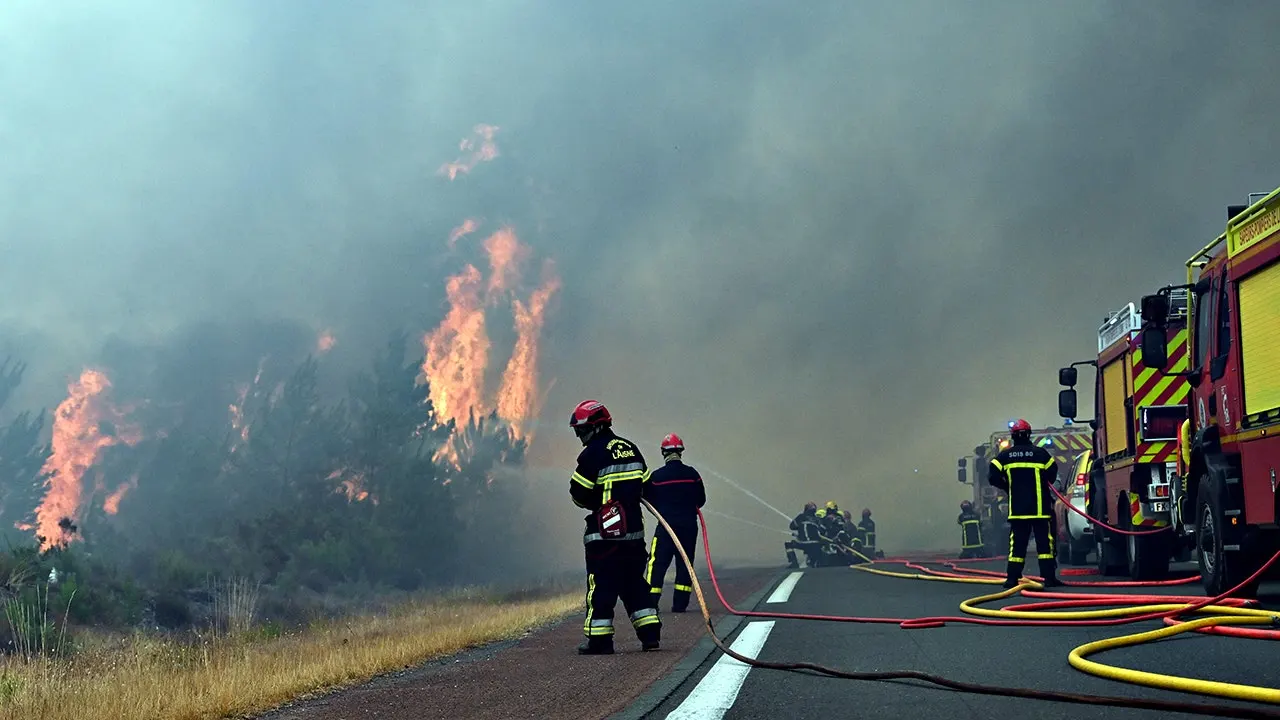
The sun-drenched, rolling hills of southwest France, renowned globally for nurturing some of the world’s most prestigious vineyards, have been transformed into a terrifying, ash-choked battleground as a monstrous wildfire barrels relentlessly toward the historic wine capital of Bordeaux. What began as a localized threat has mutated into a regional catastrophe of historic proportions, forcing more than a quarter-million people to flee their homes in a state of sheer panic and exhaustion. The situation reached a critical flashpoint overnight Sunday when authorities issued frantic, last-minute evacuation orders to an additional 55,000 residents living in vulnerable communities just south of Bordeaux, packing highways with families escaping under an ominous amber sky. This unrelenting inferno is no longer merely reacting to the elements; it has become so massive and fierce that it has begun generating its own localized weather systems, creating erratic, violent winds that mock the efforts of those trying to predict its path. Interior Minister Laurent Nunez painted a grim picture of the overnight struggle, describing a highly unfavorable situation in which the fire demonstrated extreme virulence, burning unpredictably and advancing aggressively toward the densely populated Bordeaux metropolitan area before experiencing a brief, merciful lull as dawn broke.
To comprehend the sheer scale of the devastation in the Gironde region, one must look at the staggering physical footprint of the blaze, which has already consumed at least 42,000 hectares of land—roughly 162 square miles, a scar on the earth equivalent to four times the entire geographic size of Paris. The flames, feeding on parched vegetation and driven by dry winds, have pushed to within just nine miles of Bordeaux’s city center, prompting Mayor Thomas Cazenave to order the partial closure of a major highway into and out of the region to prioritize emergency operations and keep citizens out of harm’s way. Behind these massive numbers are the deeply personal stories of displaced families who packed whatever memories they could fit into the back of their cars, leaving behind generational homesteads, historic châteaux, and livelihoods that have been tied to the soil for centuries. The air across the region is thick with the acrid scent of burning pine and ancient oaks, and a heavy, suffocating silence has settled over once-bustling tourist villages, now resembling ghost towns as the smoke plumes billow high into the atmosphere, visible even from space. For the evacuees huddled in temporary shelters, gymnasiums, and the spare rooms of kind strangers, the unfolding disaster is a heart-wrenching test of endurance, leaving them to watch the horizon in agonizing suspense, wondering if there will be anything left to return to when the winds finally die down.
Faced with an environmental crisis of this magnitude, an extraordinary, international coalition of emergency responders has mobilized on the front lines, desperate to halt the fire’s relentless march toward the metropolitan heart of the region. A small army of more than 2,500 exhausted firefighters has been working on the ground in shifts that stretch long past the point of exhaustion, their heroic efforts supported from above by a fleet of 18 water-bombing planes and helicopters that dive dangerously through the thick smoke to drop retardant on the advancing flames. Recognizing the unprecedented threat, the French government has also deployed 1,500 soldiers to the region, tasking them with the grueling, heavy physical labor of clearing dense undergrowth and building massive firebreaks ahead of the fire’s path to starve it of fuel. This desperate struggle has resonated deeply across borders, prompting several European neighbors to dispatch their own highly specialized firefighting crews and aerial assets to stand shoulder-to-shoulder with their French counterparts in a profound display of continental unity. Amidst the professional responders, a vital force of 450 local volunteers has stepped forward to assist in any way possible, embodied by people like Pascal Roudier, a resilient 65-year-old local farmer who joined the effort without hesitation. “We came to lend a hand because if it were our region, we’d want others to do the same,” Roudier shared, wiping sweat and ash from his forehead as he worked. “And given the scale of the disaster, we think our efforts are very welcome too.”
This apocalyptic scene unfolding around Bordeaux is not an isolated incident, but rather the most visible flashpoint in a broader, multi-front war that France is currently waging against a landscape turned to tinder by successive, brutal summer heatwaves. Just to the south, in the neighboring Landes region, a massive secondary wildfire has spun out of control, forcing another 36,000 people to quickly abandon their homes and search for safety. Meanwhile, along the picturesque Mediterranean coastline of the Var region in southern France, nearly 3,000 residents and vacationers have been evacuated as fast-moving flames encroached upon popular holiday destinations, cutting summer getaways short and replacing relaxation with terror. The environmental crisis is deeply intertwined with a severe public health emergency, as the historic early summer heatwaves that primed the countryside for these fires have already taken a tragic, silent toll on the population. French health officials recently reported a staggering 5,700 excess deaths directly attributed to the extreme, suffocating temperatures of early summer, a sobering statistic that highlights the lethal nature of the shifting climate and underscores the fact that these extreme weather events are putting human lives at risk long before the first spark is even struck.
The environmental crisis is not contained by national borders, as neighboring Spain is currently locked in its own terrifying, parallel struggle against a wave of highly destructive wildfires that are ravaging its dry landscapes. Across the Iberian Peninsula, Spanish emergency management authorities have been forced to evacuate approximately 116,000 people in recent days as multiple out-of-control blazes sweep through the Valencia region and the parched plateaus located just west of Madrid. The escalating danger took a tragic turn when a fast-moving, aggressive fire in a suburb of Valencia claimed the life of a local resident, marking Spain’s first confirmed casualty in this latest cycle of extreme summer blazes. This tragic loss of life comes on the heels of the country’s deadliest wildfire disaster in recent memory, which occurred earlier this month in southern Spain, where a series of ferocious fires claimed the lives of 13 people. These escalating casualties serve as a grim, continental reminder that the changing climate has transformed wildfire season from a seasonal management issue into a deadly, unpredictable threat to human life, uniting communities across France and Spain in a shared sense of vulnerability and communal grief.
As the smoke continues to hang heavily over the historic landscapes of France and Spain, the true story of this disaster is found not just in the charred ruins of forests dynamic or the economic losses suffered by the wine industry, but in the unbreakable spirit of the people who call this region home. The immediate future remains uncertain, with weather forecasts offering little relief in the form of rain, but the overwhelming waves of solidarity, the courage of the volunteers, and the tireless determination of the firefighters offer a beacon of hope in a dark landscape. The legendary vineyards of Bordeaux, which have weathered centuries of wars, political upheavals, and agricultural pests, will eventually see the skies clear, and the resilient communities that tend them will undoubtedly return to rebuild what has been lost. The road to recovery for southwest France will be long, arduous, and emotionally taxing, but the profound human connections forged in the heat of this crisis will serve as the foundation upon which a more resilient future is built. This historic disaster serves as an urgent, undeniable reminder of our delicate relationship with the natural world, while simultaneously highlighting the infinite capacity for empathy, strength, and cooperation that emerges when humanity is tested by the raw, untamed fury of nature.