


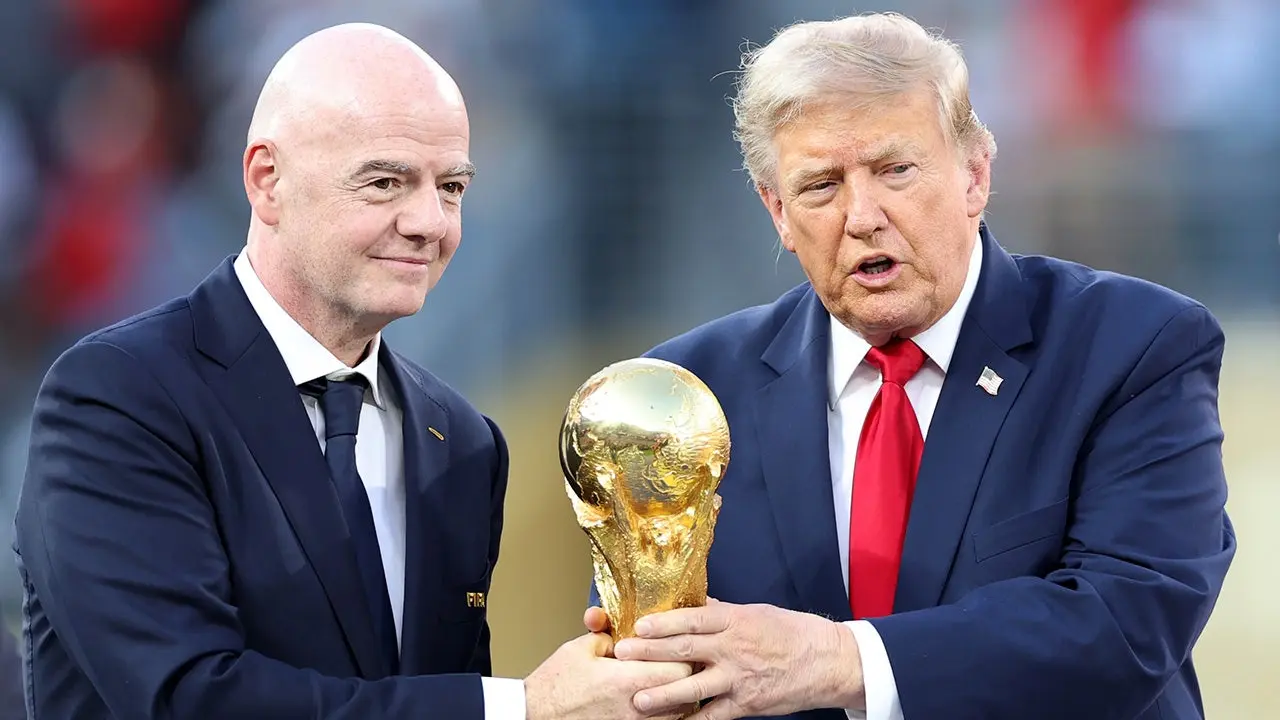
The glittering spectacle of modern sports has long served as a quiet laboratory for high-stakes international relations, but rarely have the boundaries between the playing field and global governance blurred as dramatically as they do now. In the wake of a historic, multi-national FIFA World Cup, rumors have emerged from the corridors of power suggesting that President Donald Trump wishes to transition his close personal friend, FIFA President Gianni Infantino, from the helm of soccer’s governing body to the ultimate stage of world diplomacy: the office of the United Nation’s Secretary-General. This unexpected proposition, first reported by the New York Post, stems from a deeply forged bond between the two leaders, cultivated during the intense, years-long organization of a tournament that spanned three vast North American nations. Sources close to the administration suggest that Trump views the Swiss-born sports executive not merely as an administrator, but as a rare transcendent figure—someone uniquely “respected by everyone around the world” and armed with an intuitive, charismatic ability to harmonize conflicting national interests. This personal chemistry was on full display during the climax of the World Cup at MetLife Stadium, where Trump was observed seated intimately between First Lady Melania Trump and Infantino, even participating in the post-match ceremony to hand Spain’s Rodri the coveted trophy after a tense 1-0 victory over Argentina. To those watching, the presence of the trophy in Trump’s private suite prior to the ceremony was an emblem of a new era of personalist diplomacy, where the theatrical pageantry of global sport is seamlessly weaponized to project political capital and mutual admiration on a grand scale.
To appreciate the gravity of such a proposal, one must look at the formidable, often labyrinthine machinery of the United Nations itself, which is poised to elect its next leader to succeed Portugal’s outgoing Secretary-General, António Guterres, by the end of this year. Stepping into this role on January 1, 2027, requires navigating a grueling diplomatic obstacle course that seems lightyears away from the corporate suites of FIFA. To secure the post, any candidate must first survive the scrutiny of the 15-member UN Security Council, where the five permanent members—the United States, China, Russia, France, and the United Kingdom—each wield a lethal veto power capable of crushing any candidacy in its infancy. Should a candidate survive this gauntlet, they must then receive a stamp of approval from the broader General Assembly. Historically, the position has been reserved for career diplomats and former heads of state, making Trump’s championing of Infantino a deliberate attempt to disrupt established norms. The American president reportedly views the existing field of traditional candidates, which includes prominent figures like Chile’s former socialist president Michelle Bachelet, as lackluster and uninspiring. Others in the mix, such as Argentina’s Rafael Grossi, the current head of the International Atomic Energy Agency, face their own steep geopolitical hurdles, including potential resistance from the United Kingdom due to enduring tensions surrounding the Falkland Islands—tensions that even managed to spill onto the pitches of the recent World Cup. By positioning Infantino as a disruptor to this conventional field of career bureaucrats, Trump seeks to challenge the very definition of what it means to be a global statesman.
The logic behind viewing a sports organization’s executive as a viable candidate for the world’s most prominent diplomatic office is deeply rooted in a modern understanding of organizational complexity, a perspective championed enthusiastically by Trump’s special envoy for global partnerships, Paolo Zampolli. A seasoned Italian-American businessman, diplomat, and former UN ambassador for Dominica, Zampolli argues that the structural skills required to run FIFA are surprisingly synonymous with—and perhaps even superior to—the demands of the United Nations. While the UN represents 193 sovereign member states, Infantino’s FIFA oversees a sweeping empire of over 200 member associations, demanding a hyper-fluid management style that balances diverse cultural expectations, massive financial interests, and intense nationalist passions on a daily basis. Zampolli’s own career illustrates this fascinating convergence of sports and statecraft; he previously worked within FIFA circles, famously pitching an audacious proposal to Infantino to replace Iran with Italy in the World Cup in a bid to mend diplomatic relations between Trump and Italian Prime Minister Giorgia Meloni. This brand of high-concept, back-channel maneuvering underscores a growing belief among certain circles of modern leadership that the rigid, often frozen structures of classical diplomacy are outdated, and that agile, transaction-oriented managers who understand global branding are far better equipped to solve the gridlocks of the twenty-first century than traditional political philosophers.
However, the prospect of an Infantino candidacy is not without its controversies, as critics are quick to point out that both he and Trump share a penchant for direct, highly personalized interventions that often bypass institutional rules and spark widespread public outcry. A prime example of this hands-on, highly transactional style of governance unfolded during the recent World Cup, when Team USA’s star forward and top goal scorer, Folarin Balogun, saw a controversial red card overturned just ahead of a critical Round of 16 match against Belgium. Trump later confirmed that he had personally called Infantino to initiate a review of the red-card decision, a revelation that sent shockwaves through international soccer purists who view any political meddling in refereeing decisions as a violation of the game’s sacred independence. For Infantino’s detractors, this incident was emblematic of a leadership style that favors back-room deals and personal alliances over standard institutional procedures. Yet, for his supporters, it was a demonstration of pragmatic, common-sense problem-solving—an willingness to listen to powerful allies and correct percibed injustices in real-time, regardless of bureaucratic pushback. This tension highlights the fundamental divide between those who believe global organizations should be run by strict, unyielding rules and those who believe they should be managed via personal relationships and executive decisiveness.
This philosophical divide is particularly relevant given Trump’s well-documented skepticism toward the United Nations, an institution he has frequently criticized as an inefficient, bloated talking shop that fails to serve the practical interests of its major financial contributors. Since returning to the White House, Trump has systematically challenged the status quo of international oversight, aggressively slashing U.S. financial contributions to the UN and withdrawing the nation from key bodies such as the World Health Organization (WHO), UNESCO, and the UN Human Rights Council. In this context, championing Infantino for Secretary-General is not an endorsement of the UN’s current trajectory, but rather an attempt to rebuild it from the ground up in the image of a modern, profit-driven corporate entity. By attempting to install an outsider who has spent years perfecting the art of the global spectacle, Trump hopes to steer the UN away from endless ideological debates and toward concrete, high-impact project management. It is a vision of global governance where success is measured not by the signing of non-binding resolutions, but by the successful execution of massive, logistically complex international events that capture the collective imagination of the public, much like a World Cup final.
Ultimately, whether Gianni Infantino will take the leap into the world of formal international diplomacy remains an open question, as the Swiss executive faces a pivotal career crossroads of his own in the coming years. Infantino is currently preparing for his own democratic test in March 2027, when the FIFA Congress will convene to decide whether to grant him a historic fourth term as the president of soccer’s global empire. Should he choose to remain at the helm of FIFA rather than pursue the UN post, his calendar is already brimming with monumental tasks, including the organization of the 2027 Women’s World Cup in Brazil and the highly anticipated, unprecedented 2030 men’s tournament. Designed to honor the centennial anniversary of the World Cup, the 2030 event is set to make history by kicking off in Uruguay, Argentina, and Paraguay before moving the bulk of its matches to Spain, Morocco, and Portugal—marking the first time a tournament will span three continents and six distinct host nations. The sheer audacity of coordinating such a logistical marvel proves that whether Infantino resides in the quiet, historic offices of the UN headquarters in New York or in the roaring, high-pressure stadiums of the sporting world, the line separating international diplomacy from global entertainment has been permanently erased, forever rewriting the playbook of global power.