

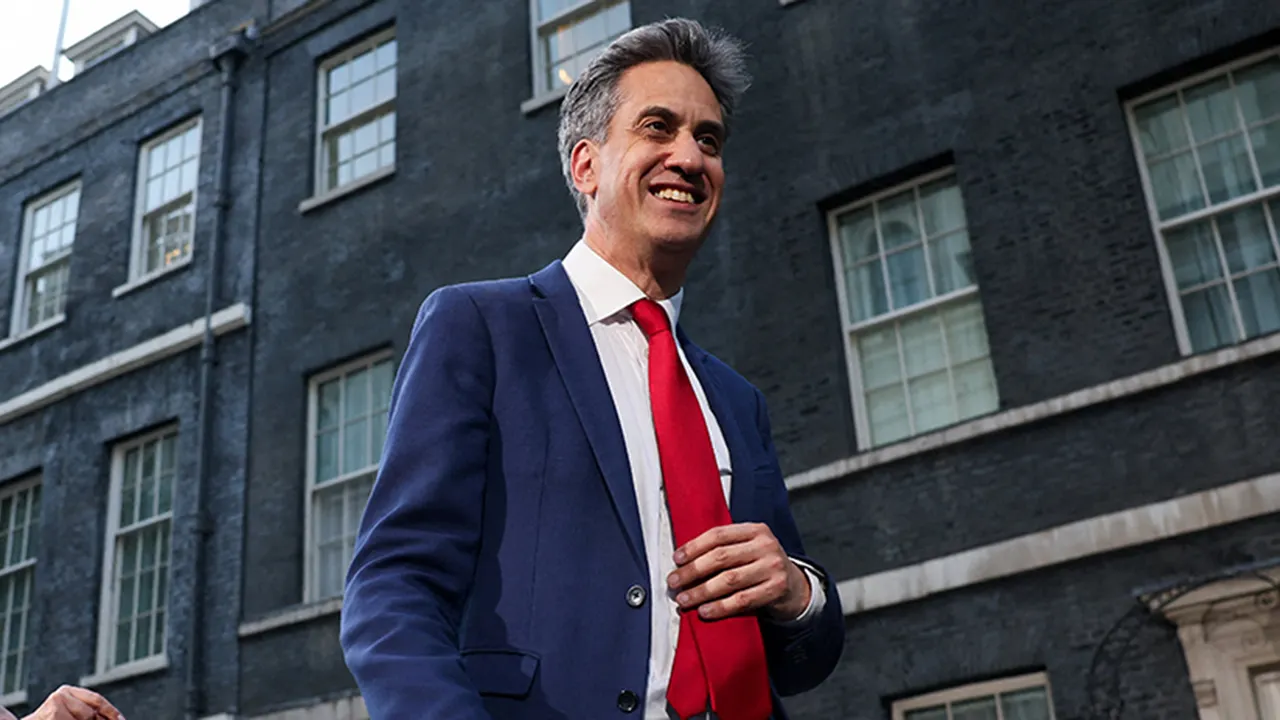
The delicate architecture of the historic “Special Relationship” between the United States and the United Kingdom is facing an unprecedented and highly precarious diplomatic stress test following Prime Minister Andy Burnham’s decision to appoint Ed Miliband as his new Foreign Secretary. This bold, unexpected cabinet reshuffle, which involved replacing the veteran politician Yvette Cooper, marks a stunning political resurrection for Miliband, who previously led the Labour Party into a bruising defeat in the 2015 general election before serving as Britain’s energy security and net zero secretary. By elevating Miliband to the pinnacle of British international relations, Burnham has placed a highly controversial, ideologically sharp figure at the vanguard of the nation’s foreign policy, instantly setting up a potentially explosive dynamic with the incoming U.S. Secretary of State, Marco Rubio. The timing of this decision has raised serious eyebrows in both London and Washington, occurring just as Burnham is actively trying to establish a stable, cooperative working relationship with the incoming second administration of President Donald Trump. Although Burnham initiated a prompt and seemingly cordial introductory telephone call with Trump shortly after assuming office to reaffirm their joint commitment to the transatlantic alliance, the sudden elevation of Miliband has threatened to undermine those fragile diplomatic overtures before they can even get off the ground. Trump’s closest political allies and media strategists have wasted no time in sounding the alarm, warning that placing Miliband in such a sensitive, high-profile role could severely damage the trust and cooperative intelligence-sharing that have historically bound the two English-speaking superpowers together. This friction highlights the eternal struggle of modern governance, where domestic political calculations, internal party rewards, and cabinet balancing acts often collide head-on with the cold, unforgiving realities of global realpolitik, leaving prime ministers to navigate a self-inflicted geopolitical minefield of monumental proportions.
At the absolute heart of the blooming tension lies a deeply personal and rancorous history of public animosity between Ed Miliband and Donald Trump, a feud that transcends the typical, polite boundaries of international statecraft. During Trump’s initial rise to the American presidency, Miliband did not mince his words, publicly condemning the real estate mogul turned politician in exceptionally harsh, derogatory terms by describing him as a “racist, misogynistic, self-confessed groper.” Now that Trump has secured a historic return to the White House, those scathing remarks have predictably resurfaced, casting a long, awkward shadow over Miliband’s debut as Britain’s chief diplomat and igniting a firestorm of media scrutiny. This intense discomfort was laid bare during a tense television exchange on BBC Breakfast, where presenter Jon Kay directly challenged Miliband on how he could possibly hope to construct a functional, respectful working relationship with an American president whom he had previously denounced with such visceral personal contempt. In response, Miliband attempted a pragmatic, albeit visibly uncomfortable, pivot, acknowledging his past inflammatory statements before asserting that his primary responsibility as a government minister is to move past historical grievances and work constructively with foreign counterparts. However, many seasoned political observers and Trump loyalists argue that such rhetorical pivots are far too convenient, questioning whether an administration that highly values personal loyalty and respect can ever truly forgive such deeply personal broadsides. From the halls of Mar-a-Lago to the corridors of Westminster, the pressing human question remains whether the raw, emotional baggage of past insults can be successfully compartmentalized, or if Miliband’s historical outbursts will inevitably fester, poisoning personal chemistry and crippling the essential channels of communication between the White House and Downing Street.
Beyond the explosive arena of personal insults and verbal sparring, there exists a far more profound, structural, and systemic ideological divide over energy policy that threatens to cause long-term damage to the U.S.-U.K. partnership. As Britain’s former energy secretary, Miliband became the highly visible, compromise-averse architect of the Labour government’s aggressive net-zero climate agenda, championing a controversial domestic ban on issuing new licenses for North Sea oil and gas exploration. This fiercely green, interventionist philosophy stands in stark, irreconcilable opposition to the energy independence policies of the Trump administration, which champions fossil fuel expansion, deregulation, and has actively pressured the United Kingdom to boost its domestic oil and gas production to stabilize global markets. Highlighting this fundamental disconnect, Nile Gardiner, a distinguished foreign-policy expert and director of the Heritage Foundation’s Margaret Thatcher Center for Freedom, has publicly labeled Miliband’s high-profile appointment as an unmitigated disaster for Britain’s global standing. Gardiner argues that Burnham’s decision betrays a shocking lack of strategic foresight, describing Miliband’s hyper-progressive climate policies as “completely poisonous” to conservative policymakers in Washington who view the net-zero ideology as an existential threat to economic growth and industrial competitiveness. From this perspective, appointing the chief architect of an economically restrictive environmental agenda to manage relations with a highly transactional, pro-energy American administration is an act of diplomatic self-sabotage. If Gardiner’s warnings prove accurate, this fundamental clash of worldviews will not merely result in polite disagreements behind closed doors; rather, it could actively marginalize Britain’s influence on the world stage, leaving the country economically isolated and strategically vulnerable while its American allies look elsewhere for partners who share their pro-growth, fossil-fuel-centric vision of the future.
Faced with these mounting waves of external skepticism and domestic criticism, Miliband has chosen to anchor his new diplomatic mission in a deeply personal, emotionally resonant narrative that draws upon his own family’s history of survival and resilience. In his very first address as Foreign Secretary, he poignantly reminded the public of his identity as the son of Jewish refugees who fled the horrific atrocities of the Holocaust in Nazi-occupied Europe, finding a precious sanctuary, safety, and hope within the shores of Great Britain. For Miliband, the opportunity to represent the nation that saved his parents from extermination is not merely a political milestone, but the absolute honor of his life, instilling in him a profound obligation to defend democratic principles. He pledged to carry this ancestral spirit of anti-fascism, freedom, and the rule of law directly into his daily work on the global stage, arguing that these fundamental human values are currently facing their most severe threats since the mid-twentieth century. By framing his foreign policy through the lens of moral duty and survival, Miliband is attempting to rise above the grubby, transactional nature of contemporary politics, presenting himself as a principled defender of Western democracy. In terms of strategy, he promised a balanced approach, vowing to simultaneously nurture the “strong, enduring, and essential alliance” with the United States while aggressively seeking to deepen Britain’s strategic integration with the European Union. Whether Miliband can successfully walk this tightrope—balancing a values-based foreign policy rooted in his family’s progressive legacy with the cold, transactional demands of dealing with a highly nationalistic, skeptical American administration—remains one of the most compelling and unpredictable human dramas of modern international affairs.
However, Miliband’s appeals to moral high ground and progressive values have done little to soothe his critics, as his appointment has simultaneously reignited a series of fierce domestic controversies spanning national security, Middle Eastern policy, and sovereignty. Within the British Jewish community and among pro-Israel advocacy circles, his elevation has been met with considerable apprehension, with prominent commentators like Stephen Pollard openly questioning his historical enabling of shifts within the Labour Party that ultimately facilitated the rise of the hard-left. Pollard and other critics worry that under Miliband’s diplomatic stewardship, the Burnham administration will succumb to progressive pressure and enact aggressive punitive measures, such as unilateral sanctions against Israel, thereby breaking ranks with key Western allies. At the same time, the government is facing blistering attacks from the Conservative opposition over its geopolitical decisions, particularly its controversial determination to finalize the Chagos Islands agreement. Prominent Tory MP Priti Patel has vehemently condemned Burnham and Miliband for what she characterizes as an “appalling surrender” of sovereign British territory, a fragile and costly strategic concession that she claims will burden taxpayers with a staggering £35 billion bill while actively undermining national security. By relinquishing control of these strategically vital islands, critics argue that the Labour government is projecting an image of weakness and retreat on the global stage, telegraphing to both allies and adversaries that Britain is no longer willing to defend its global footprint. These overlapping domestic storms demonstrate that Miliband’s challenges are not confined to the diplomatic cables of Washington; he must also fight a grueling, multi-front domestic battle to prove his commitment to British national interests amid accusations of ideological vanity and military naivety.
As the dust begins to settle on this highly controversial appointment, the ultimate fate of the U.S.-U.K. alliance hangs in a delicate, unpredictable balance, suspended between the warm rhetoric of heads of state and the cold friction of administrative reality. While highly influential voices in the conservative movement, such as former White House strategist Steve Bannon, continue to warn that Miliband’s presence in the cabinet is actively “injurious” to the special relationship, there are still tentative glimmers of pragmatism on the horizon. President Trump himself recently confirmed that he had engaged in a “very good” introductory conversation with Prime Minister Burnham, even hinting at a mutually convenient face-to-face meeting in the not-too-distant future to chart a course forward on critical shared interests. This stark duality perfectly captures the deeply human, volatile, and often contradictory nature of modern global diplomacy, which is rarely a clean machine of logic, but rather a chaotic drama driven by personality, pride, institutional memory, and national survival. The overarching question that will define the coming years is whether Burnham’s high-risk gamble of putting a fiercely ideological, climate-focused, and historically outspoken critic in charge of foreign affairs will permanently fracture the historic bond between London and Washington. Alternatively, the demands of global security, economic interdependence, and the shared defense of the democratic world may force both Miliband and his American counterparts to put aside their past rhetorical warfare and find a common, pragmatic language of cooperation. Ultimately, the world is watching to see if these two historic allies can rise above the personal grudges and ideological divides of their leaders, or if the “Special Relationship” is destined to drift into a cold, transactional estrangement.