




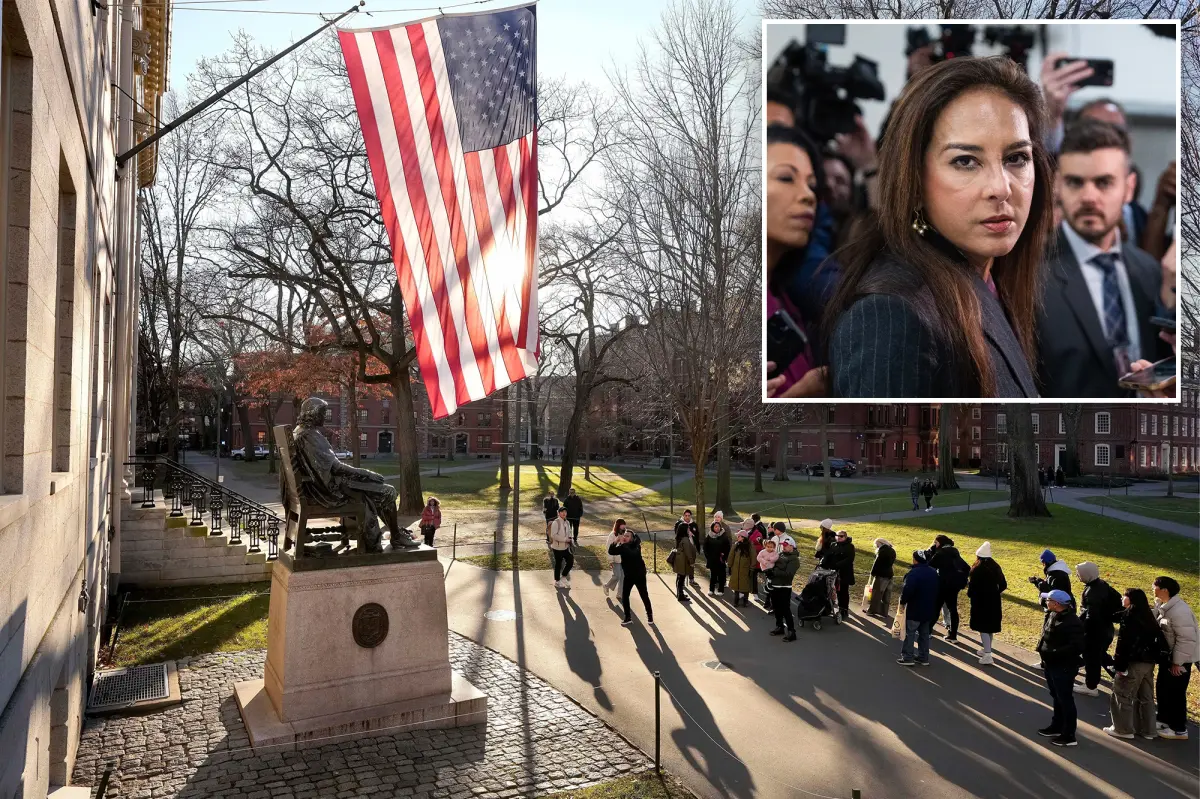
For generations, the ivory-towered gates of Harvard University have symbolized the absolute pinnacle of academic achievement and social mobility, representing a sacred space where the brightest minds from every corner of the globe converge to shape the future of humanity. For the average American family, however, the dream of sending a child to such an illustrious institution is often accompanied by a daunting, deeply personal obstacle: the astronomical and ever-rising cost of higher education. In this high-stakes environment, college financial aid is far more than a bureaucratic line item; it is a vital lifeline that transforms unaffordable dreams into tangible realities for millions of hardworking young people. This delicate ecosystem of hope, merit, and opportunity has recently been thrust into an intense, nationwide debate as the United States Department of Justice initiates a sweeping review into Harvard’s massive foreign donation streams. The federal inquiry is examining a simple yet explosive question: Did Harvard accept millions of dollars in foreign donations that carried restrictive, nationality-based strings, effectively creating exclusive elite scholarship programs that unfairly favored students from China and other foreign nations at the direct expense of American applicants? This probe cuts to the very heart of how we value domestic educational equity versus global intellectual development, forcing a painful examination of the human cost of academic funding. Underneath the complex legal jargon lies a deeply unsettling possibility for domestic teenagers who have spent their entire lives working toward an elite education, leaving them to wonder if the playing field has been tilted against them by international capital and secret geopolitical transactions.
At the core of the federal government’s legal challenge is Title VI of the Civil Rights Act of 1964, a monumental milestone born out of the American Civil Rights Movement that strictly prohibits any institution receiving federal financial assistance from discriminating on the basis of race, color, or national origin. The Justice Department’s Civil Rights Division is exploring whether academic institutions can legally accept millions of dollars in federal research grants and student subsidies while simultaneously honoring highly restrictive requests from overseas donors that explicitly exclude American citizens from specific financial aid pools. Assistant Attorney General for Civil Rights Harmeet Dhillon framed this as a matter of fundamental domestic fairness and constitutional integrity, asserting that every single American student deserves an equal opportunity to compete for scholarships, grants, and institutional financial aid without being sidelined by nationality-based barriers. The government alleges that when foreign donors dictate exactly which nationalities can access their private trust funds, and when universities accommodate these demands within their broader institutional budgets, they create an illegal, bifurcated system of opportunity. For an ambitious middle-class American student aiming for Ivy League admission, the realization that certain generous financial assistance programs are closed to them simply because of their passport is a deeply discouraging prospect. By initiating this review, federal officials seek to dismantle what they view as a systemic, backdoor exclusion of domestic applicants, asserting that no amount of private foreign philanthropy can justify overriding the foundational civil rights protections that govern American public and private education.
In response to these serious allegations, Harvard University has stepped forward to robustly defend its institutional integrity, its compliance with federal reporting laws, and its historic commitment to diverse financial aid structures. University administrators argue that Harvard’s financial ecosystem is meticulously designed to support a vibrant, international student body without shortchanging domestic applicants, emphasizing that the institution adheres strictly to both the letter and the spirit of Title VI. From the university’s perspective, providing targeted, privately funded scholarships to international students is not a form of discrimination against Americans, but rather a vital mechanism for fostering global perspectives and cross-cultural dialogue on campus. For many brilliant, low-income students from developing countries, these specialized scholarships are the only possible pathway to an education that would otherwise remain completely out of reach, as federal grants and other government assistance programs are legally restricted to United States citizens. Harvard points out that domestic students already have access to a robust array of federal aids that are entirely unavailable to their international peers. To bridge this gap, private philanthropy has historically stepped in to fund scholars from specific regions—such as the high-profile $15 million gift in 2014 from SOHO China co-founders Pan Shiyi and Zhang Xin, designed specifically to help underprivileged Chinese students access a Harvard education. To dismantle these targeted funds, Harvard argues, would not help American students; instead, it would strip life-changing opportunities away from deserving young people from overseas, impoverishing the cultural and academic diversity of the entire campus community.
To understand the sheer magnitude of this controversy, one must examine the astonishing financial landscape of modern elite higher education, where Harvard stands as an unparalleled global juggernaut of wealth and influence. A Civil Rights Division audit of federal disclosures revealed that Harvard reported a staggering $4.5 billion in foreign funding—the highest of any American university—including more than $630 million originating from China alone. In an era where prestigious universities operate less like simple schools and more like multi-billion-dollar global enterprises, the flow of international capital has become essential to funding cutting-edge laboratories, hiring world-renowned faculty, and maintaining sprawling campus infrastructures. However, this massive influx of foreign wealth has also triggered deep anxieties about national sovereignty, intellectual property theft, and the creeping influence of foreign governments over American academic thought. For critics, the idea that foreign billionaires can effectively purchase preferential treatment or carve out exclusive educational pathways for their own citizens within landmark American institutions feels like a failure of the national compact. Ordinary families watching from the sidelines are left to wonder if the traditional values of merit, hard work, and equal opportunity are being bought out by overseas interests who view American universities as status symbols to be acquired and influenced. The sheer volume of Chinese funding in particular has put a direct spotlight on the geopolitical tensions that now permeate higher education, transforming what should be a debate about student aid into a complex ideological battle over academic independence and global soft-power dynamics.
This latest federal inquiry does not exist in a vacuum; rather, it represents a dramatic and highly coordinated new chapter in a long-standing, multi-front conflict between federal regulators and the nation’s most prestigious university. For years, Harvard has found itself in the crosshairs of intense political and cultural scrutiny, ranging from high-profile Supreme Court battles over affirmative action and holistic admissions practices to more recent, highly charged investigations into campus antisemitism, administrative governance, and the university’s handling of free speech. The Trump administration, in particular, has consistently challenged Ivy League institutions, accusing them of harboring partisan biases, turning a blind eye to foreign influence, and failing to protect the interests of hard-working American citizens. Prior political battles have even seen the administration attempt to claw back or withhold billions of dollars in federal research funding, a move that was subsequently blocked by federal judges who sought to insulate academic research from shifting political winds. By launching this latest civil rights investigation into foreign funding, federal officials are signaling that they view the university’s financial practices not merely as administrative matters, but as a critical battleground for defining national identity and preserving fairness for domestic students. For the administrators, faculty, and students caught in the middle, this relentless scrutiny has created an atmosphere of defensiveness, where every institutional policy is parsed for political vulnerability and every major donation is analyzed through the lens of national security and regulatory compliance.
Ultimately, this complex dispute exposes a profound, unresolved tension at the heart of modern higher education: the delicate balance between local responsibility and global ambition. As the Justice Department continues its meticulous review without yet reaching any definitive conclusions, the ultimate fate of these foreign gift programs remains hanging in the balance, leaving thousands of prospective students in a state of anxious limbo. This case forces us to grapple with what it truly means to be a global university in an increasingly nationalistic world, prompting us to ask whether an American institution, heavily supported by US taxpayers, can truly serve as an impartial global academy, or if its primary, unwavering loyalty must always lie with the domestic citizens whose taxes and communities sustain it. The human stories at the center of this controversy—from the anxious American high school senior hoping for a fair shot at a scholarship, to the brilliant international student escaping systemic poverty through a targeted private gift—remind us that behind the billion-dollar spreadsheets and dense legal briefs lie the real-life destinies of young people. As the legal battle unfolds, the resolution of this investigation will not only redefine the financial rules for elite universities across the United States but will also send a clear, lasting message about who gets to sit at the table of opportunity in the decades to come, permanently shaping the future of global academic exchange and the preservation of domestic civil rights.