



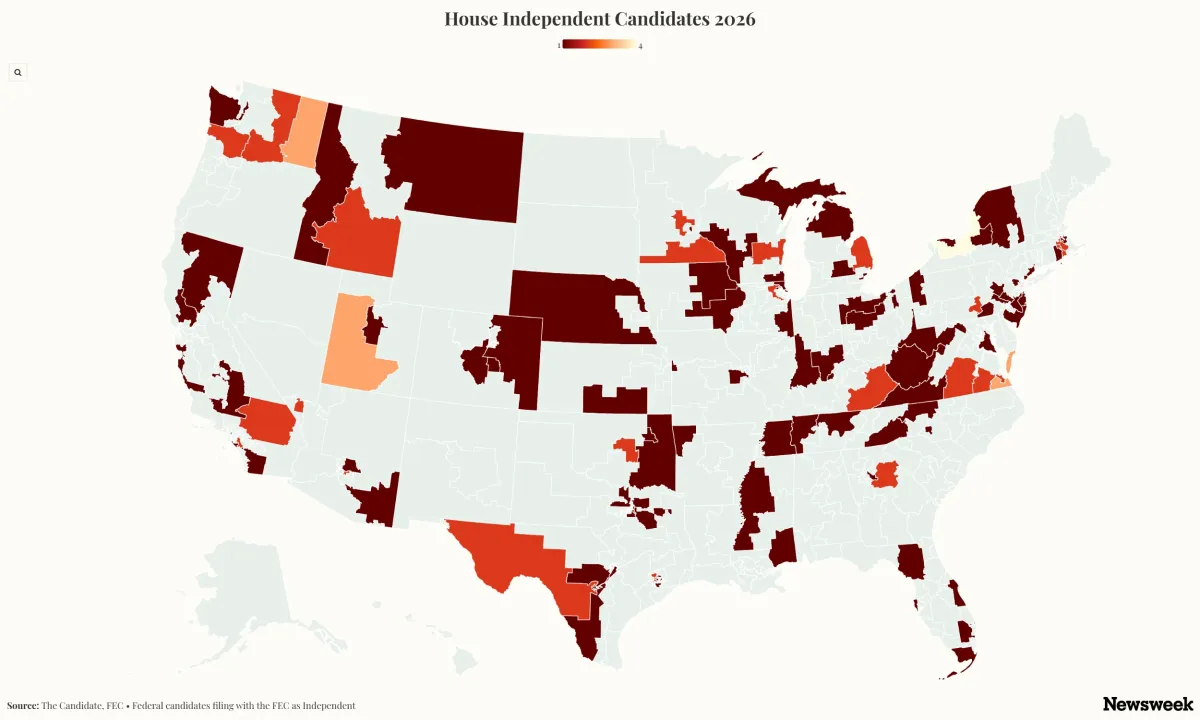
As the United States marches toward the highly anticipated 2026 midterm elections, a quiet rebellion is brewing on the campaign trail. Tired of the relentless polarization and gridlock of the traditional two-party system, a rapidly growing number of candidates are choosing to run for federal office without the backing of either the Democratic or Republican parties. A recent analysis reveals that at least 217 independent candidates have already stepped into the arena across both chambers of Congress, spanning 129 House districts and 24 Senate races. This surge of independent hopefuls is concentrated heavily in populous and politically influential states like Texas, New York, California, Illinois, Washington, and Virginia, signaling a widespread desire for change that transcends geographical and political boundaries.
This wave of independent campaigns is fueled by a profound, systemic shift in how Americans view national politics. For decades, the two-party system has held an iron grip on the country’s governance, but voter frustration with both major parties has reached a breaking point. While Republicans struggle with the polarizing influence of Donald Trump and Democrats battle a weak national brand, everyday Americans are feeling politically homeless. Experts note that more citizens now identify as politically independent than at almost any other point in modern history. These voters are no longer looking for candidates who blindly toe a party line to appease a partisan base; instead, they are searching for pragmatic leaders capable of building broad, common-sense coalitions to solve real-world problems.
What makes the 2026 cycle particularly unique is that this anti-party sentiment is no longer confined to traditionally moderate regions or isolated protest movements. Independent candidates are emerging in deep-red conservative strongholds, solid-blue Democratic bastions, and crucial swing states alike. In places like Colorado, unaffiliated voters now actually outnumber registered Democrats and Republicans combined. This grassroots energy has also fueled a broader push for systemic electoral reform. Advocacy groups and candidates are increasingly advocating for open primaries and ranked-choice voting—structural changes designed to level the playing field and dismantle the institutional barriers that have historically kept third-party and independent voices shut out of the democratic process.
The high-stakes battlegrounds of the U.S. Senate highlight just how viable these non-partisan bids have become. In Montana, political outsider and former university president Seth Bodnar is running an independent Senate campaign driven by the belief that national leaders are actively fueling the fires of division rather than working to extinguish them. Meanwhile, in Nebraska, independent Dan Osborn has become a national symbol for this movement following his remarkably competitive 2024 Senate run. Osborn openly criticizes Congress as a dysfunctional body beholden to corporate lobbyists and special interests, promising instead to take his directives straight from the working-class people of his state. These candidates represent a growing cohort of leaders attempting to bypass the traditional party primaries entirely.
While the energy behind these campaigns is palpable, independent candidates still face a grueling uphill climb. Unlike major-party candidates, who enjoy built-in donor networks, sophisticated voter databases, and automatic ballot access, independents must build their operations entirely from scratch. Navigating state-by-state ballot requirements is a monumental task, requiring candidates to gather anywhere from 1,000 signatures in Tennessee to upwards of 90,000 in California just to get their names printed on the ballot. Furthermore, they must constantly combat the “spoiler” narrative, reassure skeptical voters that their votes will not be wasted, and resist aggressive attempts by major parties to pigeonhole them as secret allies of the opposing side.
Ultimately, the 2026 midterms will serve as a crucial litmus test for the future of American democracy. If trailblazing candidates like Bodnar and Osborn can translate widespread public dissatisfaction into actual legislative seats, they may pave the way for a new era of competitive multi-party politics in America. However, if the political machines of the Democrats and Republicans successfully shut them out, it may reinforce the narrative that the two-party system is simply too entrenched to break. Regardless of the final vote tallies, the sheer volume of independent candidates running from coast to coast sends an unmistakable message: nearly half of the American electorate is ready to move past the binary choices of the past and chart a different path forward.