



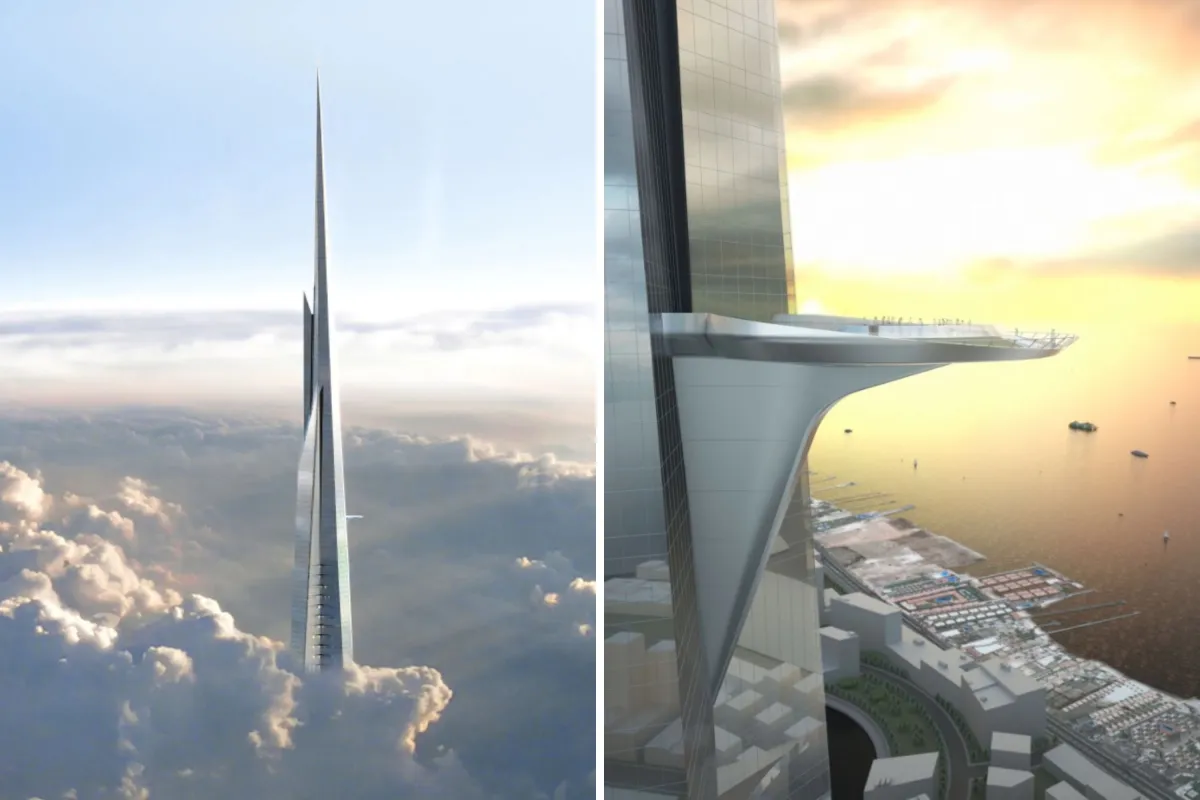
Since the dawn of civilization, humanity has harbored an almost spiritual obsession with reaching the heavens, a restless drive that has propelled us from the clay-brick Ziggurats of Mesopotamia to the soaring steel spires of the modern metropolis. Today, this ancient ambition finds its ultimate contemporary manifestation in the sands of Saudi Arabia with the rise of the Jeddah Tower, a breathtaking monument of engineering designed by the visionary architectural duo Adrian Smith and Gordon Gill. Spearheaded structurally by managing principal John Peronto of Thornton Tomasetti, this colossal structure is poised to break the symbolic kilometer-high barrier, comfortably exceeding 1,000 meters (or roughly 3,281 feet) to claim the crown of the world’s tallest building. In doing so, it will cast a long literal and metaphorical shadow over Dubai’s iconic Burj Khalifa, which currently holds the record at an otherwise staggering 2,717 feet. Yet, as majestic as the Jeddah Tower promises to be, those operating behind the scenes whisper of a future where even this unfathomable giant will seem modest by comparison. The human desire to scale the sky is not merely a consequence of technological progress; it is deeply embedded in our collective DNA, serving as a physical measurement of our species’ refusal to accept natural boundaries. As we stand on the precipice of this new paradigm, we are forced to redefine not only the landscapes of our cities but the very boundaries of what we consider physically possible on Earth.
While the public watches the Jeddah Tower slowly pierce the clouds, structural engineers are already mapping out the next great leaps in vertical architecture behind closed doors. John Peronto recently made the startling revelation that designs for buildings double or even triple the scale of the Jeddah Tower are not just theoretical fantasies, but concepts already undergoing rigorous exploration in quiet design phases; some of these multi-kilometer layout plans are surprisingly well-mapped, though they remain fiercely guarded secrets hidden from the public eye. Imagine a freestanding structure rising two or three kilometers into the sky—a vertical city stretching up to nearly ten thousand feet, carving through multiple layers of the atmosphere where wind currents behave like ocean tides and the temperature at the penthouse is radically different from the ground below. Building at this scale is an entirely different discipline than traditional skyscraper construction, requiring engineers to design structures that act more like living mountain ranges than static office blocks. These hypothetical super-spires must possess the aerodynamic sophistication to dissipate the immense kinetic energy of high-altitude winds while distributing colossal dead loads over footprints that could span entire city neighborhoods. The fact that such monumental structures are already being quietly calculated proves that our current golden age of skyscraper construction is merely a prelude to a far more radical architectural revolution.
The primary catalyst for this impending leap into the stratosphere lies not in our mathematical formulas, which have long been capable of conceptualizing these heights, but in the rapid, quiet revolution taking place within material science. Historically, the heights of our physical structures were strictly governed by the brute-force limitations of traditional steel and concrete, but Peronto emphasizes that as advanced concrete chemistry and composite materials evolve, they will fundamentally change everything we know about construction. We are moving toward an era of ultra-high-performance, fiber-reinforced concretes infused with nanotechnologies, smart self-healing compounds, and carbon fiber matrices that boast unprecedented tensile strength while remaining incredibly lightweight. However, as the structural math becomes more solvable, the industry’s real battleground shifts from the drawing board to the logistical chaos of the construction site. The physical act of building a multi-kilometer structure presents mind-boggling practical challenges: pumping wet concrete thousands of vertical feet into the air before it cures, coordinating fleets of cranes operating at heights where weather patterns are unpredictable and hostile, and managing the transport of thousands of laborers daily. Overcoming these hurdles requires a deep, symphonic collaboration between visionary structural engineers, master contractors, supply chain logisticians, and specialized construction teams, all working in unison to translate highly optimized mathematical models into a buildable, tangible reality.
Yet, this relentless race toward the stars does not exist in an ecological vacuum, and the architectural community is increasingly grappling with a profound ethical tension between monumental ambition and environmental responsibility. Even as the Jeddah Tower pushes the limits of human ingenuity, critical voices are questioning the massive carbon footprints and resource consumption associated with these modern marvels, pointing out that our planet is already buckling under the weight of climate change. Architect Gordon Gill has pointedly argued that the defining architectural challenge of the twenty-first century may not be the creation of ever-taller monuments, but rather the sustainable curation and preservation of our existing urban environments. Statistics from the American Institute of Architects paint a sobering picture of our current reality: nearly half of the 125 million structures in the United States alone are at least fifty years old, representing a massive inventory of aging, energy-inefficient buildings. Gill suggests that true architectural heroism in the coming decades will be found in the complex, unglamorous work of retrofitting, adaptive reuse, and circular engineering—breathing new, sustainable life into the structures we already have rather than abandoning them in pursuit of shiny new monoliths. This perspective forces us to balance our innate urge for vertical pioneerism with a grounded stewardship of the Earth, challenging us to prove that our tallest structures can also be our greenest.
This tension raises a fundamental, philosophical question that future generations will undoubtedly ask with increasing urgency: why must we keep going higher, and what is the ultimate human purpose of these vertical spires? For some, the skyscraper is a practical solution to the realities of rapid global urbanization, offering a densifying world a way to live, work, and play within compact spatial footprints, thereby preserving precious rural landscapes and minimizing destructive urban sprawl. In this view, the future belongs to the “vertical city”—integrated ecosystems where residential spaces, vertical agriculture, commercial districts, schools, and parks are stacked cohesively, reducing physical commutes to a series of elevator rides and fostering localized, highly efficient communities. For others, however, the climb is less about pragmatic urban planning and more about a psychological, almost primitive urge to conquer the impossible purely because the challenge exists. John Peronto acknowledges this duality, noting that while we must constantly ask what makes practical sense to build, humanity’s historical track record is defined by our insistence on tackling the extraordinarily difficult simply to prove we can. The skyscraper, in its purest cultural form, is an act of collective defiance against gravity, localized vanity transformed into a permanent testament to our species’ capability to reshape the physical world in our own image.
Ultimately, this boundless desire to build upward will inevitably break free from the gravity of our home planet altogether, steering the future of structural engineering toward the ultimate frontier: outer space. As we look fifty years into the future, Peronto suggests that our conversations about mega-structures will shift away from the tallest towers in our earthly cities and focus instead on the monumental infrastructure we are preparing to erect on the surface of the moon and Mars. Fueled by a growing global interest in space exploration and commercial lunar development, engineers are already contemplating the structural physics of low-gravity environments, where the lower gravitational pull allows for radically different architectural forms and unprecedented spatial spans. From lunar data centers housing the collective knowledge of humanity to sprawling habitats designed to shield pioneering astronauts from cosmic radiation, the lessons learned from our terrestrial supertall towers are paving the way for galactic architecture. These extraterrestrial projects will serve as vital staging grounds, the actual launching pads and logistical infrastructure required for our eventual leap to Mars and beyond. Whether anchoring our dreams in the desert sands of Saudi Arabia or in the powdery, alien regolith of the moon, our architecture remains the truest mirror of our evolutionary trajectory—a physical declaration that as long as there is space above us, humanity will never stop building upward.