


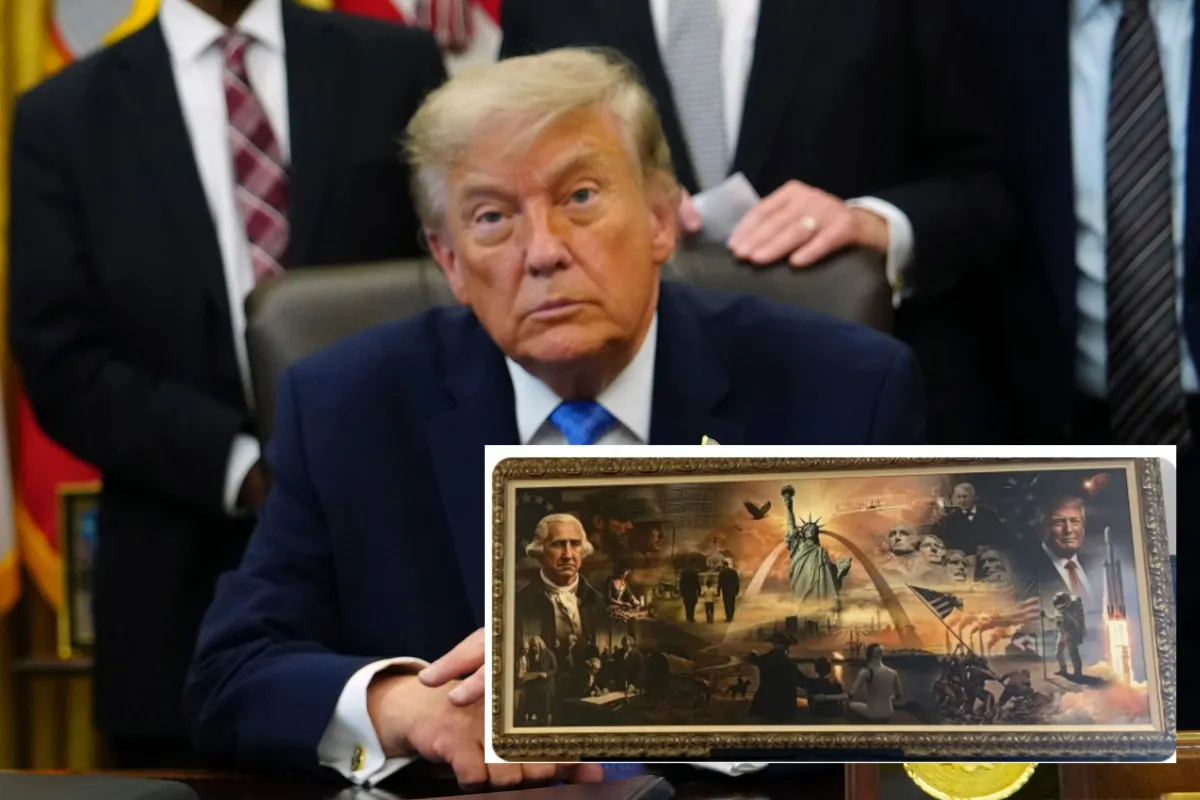
In an era where political discourse is increasingly shaped not by traditional speeches or policy papers, but by the swift and unpredictable current of viral digital imagery, a single social media post can ignite a national conversation about identity, history, and the future. On a quiet Sunday evening, the digital landscape lit up when Donald Trump shared a highly unusual and visually striking image on his platform, Truth Social. The artwork, an eclectic and surreal digital montage, showcases Trump standing confidently side-by-side with the nation’s first president, George Washington, while a highly advanced, sleek silver humanoid robot stands quietly nearby. This unexpected trio is positioned against a sweeping panoramic backdrop that celebrates some of the most sacred landmarks and monumental achievements in the history of the United States. Viewers are treated to a visual feast that includes the majestic granite faces of Mount Rushmore, the welcoming torch of the Statue of Liberty, the dramatic, dust-kicking moment of the Apollo 11 moon landing, and a digital rendering of Joe Rosenthal’s Pulitzer Prize-winning photograph of United States Marines raising the American flag during the fierce, bloody, and heroic Battle of Iwo Jima. Trump’s reaction to this sweeping visual narrative was direct and characteristically enthusiastic, captioning the post with the brief but emphatic praise: “Great painting!!” Within minutes, the post became a focal point of intense discussion across the internet, serving as a striking metaphor for how contemporary political communication bridges the gap between historical reverence and avant-garde, almost sci-fi imagination. The image did not just capture a moment in time; it served as a loud, visual declaration of a political philosophy that seeks to unify the triumphs of the past with a bold, high-tech vision of the future, all while keeping the persona of the president firmly at the center of the frame. By blending these disparate historical epochs, the image challenges the viewer to contemplate what it means to be American in an age where the boundaries between reality, digital art, and political mythmaking are becoming increasingly blurred.
To truly understand the human resonance of this surreal digital canvas, one must look closely at the complex layers of iconography woven into its digital threads and how they speak to the collective psyche of a nation. By positioning himself directly alongside George Washington, the legendary general and father of the country, Trump taps into a deep-seated human desire for continuity, strength, and historical legacy, projecting an image of leadership that claims direct heritage from the very founding of the republic. The inclusion of the robot, an element that has left many cultural commentators and casual observers both fascinated and bewildered, is perhaps the most telling symbol of all, serving as an overt nod to the rapid rise of artificial intelligence, automation, and the digital frontier. This robot represents a future where American ingenuity and technological supremacy remain unmatched, asserting that the country’s next 250 years will be defined by scientific triumph just as its past was defined by physical exploration and industrial might. Surrounding this central trio are the historical landmarks that evoke deep, emotional responses from citizens of all walks of life: the Statue of Liberty symbolizes the welcoming promise of freedom, Mount Rushmore represents democratic stability, the moon landing is a testament to boundless human curiosity, and the Iwo Jima scene honors the immense, selfless sacrifice of the American soldier. For many everyday Americans, seeing these legendary moments grouped together in a single, vibrant image triggers a profound sense of nostalgia and patriotic pride, reminding them of the monumental hurdles their country has overcome. Yet, for others, the juxtaposition of these solemn, historic achievements with a contemporary political figure and a futuristic machine feels jarring, sparking active debates at dinner tables and on social media platforms about how sacred national memories should be preserved, honored, and presented to the public in the digital age.
This dramatic visual statement on social media is far from an isolated event or a passing whim; rather, it is a highly calculated manifestation of a branding strategy that has defined Donald Trump’s entire public life and has now become a hallmark of his second presidential term. For decades, long before he ever considered running for the highest office in the land, Trump’s primary currency was his personal brand, a carefully curated image of wealth, power, and ultimate success. This brand was physically stamped onto towering skyscrapers, luxury resorts, commercial airlines, and consumer products in bold, eye-catching gold letters, establishing a precedent of self-promotional marketing. As president, this lifelong impulse to merge his personal likeness with the institutions he represents has found a powerful new outlet in the machinery of statecraft, transforming the traditional, often modest aesthetics of the presidency into a highly personalized vehicle for national branding. This trend was dramatically illustrated just days before the Truth Social post, when the president-elect’s administration unveiled a brand-new, limited-edition United States passport design featuring his own photograph, an unprecedented administrative initiative designed to commemorate the nation’s upcoming 250th anniversary of independence. Traditionally, the U.S. passport has been preserved as a neutral, non-partisan document, decorated with classic historical quotes, national seals, and landscapes to represent the collective identity of the American people rather than any single political leader. By introducing his own likeness onto a document carried by millions of citizens traveling across the globe, Trump has fundamentally challenged long-standing democratic protocols, signaling a paradigm shift wherein the identity of the nation and the personal brand of its leader are presented as inextricably linked, creating a new standard for presidential self-commemoration that has no modern parallel in American political history.
The introduction of these highly personalized state symbols and dramatic visual narratives has naturally sent ripples through the daily lives of the American public, evoking a wide and passionate spectrum of human emotion that highlights the profound polarization of modern society. For his millions of ardent supporters, these bold aesthetic choices are met with genuine enthusiasm, seen as a refreshing and powerful reclamation of national confidence, patriotism, and unyielding strength in the face of global uncertainty. To these individuals, seeing their president stand proudly next to George Washington, or finding his image inside a newly designed passport, is a comforting symbol of a leader who is deeply invested in the country’s greatness and is not afraid to break stale, bureaucratic conventions to assert American pride on the world stage. They view these actions as a heroic celebration of a shared national destiny, a visual promise that the government is actively working to make the country proud, strong, and technologically dominant in a fast-moving century. Conversely, for a substantial portion of the population, these developments are a source of deep, unsettling concern, prompting worrying discussions about the erosion of democratic norms and the rise of a personalized style of governance that values individual loyalty over institutional permanence. To these critics, the integration of a sitting president’s face into official, administrative documents and his self-insertion into sacred historical tableaus feels like an unnecessary departure from the egalitarian principles of the founders, who intentionally sought to distance the new American republic from the monarchical, self-glorifying traditions of the European old world. This deep cultural divide reveals that a simple painting or a passport design is never just about aesthetics; it is a mirror reflecting a complex, ongoing national debate about the true nature of power, leadership, and belonging in a democratic society.
At the heart of this intense aesthetic and political debate is the looming, historic milestone of the United States Semiquincentennial in 2026, a momentous occasion marking 250 years since the signing of the Declaration of Independence. Such a significant mathematical and historical anniversary naturally inspires a profound period of national introspection, prompting communities, historians, and policymakers across the nation to ask fundamental questions about what the American experiment has achieved, what it has cost, and where it is heading. A national birthday of this magnitude is historically a time for collective storytelling, but it also inevitably becomes a battleground over who has the authority to define and shape that story for future generations. The Trump administration’s visual campaign, characterized by grand digital paintings featuring robots and personalized commemorative items, presents a highly specific, triumphant version of the American saga—one that celebrates monumental engineered achievements, military dominance, technological manifest destiny, and a lineage of strong, singular leaders who have guided the country through its darkest hours. This patriotic, high-altitude view of history consciously focuses on the peaks of national success, organizing the American narrative into a series of heroic milestones that inspire awe and unity. However, this perspective exists in constant tension with more traditional, community-focused narratives of the anniversary, which seek to emphasize the slow, often painful progress of civil rights, the diverse contributions of ordinary citizens, and the ongoing, collective struggle to live up to the promise that all people are created equal. As the country prepares for the massive celebrations of 2026, these competing artistic and historical visions highlight a healthy, if chaotic, democratic dialogue about whether a nation’s true greatness lies in the singular power of its leaders and monumental triumphs, or in the quiet, persistent moral progress of its diverse populace.
Ultimately, the viral image of Donald Trump, George Washington, and a futuristic robot standing amidst the grandest symbols of American history serves as a perfect, fascinating artifact of our contemporary cultural moment, encapsulating a society that stands at the intersection of deep historical memory and uncharted technological horizons. Throughout the long course of human history, political leaders from ancient Roman emperors stamping their profiles onto gold coins to the revolutionary painters of the eighteenth century capturing battles on canvas have understood that art is a powerful, indispensable tool for building legitimacy, shaping public perception, and forging a shared national identity. Today’s digital age has not changed this fundamental human reality, but it has accelerated it, giving leaders the power to instantly broadcast complex, emotionally charged, and highly stylized visual myths to millions of citizens with a single tap on a smartphone screen. As the United States marches steadily toward its historic 250th anniversary, the intense, passionate debates sparked by these unconventional images demonstrate that the American spirit remains as vital, restless, and deeply engaged as ever. Whether one views this modern, tech-infused iconography as an inspiring, forward-looking vision of a bold new American century or as a concerning departure from standard presidential humility, it is undeniable that these symbols have successfully captured the public imagination, forcing us all to reflect on our past and contemplate our future. In the end, as the nation prepares to cross the threshold into its next quarter-millennium, these conversations remind us that the American experiment is not a static monument frozen in time, but a living, breathing, and ever-evolving mosaic that continues to rewrite its own story with every passing generation.