


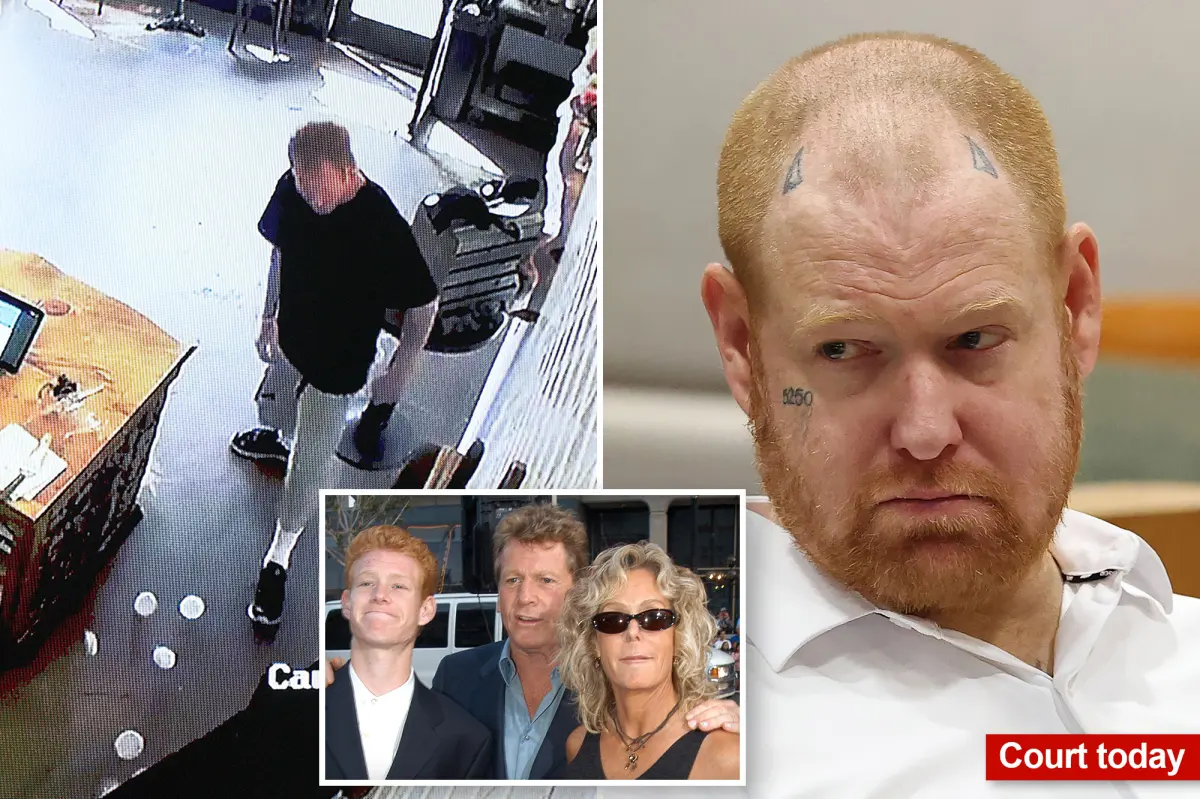
On an afternoon in May 2018, the laid-back, bohemian atmosphere of a Venice, Los Angeles coffee shop was shattered by a chilling confrontation that would later be recounted in agonizing detail within the sterile walls of a courtroom. Redmond O’Neal, the deeply troubled scion of Hollywood royalty, walked into the establishment carrying both his famous family name and a highly unpredictable rage about to boil over into public tragedy. He approached the counter and requested a free sample of coffee, a seemingly mundane request that quickly took a dark turn under the weight of his volatile state. When the barista on duty, Samantha Cline, gently and professionally informed him that the shop did not offer free samples, O’Neal’s demeanor shifted instantaneously, freezing the warm air in the room and replacing it with an atmosphere of immediate danger. He locked his eyes onto hers with a piercing, predatory intensity, his gaze carrying an unspoken but palpable threat that made the young worker’s heart race. “Stop staring at me,” he commanded in a low, hostile tone, his voice laced with a volatile mixture of severe paranoia and bubbling aggression. As Cline and her terrified co-worker watched in rising panic, O’Neal’s focus shifted briefly to the tip jar on the counter, implying a desperate, criminal intent to rob the store before they could even react. Without warning, he reached into his pocket, pulled out a knife, and began to advance directly toward the counter where the two defenseless employees stood trapped. The terrifying specter of immediate physical violence hung heavily in the air as he stalked closer, the sharp blade glinting under the store’s lights. Just as the encounter seemed destined for a bloody conclusion, O’Neal abruptly pivoted, turning away to stalk out of the shop. On his way to the exit, he aggressively knocked down store merchandise and displays, leaving a trail of physical chaos behind him that mirrored the internal tempest raging in his mind. For the employees, those fleeting moments felt like an agonizing eternity, marking the terrifying climax of a man completely lost to his own inner demons.
This coffee shop incident capped a violent, three-day rampage across Los Angeles that had held various neighborhoods of the city in a tight grip of fear. Over the course of those seventy-two hours, Redmond O’Neal embarked on a sporadic and seemingly random spree of violence, traversing the sprawling Southern California metropolis and leaving a trail of traumatized and physically battered victims in his wake. Innocent bystanders who simply happened to cross paths with him during this dark period were subjected to sudden, unprovoked physical assaults and stabbings, transforming everyday walks and activities into life-threatening encounters. The sheer randomness of the attacks amplified the terror for the community, as there was no discernible pattern, motive, or pre-existing connection between O’Neal and the innocent people he targeted. Following his arrest, he faced a mountain of severe legal charges, including attempted murder, assault with a deadly weapon, committing battery, and making terrorizing criminal threats. Each charge painted a grim, heartbreaking picture of a man who had completely lost touch with reality, acting out of a deep, inexplicable well of hostility that could no longer be contained or ignored by society. The legal path ahead was guaranteed to be complex, as the justice system was forced to grapple not only with the violent actions he committed against unsuspecting citizens but also with the profound psychological collapse that prompted them. For the victims, the physical wounds would eventually heal, but the psychological trauma of being randomly targeted by an armed, unstable assailant in broad daylight remained a persistent reminder of how fragile public safety can be when a severe mental health crisis goes unaddressed on the streets of a major American city. The court proceedings would serve as a public autopsy of these three days of terror, reconstructing the moments where O’Neal roamed the city as a ticking time bomb, illustrating the tragic reality of a community forced to bear the brunt of an individual’s unchecked psychological deterioration.
To understand the tragic trajectory of Redmond O’Neal, one must look beyond the frightening headlines to his life as the only son of late Hollywood legends Ryan O’Neal and Farrah Fawcett. Born into the apex of 1980s celebrity culture, his life was lived under the microscope of public scrutiny, a gilded cage where immense privilege and the glitz of the spotlight often masked profound systemic trauma and emotional neglect. His mother, the iconic “Charlie’s Angels” star Farrah Fawcett, and his father, the charismatic “Love Story” actor Ryan O’Neal, possessed a volatile relationship that dominated tabloids for decades, creating an unstable environment for a growing child. Growing up in this high-intensity environment, Redmond was exposed to the excesses of fame, parental instability, and the relentless attention of paparazzi from his earliest years, preventing him from ever establishing a normal sense of self. While wealth and beauty surrounded him, they offered no protection against the deeper vulnerabilities of the human condition; instead, the pressure of living up to his parents’ legendary statures, combined with the chaotic dynamics of his home life, created a fertile breeding ground for personal struggles. From a very young age, Redmond battled severe substance abuse issues, finding himself caught in a devastating cycle of addiction, rehab stints, arrests, and prison sentences that his parents desperately tried, yet ultimately failed, to resolve. This constant, public struggle with addiction wore down his resilience over the decades, gradually eroding his mental stability and eclipsing the promising young man he might have otherwise become, transforming his life story into a modern-day tragedy about the destructive costs of inherited fame and the limitations of wealth in curing ancestral pain. As a child who was meant to inherit the world, he instead inherited a legacy of addiction and emotional fragmentation that proved too heavy for his shoulders to bear.
When Redmond O’Neal underwent psychiatric evaluations to determine his competency to stand trial, the findings laid bare a devastating trifecta of severe mental health disorders. Experts determined that he suffered from schizophrenia, bipolar disorder, and antisocial personality disorder—a brutal combination of psychological conditions that severely impaired his perception of reality, emotional regulation, and capability for empathy. Schizophrenia, characterized by profound delusions, paranoia, and sometimes auditory or visual hallucinations, likely explained the intense paranoia he exhibited when he commanded the Venice barista to stop staring at him during his final confrontation. Paired with bipolar disorder, which causes extreme shifts in mood, energy, and cognitive focus, O’Neal was trapped in a highly volatile emotional state, perpetually swinging between aggressive, manic agitation and profound, debilitating depressive darkness. Furthermore, his antisocial personality disorder complicated his ability to function within the boundaries of societal laws, manifesting as a pervasive, long-term disregard for the rights, safety, and feelings of others. These severe, overlapping psychiatric conditions, when compounded by decades of chronic substance abuse and self-medication, created a toxic psychological environment where violent impulses easily overrode rational thought or moral restraint. Labeling him merely as a heartless villain ignores the profound systemic tragedy of a human mind completely fractured by illness. The failure of family resources, private institutions, and public systems to successfully treat and manage his deteriorating mental state before it manifested in violence is a sobering reminder of the limitations of our healthcare system, which often struggles to intervene effectively in severe cases where psychosis and addiction are deeply, chronically intertwined. This severe mental health crisis highlights the painful reality that behind the terrifying courtroom testimonies lies a human being who was actively losing a war against his own brain, a battle fought in the dark while the world watched his public descent with a mixture of curiosity and horror.
During his court appearance, the physical transformation of forty-one-year-old Redmond O’Neal served as a stark testament to a life ravaged by incarceration and psychological decay. Dressed in standard-issue white courtroom attire, O’Neal sat quietly at the defense table, a haunting shadow of the golden-haired boy who once graced family photos alongside his glamorous parents. His body was covered in extensive ink, most notably the distinctive devil horns tattooed across his forehead, symbolizing a deep-seated rebellion, a desperate cry for identity, or perhaps a profound inner darkness made external. As Samantha Cline and other traumatized witnesses took the stand to deliver their chilling testimonies, describing his erratic behavior, unsettling eye contact, and threatening gestures, O’Neal remained mostly stoic and detached. He did little to acknowledge the severity of the proceedings around him, occasionally wiping his face in a gesture of profound weariness or distraction, seemingly disconnected from the weight of the crimes he was accused of committing. To those watching in the gallery, his quiet, passive demeanor contrasted sharply with the violent assailant described by the victims, illustrating the profound dissociation that often accompanies severe, untreated mental illness. The trial became a tragic theater where the devastating consequences of a shattered life were laid bare for the public to witness, leaving everyone in attendance with a profound sense of sadness over a life so utterly wasted and the innocent lives that were forever altered by his sudden burst of manic violence. His quiet presence in the courtroom was a powerful contrast to the chaotic and aggressive person described by the prosecution, making it clear to all observers that the man sitting in the defendant’s chair was a shell of his former self, fully institutionalized and emotionally hollowed out. The courtroom, which should have been a place of simple resolution, instead became a mirror reflecting the complicated intersection of celebrity tragedy, systemic societal failure, and the cold reality of a life lived on the margins of sanity.
Today, Redmond O’Neal remains confined inside Patton State Hospital in San Bernardino County, located roughly sixty-five miles east of Los Angeles. This forensic psychiatric facility serves as his temporary home and prison, a facility where the focus is not on punitive incarceration, but on psychiatric care and medication management required to stabilize his severely fractured mind. His long-term institutionalization represents a somber end to a tragic saga that began with the highest promises of wealth, beauty, and inherited status. It serves as a reminder that no amount of privilege or fame can shield a human being from the devastating onslaught of severe biological mental illness and the destructive spiral of addiction. The story of Redmond O’Neal is one where everyone lost: his legendary parents did not live to see their beloved son find peace or stability, his victims will forever carry the physical and psychological scars of his unprovoked fury, and Redmond himself remains trapped in a mental and physical purgatory, his identity defined more by his tragedies than his human potential. As he continues his state-mandated confinement, his journey stands as a haunting, humanized warning about the urgent need for comprehensive mental health intervention, compassion in the face of psychological illness, and the reality that behind every violent headline lies a deeply broken human soul in need of redemption, healing, and peace. The walls of Patton State Hospital represent a stark boundary between the world of Hollywood glamour he was born into and the quiet, clinical reality of his present life. In this sterile environment, the noise of public scandal is finally silenced, replaced by the slow work of psychological rehabilitation. It is here, far from the cameras and the public eye, that Redmond must face his longest and most difficult journey—not as a famous heir or a feared assailant, but as a human being striving to reclaim pieces of a mind shattered by illness. Ultimately, his life stands as a testament to the fact that beneath the sensational headlines lies a tragic story, reminding us that empathy and structural support are vital for those navigating the darkest corners of the human psyche.