


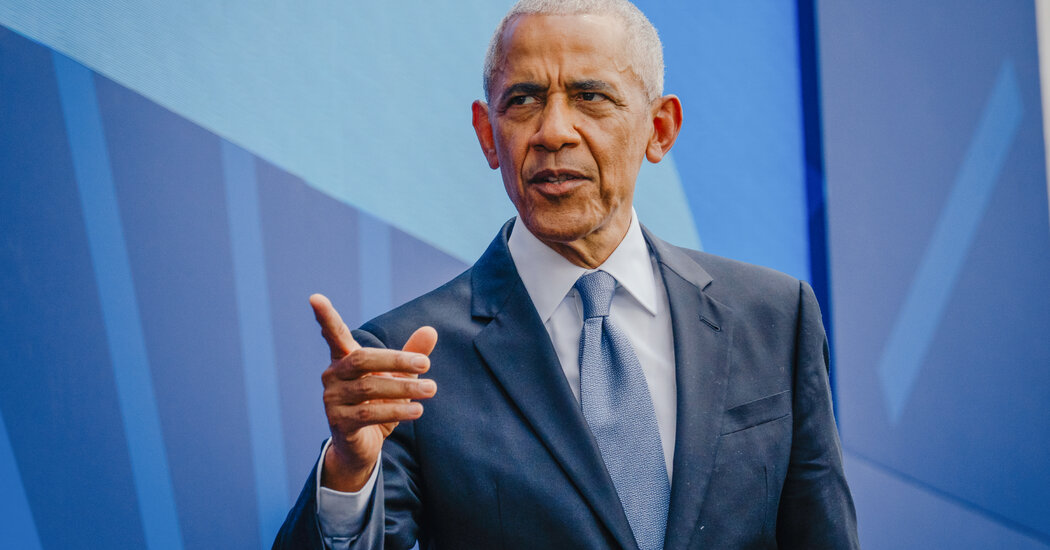
In a remarkably candid, deeply humanizing conversation on the All The Smoke podcast, hosted by former NBA champions Matt Barnes and Stephen Jackson, former President Barack Obama pulled back the political curtain to address the relentless, yearslong hostility directed at him by his successor, Donald Trump. Rather than responding with defensive anger or reciprocal vitriol, Obama approached the subject with a calm, almost clinical detachment, describing Trump’s unending preoccupation with him and his family as a full-blown public “obsession.” With a wry smile that resonated with the hosts and listeners alike, Obama joked that he clearly occupies prime real estate in Trump’s mind, declaring that he has “a room in his head—a suite—in his head.” This relaxed, highly personal setting allowed Obama to step away from the polished, formal language of a statesman and speak as a man who has had to navigate the surreal experience of becoming a permanent, digitized target for the most powerful office in the world. By framing the continuous attacks as a psychological fixation rather than a legitimate political critique, Obama highlighted the strange, modern phenomenon where a sitting president remains utterly consumed by the shadow of the person who came before him.
Beneath the humor, however, lay a sharp observation about physical courage, digital bravado, and the profoundly distorting effects of social media on human communication. Obama pointed out a glaring disconnect between Trump’s aggressive online persona and his actual, real-life behavior, asserting that when the two men have crossed paths in person, Trump “knows better” than to speak to him with such hostility. Obama noted that “if this—whoever you were talking about—was in front of me, which has happened a couple times, he don’t talk like that,” suggesting that the physical presence of another human being naturally imposes a standard of respect and self-restraint. He argued that the “filter of the phone” has stripped away these natural social boundaries, creating a toxic, consequence-free environment where public figures and ordinary citizens alike feel empowered to say incredibly cruel and erratic things that they would never dare utter face-to-face. This observation is borne out by their last public interaction at the funeral of former President Jimmy Carter, where the two men sat directly adjacent to one another and were captured on camera smiling, sharing polite pleasantries, and engaging in quiet conversation—a stark contrast to the relentless digital warfare that defines their public relationship.
This bizarre dichotomy further illuminates the radically different philosophies the two men hold regarding the work, dignity, and heavy responsibility of the presidency itself. Obama explained that when he occupied the Oval Office, his focus was entirely consumed by the immediate, crushing demands of governing the nation, leaving him absolutely no time or desire to obsess over his predecessors. For Obama, the immense weight of the office—handling economic crises, managing global conflicts, and steering domestic policy—demanded a forward-looking, monk-like focus on the American people, making any preoccupation with former presidents seem utterly alien. He remarked that constantly measuring oneself against a predecessor is “a strange thing to me” and serves as a troubling indicator of a leader who is fundamentally distracted from the actual duties they were elected to perform. By contrasting his own discipline with Trump’s well-known habits of consuming hours of cable news and firing off early-morning social media posts, Obama painted a picture of a presidency that has been dangerously hollowed out, transformed from a sacred public trust into a highly personalized, reactive theater of grievance.
To understand the depth of this rivalry, one must look back at the long, fifteen-year history of Trump’s preoccupation with Obama, which began long before he entered formal politics through the racist “birther” conspiracy theory that falsely claimed America’s first Black president was not born in the United States. This initial campaign was not a mere political disagreement, but a deeply personal, racially coded attempt to delegitimize Obama’s very identity and citizenship, serving as the launching pad for Trump’s own political ascent. Years later, as president, Trump has routinely returned to Obama as a reliable scrapegoat whenever his own administration faces significant political setbacks or international scrutiny. A prime example of this occurred during a recent Group of 7 summit in France, where Trump, facing mounting criticism even from his own allies over his foreign policy decisions, invoked Obama’s name more than two dozen times in a frantic effort to paint his own tenuous diplomatic efforts with Iran as vastly superior to the landmarks 2015 Joint Comprehensive Plan of Action (JCPOA) brokered by Obama. During an expletive-laden tirade at the summit, Trump claimed that the Iranian government had laughed at his predecessor, using highly offensive language to call Obama a “stupid son of a bitch” in an attempt to diminish his legacy on the world stage.
This pattern of deflection and personal denigration has routinely bled into domestic issues, where Trump has blamed Obama for everything from his own policy failures to minor local infrastructure issues, such as the delayed renovations of the Lincoln Memorial Reflecting Pool. The attacks have also targeted the physical and cultural initiatives designed to preserve Obama’s historic legacy, with Trump twice taking to his social media feeds to depict the highly anticipated construction of the Obama Presidential Library in Chicago as a chaotic pile of debris, disparagingly calling it a future “‘Mecca’ for those who hate America!” Far more damagingly, the hostility has frequently crossed into deeply personal, racially charged territory, targeting not just the former president but his family as well, as seen when Trump shared a highly offensive, racist video on his social media account depicting Barack and Michelle Obama as apes. Although the post was eventually deleted and blamed on a low-level staff member, Trump’s steadfast refusal to offer a personal apology highlighted a troubling lack of empathy and accountability, illustrating how the highest office in the land could be used to amplify historic racial prejudices against a family that spent eight years serving the country.
The systemic nature of this hostility was further confirmed by the official reaction from the White House, where spokeswoman Anna Kelly responded to Obama’s podcast remarks by immediately launching into a defense of local policy and labeling him “one of the weakest and worst presidents in history.” This official echo of personal grievance demonstrates how the traditional, dignified infrastructure of presidential communications has been weaponized to sustain a permanent, deeply personal political feud. Historically, the “Presidents Club” existed as an exclusive, bipartisan fraternity of former leaders who, despite their profound ideological differences, maintained a baseline of mutual respect, shared counsel, and public decorum to preserve the dignity of the office. The collapse of this norm into a digitized, mud-slinging spectacle represents a profound shift in American political culture, one that leaves the public caught in the crossfire of an endless, exhausting conflict. Ultimately, Obama’s reflections on the All The Smoke podcast serve as a powerful humanist critique of this era, reminding us that behind the grand institutions of democracy are fragile human egos, and that the true measure of leadership lies not in the performance of digital hostility, but in the quiet, focused service to the nation.