


A Double Blow to a Fragile State: Twin Earthquakes Strike Venezuela Amid Political and Economic Turmoil
The Fury of the Earth: A Rare Doublet Shakes Venezuela’s Foundations
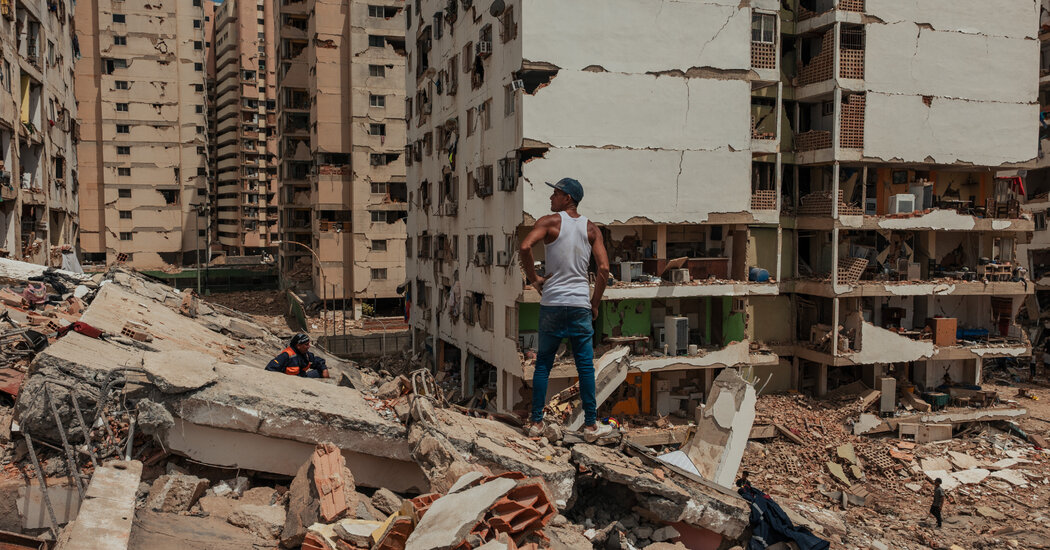
On a quiet Wednesday evening, just after six o’clock, the earth beneath Venezuela gave way with terrifying violence, unleashing a rare dual-seismic event that has left the nation reeling and the international community scrambling to respond. The initial shock, a powerful magnitude 7.2 earthquake, struck just west of the capital city of Caracas, sending panicking residents pouring into the streets as buildings began to sway. Before the dust could even settle, a mere 39 seconds later, an even more devastating magnitude 7.5 earthquake tore through the region. Seismologists classify this rapid, back-to-back tectonic occurrence as an earthquake doublet—one of the most powerful and destructive seismic events of its kind to hit the South American continent in the last century. Moving along the boundary where the South American plate collides with the Caribbean plate, the twin quakes shattered the fragile concrete, brick, and adobe infrastructure of urban neighborhoods, triggering landslides, collapsing multi-story apartment complexes, and leaving at least 188 dead and more than 1,500 injured. Emergency responders and geologists note that Venezuela has not faced an earthquake of this magnitude since the devastating 1900 disaster, and the current death toll is almost certain to climb as rescue teams slowly navigate blockaded mountain roads and debris-choked streets to reach more isolated communities.
              VENEZUELA EARTHQUAKE DOUBLET

     Wednesday, post-6:00 PM Local Time
[First Event] ————————> [Second Event]
Magnitude 7.2 Magnitude 7.5
West of Caracas 39 Seconds Later
Scenes of Despair: The Human Toll in La Guaira and Caracas
In the historic port city of La Guaira, situated just north of the capital, the devastation is absolute, transforming vibrant, seaside neighborhoods into skeletal ruins of twisted iron and pulverized concrete. Here, more than a hundred buildings collapsed in a matter of seconds, leaving desperate residents to dig through the rubble with their bare hands in a race against time. On Thursday morning, amid the choking dust of what was once a busy apartment complex, Yorliana Colmenares stood vigil, listening intently to the faint, rhythmic tapping sounds emanating from beneath a mountain of crushed brick where she believed her boyfriend was trapped. Like many others in her neighborhood, she was forced to search without the aid of heavy machinery, working alongside neighbors to pull survivors, bodies, and household pets from the wreckage because municipal rescue teams had simply not yet arrived. Similar scenes of anguish played out across the city, where a frantic couple searched the debris of a public park for their eight-year-old son, who had been playing basketball when the first tremor struck and has not been seen since. Further down the coast, Angie Reyes expressed her growing desperation regarding her colleague, Daniel Vivas, trapped on the upper floors of a collapsed six-story building, echoing a sentiment felt by millions that without immediate, professional international intervention, many buried alive would not survive the week.
Broken Lifelines and Hollowed-Out Systems
The physical destruction of the built environment has been compounded by a near-total collapse of critical infrastructure, exposing the deep vulnerabilities of a state hollowed out by years of severe economic depression and administrative neglect. The tremors violently ruptured main water conduits and triggered automatic safety shutdowns of gas lines, leaving vast swathes of Caracas and several northern states—including Falcón, Yaracuy, Zulia, Miranda, and La Guaira—without electricity, running water, or cooking gas. Luisa Martínez, a 68-year-old resident of the industrial city of Valencia, described the sheer terror of the event, recalling how the walls of her home groaned, windows shattered inward, and the ground rolled so violently that she could only cling to her family in the dark and pray for deliverance. The country’s transit networks have ground to a halt, with Caracas’s subway system offline and the heavily damaged Simón Bolívar International Airport completely closed to commercial traffic, severing the nation’s primary air link to the outside world. This widespread disruption represents a catastrophic challenge for local authorities; without functional roads, power, or airports, deploying what little emergency equipment remains in the state’s depleted reserves has become an logistical nightmare, leaving local civil defense volunteers to operate with little more than plastic helmets and hand shovels.
A Catastrophe at a Geopolitical Crossroads
This natural disaster has struck Venezuela at one of the most politically volatile moments in its modern history, threatening to upend an already fragile transitional government. Less than six months ago, U.S. special operations forces arrested the country’s longtime autocratic leader, Nicolás Maduro, extraditing him to New York to face high-profile narco-trafficking charges. In his wake, the Trump administration recognized former Vice President Delcy Rodríguez as the interim leader, effectively shifting Venezuela into a geopolitical dependency of the United States. Since taking office under the watchful eye of Washington, Rodríguez’s administration has faced immense public discontent while attempting to navigate stringent American demands: opening Venezuela’s state-controlled oil reserves to multinational extraction companies, restructuring intelligence agencies to align with U.S. national security goals, and dismantling the remnants of the socialist state. The catastrophic double earthquake now serves as a high-stakes test of this new relationship, forcing Washington to decide how deeply it will invest in rebuilding and stabilizing a nation it has worked so aggressively to reshape, even as local opposition groups accuse the new government of bureaucratic paralysis in the face of tragedy.
GEOPOLITICAL LANDSCAPE[ Past Regime ] ===> [ Transition (6 mos ago) ] ===> [ Present Crisis ]
Nicolás Maduro Delcy Rodríguez Govt. Twin Earthquakes
(Arrested by US) (US-Backed Coalition) (Infrastructure Test)
The Complicated Dynamics of International Relief
The immediate geopolitical theater of the disaster recovery was on full display during a late-night televised address, where Interim President Delcy Rodríguez stood shoulder-to-shoulder with her powerful interior minister, Diosdado Cabello—a figure who remains under federal indictment in the United States on drug trafficking charges. Rodríguez pleaded for national unity and calm, framing the recovery as an opportunity for the country to unite across ideological lines, though her appearance alongside Cabello highlighted the complex web of alliances still operating within Caracas. Across the globe, international powers have moved quickly to offer assistance, turning the humanitarian crisis into a diplomatic arena; U.S. Secretary of State Marco Rubio announced the deployment of elite disaster response units, including search-and-rescue teams from Fairfax County, Virginia, and Los Angeles, alongside advanced satellite imaging assets, with the Pentagon supervising logistics flights to bypass the ruined airport. Meanwhile, global powers like China and India, along with regional neighbors like Colombia, Brazil, and Argentina, have also pledged significant aid packages, illustrating that even during a humanitarian emergency, Venezuela remains a contested prize on the global chessboard.
The Long Shadow of History and the Road to Rebuilding
For many Venezuelans, the current catastrophe is a grim reminder of the country’s modern history, echoing the infamous 1999 mudslides in La Guaira that claimed over 15,000 lives and defined the early, tumultuous presidency of Hugo Chávez. Today, however, the country is far less equipped to rebuild, its oil-dependent economy decimated by years of hyperinflation, crumbling public services, and the mass exodus of millions of its most skilled citizens, including doctors, engineers, and emergency workers. In the El Paraíso neighborhood of Caracas, where heavy backhoes slowly cleared the pulverized remains of a six-story residential building, families watched in somber silence, knowing that the likelihood of finding survivors diminished with every passing hour. Vladimir Navas, anxiously awaiting news of his elderly in-laws, Freddy Carrero and Eliana Hernández, who were believed to have been watching a football match when their home collapsed, spoke softly of the grim reality on the ground, noting that in a country so thoroughly broken by political conflict, surviving this latest disaster would require nothing short of a miracle. As the search for survivors continues, Venezuela face a long and uncertain path toward recovery, one that will test not only the structural integrity of its cities but the resilience of its people and the true commitment of its international allies.