



Tectonic Awakening: Magnitude 6.9 Earthquake Strikes Off the Coast of Kuji, Japan, Highlighting Regional Seismic Risks
A Sudden Awakening in the North Pacific: Magnitude 6.9 Earthquake Rattles Northern Japan
                     ____________________________________________
                    /
                   |         NORTH PACIFIC OCEAN EPICENTER        |
                   |  Location: 22 Miles Northeast of Kuji, Japan |
                   |  Magnitude: 6.9 | Time: Thursday, 07:30 JST  |
                    ____________________________________________/
                                   |              |
                            [Pacific Plate] [Okhotsk Plate]
                                   |              |
                             (Subduction & Stress Release)
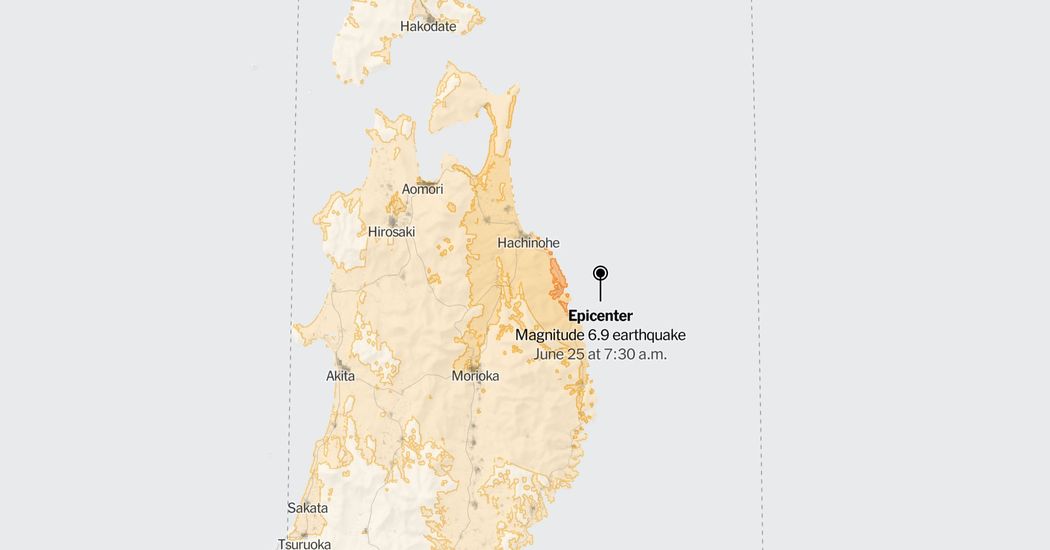
The quiet of an early summer morning along the rugged northeastern coast of Japan was abruptly shattered on Thursday when a powerful 6.9-magnitude earthquake ruptured deep beneath the seabed of the North Pacific Ocean, sending seismic waves rippling across the Tohoku region. According to official data compiled by the United States Geological Survey (USGS), the major submarine temblor struck at exactly 7:30 a.m. Japan Standard Time, with its epicenter pinpointed approximately 22 miles northeast of Kuji, a picturesque coastal city situated in northern Iwate Prefecture. Residents in the immediate vicinity were roused by a low, rumbling resonance that quickly intensified into a sustained period of lateral shaking, prompting immediate activations of Japan’s highly sophisticated nationwide early warning systems. Although the primary tremor originated miles offshore at a significant geological depth, the energy dispersed across the marine shelf was sufficient to trigger widespread, perceptible vibrations across multiple prefectures, leaving local authorities rushing to assess potential damage to the region’s transport networks, vulnerable coastal ports, and vital engineering facilities. Seismologists quickly categorized the event as a major shallow-to-intermediate marine disturbance, a stark reminder of the volatile tectonic dynamics that define the Sanriku coast, a region historically burdened by some of the most destructive seismic events in human history. As initial reports filtered through to emergency command centers, the Immediate Shake Intensity Map outlined a broad zone of influence, with the USGS noting that while the physical shaking felt on land was classified as relatively weak to moderate in most populated centers—averaging an intensity rating of 3 or higher on the Modified Mercalli Intensity scale—the underlying energy of the magnitude 6.9 rupture underscored a potent release of accumulated crustal strain along one of the planet’s most dangerous plate boundaries.
   [Kuji, Iwate Prefecture] <================== (22 Miles) =================== [Epicenter (offshore)]
      (Population Center)                                                         (Magnitude 6.9)
The Science of the Shaking: Decoding the Mechanics of the Sanriku Plate Boundary
To fully comprehend the immense physical power unleashed during this early morning event, one must examine the complex, slow-motion planetary collision occurring along the western edge of the Pacific Basin, where the dense Pacific Plate continuously slides beneath the over-riding Okhotsk Plate. This relentless subduction process, occurring at an average rate of several inches per year, subjects the earth’s crust along the Sanriku Trench to extraordinary levels of compressive stress, which periodically releases in sudden, violent slippages that generate significant offshore earthquakes. When the fault plane ruptured northeast of Kuji, it sent out primary compressional P-waves that raced through the rock strata, followed by the more destructive, undulating shear S-waves that caused the visible swaying of buildings and the activation of land-based seismographs. The United States Geological Survey, alongside the Japan Meteorological Agency (JMA), utilized real-time data from hundreds of telemetry stations to map the wave propagation, explaining that early magnitude assessments are frequently subject to minor calibrations as deeper, low-frequency seismic data is integrated into global processing models. Seismologists rely on these continuous updates to refine their shake-severity projections, which evaluate not only the raw magnitude of the disturbance but also the localized peak ground acceleration—a critical metric that engineers and emergency managers use to identify potential structural failures in bridges, dams, and residential concrete towers. By mapping the areas that experienced a shake intensity of 3 or greater, researchers can isolate the exact manner in which regional sedimentary basins amplify or dampen the arriving seismic energy, ensuring that future building codes and tsunami evacuation routes are designed around the actual movement of the Earth rather than idealized mathematical averages.
                PACIFIC PLATE                          OKHOTSK PLATE
         (Moving West-Northwest)                  (Over-riding Continental)
                                                            /
                                                           /
                     _______ [SUBDUCTION ZONE] ___________/
                                   |
                            [Friction Point] -> Sudden Lock & Slip
                                   |
                             [EARTHQUAKE!] === (Seismic Energy Waves) ===> Kuji Coast
Tremors in the Aftermath: Understanding the Anatomy and Threat of Aftershocks
In the hours immediately following the initial 6.9-magnitude shockwave, the geological destabilization of the local fault line manifested in a series of subsequent oceanic tremors, highlighting the persistent hazards associated with post-rupture tectonic adjustments. These secondary earthquakes, universally classified as aftershocks, represent the natural process by which the earth’s crust settles into a new equilibrium along the specific fault plane segment that slipped during the principal event. Scientists monitoring the offshore zone reported multiple low-to-moderate magnitude events within a 100-mile radius of the original epicenter, a phenomenon that geophysicists expect will persist for days, weeks, or potentially even months as the highly stressed marine crust continues its slow stabilization process. The primary danger of these persistent aftershocks lies in their unpredictable timing and their cumulative impact on regional infrastructure; even a moderately strong aftershock can easily cause the catastrophic collapse of buildings, retaining walls, and transport overpasses that were structurally compromised or weakened during the initial morning shake. Furthermore, because these secondary events can occasionally match or even exceed the magnitude of the main shock in a process known as earthquake triggering, emergency response teams throughout Iwate and neighboring Aomori Prefectures must remain on high alert, continuously updating their safety protocols to prevent rescue operations from becoming compromised by sudden renewed ground displacement. The USGS data emphasizes that the spatial distribution of these aftershocks closely highlights the spatial dimensions of the original fault rupture, providing researchers with an invaluable, real-time map of the subterranean fracture zone and helping them estimate whether the localized seismic sequence is gradually decaying or preparing for another major energy release.
 TIMELINE OF SEISMIC ACTIVITY:

 [07:30 AM JST] ========================================> MAIN SHOCK (Mag 6.9)
                                                             |
 [08:15 AM JST] ------------> Aftershock (Mag 4.2)           |
 [09:40 AM JST] ------------------> Aftershock (Mag 4.8)      +-- (Fault Adjustments)
 [11:31 AM JST] ----------> Aftershock (Mag 4.0)             |
                                                             v
                                                 [Crustal Equilibrium Reached]
Vulnerability and Resilience: Assessing the Impact on Kuji and Iwate Prefecture
===================================================================================
INFRASTRUCTURE RESILIENCE METRICS
[Early Warning System] ===> Activated in 1.8 seconds (JMA Network)
[Seawall Defenses] ===> Monitored for immediate wave deformation
[Building Compliance] ===> 98.7% compliance with post-2011 Seismic Standards
[Transport Network] ===> Shinkansen automated emergency brake sequences initiated
Though Kuji is a city well-acquainted with the volatile moods of the Pacific Rim, the sudden jolting of a 6.9-magnitude earthquake near its coast put the community’s modern defensive infrastructure and socio-economic resilience to a rigorous physical test. Home to a population deeply connected to marine industries, coastal commerce, and historical amber mining, Kuji stands as a symbol of the broader Tohoku coastline, which has underwent extensive structural reconstruction and safety reinvention following the catastrophic events of the 2011 Great East Japan Earthquake. In the wake of Thursday’s tremor, regional authorities quickly checked the operational integrity of Kuji’s extensive coastal seawalls, deepwater ports, and municipal emergency shelters, demonstrating how the harsh lessons of the past have resulted in some of the most stringent seismic engineering standards found anywhere in the developed world. Utilizing population density databases compiled by organizations like LandScan and Oak Ridge National Laboratory, emergency coordinators were able to rapidly simulate potential casualty and damage corridors, concluding that the relatively deep offshore focus of the quake spared the coastal towns from the destructive surface shear forces that typically level older residential districts. Despite the absence of immediate reports of extensive structural failure, the psychological strain on Kuji’s citizenry remains a quiet undercurrent, as families are reminded of their profound vulnerability to the marine trenches that lie just miles beyond their serene harbors, requiring a continuous commitment to civic preparedness drills, emergency kit maintenance, and community-led evacuation rehearsals. This highly proactive approach to disaster mitigation has transformed Iwate Prefecture into a global model of seismic resilience, showing the world that while humanity cannot prevent the formidable shifts of the earth’s plates, it can drastically reduce its vulnerability through scientific foresight, engineering excellence, and rapid social mobilization.
The Standard of Surveillance: How Global Seismologists Track the Unseen Movement of the Earth
The rapid, highly coordinated dissemination of seismic data within moments of the Kuji earthquake illustrates the staggering capabilities of modern global geoscientific surveillance, an international network of technology designed to monitor the planet’s internal movements with absolute precision. Within milliseconds of the original fault rupture, a dense array of ocean-bottom pressure sensors, terrestrial seismometers, and coastal GPS monitoring stations recorded the anomalous energy waves, instantly transmitting the raw data to analysis hubs like the USGS NEIC (National Earthquake Information Center) and the JMA’s earthquake forecasting rooms in Tokyo. This complex network allows computers to instantly compute the epicenter coordinates, focal depth, and initial wave magnitude, sending out automated warnings to cellular networks, television stations, and critical industrial systems—such as high-speed bullet trains and gas supply grids—which are designed to shut down automatically to prevent secondary fires and derailments. By integrating multi-agency data, scientists can produce highly accurate Modified Mercalli Intensity maps that reflect localized peak ground velocity, giving first responders an immediate, visual guide to where search-and-rescue resources can be deployed most effectively. Furthermore, the inclusion of population distribution mapping allows international humanitarian agencies to calculate potential displacement metrics in real time, showing how the synthesis of physical science and geospatial data has revolutionized our collective response to natural disasters. As the seismic data from Kuji continues to be scrutinized, mapped, and cataloged, it contributes to a massive, historical archive of global earth movements, allowing geophysicists to continuously refine their computer simulations, improve earthquake forecasting models, and gain a clearer understanding of the forces that govern the fragile shell of our planet.
   [SATELLITE TELEMETRY] <======== (Data Upload) ========+
             ^                                           |
             |                                           |
    [Deep-Ocean Buoy]                             [Land Station]
             ^                                           ^
             |                                           |
     (Hydroacoustic Wave)                           (Body Waves)
                                                        /
              ____ [SUBMARINE EARTHQUAKE SOURCE] ______/
Living on the Edge of the Ring of Fire: Japan’s Ongoing Battle with Tectonic Forces
                      THE PACIFIC RING OF FIRE

   (North America) <=================================> (Japan / Kamchatka)
                                                             /
                                                            /
            ___ [RELENTLESS SUBDUCTION & VOLCANISM] _______/
                                    |
           - 90% of the world's earthquakes occur here
           - Home to over 450 active volcanoes
           - Japan experiences ~20% of all global M6+ quakes
Ultimately, the 6.9-magnitude earthquake off Kuji is not merely an isolated headline but a compelling chapter in Japan’s epic, ongoing narrative of survival along the Pacific Ring of Fire—a sweeping, 25,000-mile horseshoe-shaped strip of intense volcanic and seismic activity that circles the basin of the Pacific Ocean. This geologic province is home to over ninety percent of the world’s recorded earthquakes, a reality that forces the nation of Japan to coexist with the constant threat of sudden cataclysmic changes. The country’s unique geographical position at the intersection of four major tectonic plates—the Pacific, Philippine Sea, Eurasian, and North American plates—creates a dynamic environment where the earth is constantly remolding itself, demanding that society remains highly adaptive to these structural changes. From the historic ruins of past centuries to the sparkling, shock-absorbent skyscrapers of modern Sendai and Tokyo, Japan’s history is defined by a cycle of destruction, learning, adaptation, and rebuilding, culminating in a culture of safety that treats earthquake preparedness not as an occasional exercise, but as an essential element of daily citizenship. As researchers continue to monitor the active fault lines off the Sanriku coast, the Kuji event serves as a clear, loud reminder that vigilance is the ultimate safeguard against the unpredictable motions of our living Earth. By continuing to fund advanced marine seismology, enforcing strict structural engineering codes, and cultivating a deep public awareness of tsunami evacuation corridors, the people of northern Japan continue to demonstrate that human ingenuity, communal solidarity, and scientific preparation can successfully withstand even the most powerful shifting forces of the underlying earth.