


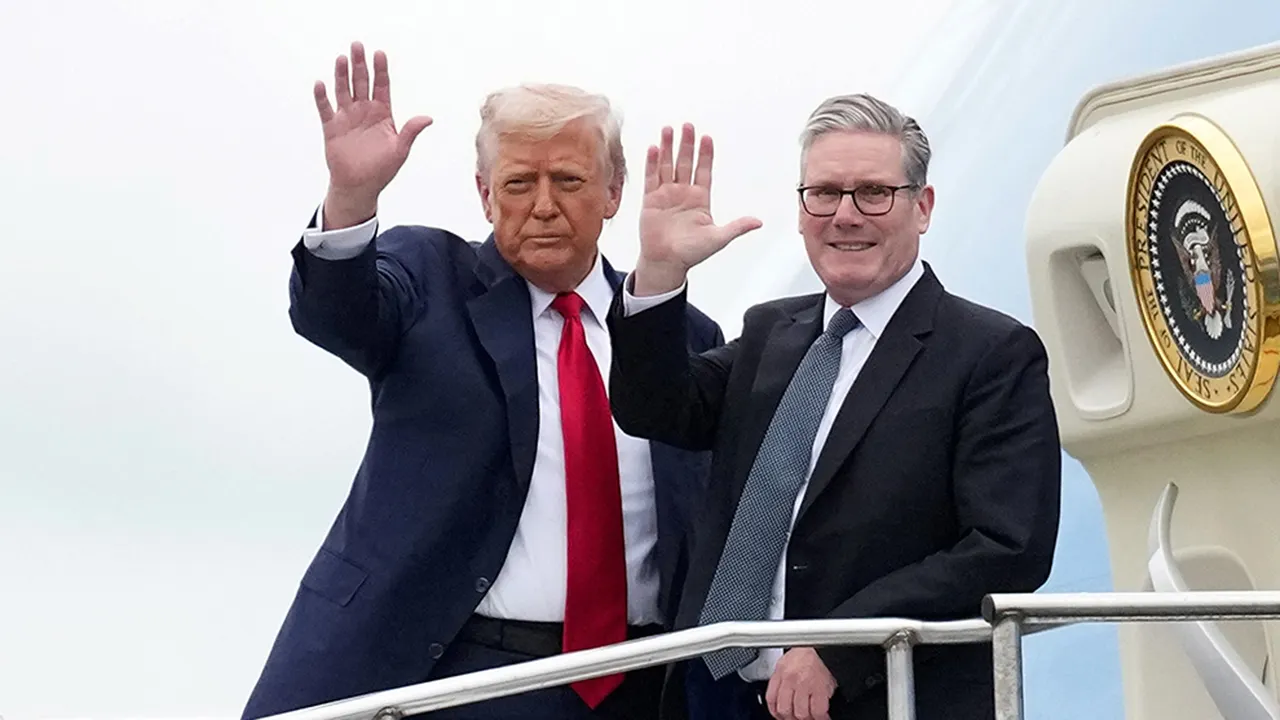
In an era where geopolitical commentary is instantly transmitted across the globe with the simple tap of a smartphone screen, domestic political crises are no longer confined to the borders of the nations experiencing them. This reality was vividly illustrated on a recent Sunday afternoon when former U.S. President Donald Trump took to his social media platform, Truth Social, to deliver a startlingly confident prognostication regarding the future of British governance. With his characteristic blend of bold assertion and transactional courtesy, Trump declared that British Prime Minister Keir Starmer would soon be forced to resign from his post. Trump’s digital decree did not merely predict Starmer’s downfall; it actively diagnosed the perceived failures of the Labour leader’s administration, specifically targeting his handling of immigration and energy policy, while punctuated by a trademark call to “OPEN NORTH SEA OIL!” Despite the stinging criticism, Trump offered a brief parting gesture of goodwill, wishing the Prime Minister well. This intervention from across the Atlantic highlights how modern political figures operate in an interconnected amphitheater, where a leader’s domestic vulnerabilities are instantly seized upon, repackaged, and broadcast to a global audience hungry for conflict and change.
Behind the closed, heavy doors of 10 Downing Street, the atmosphere was undoubtedly far more sober and introspective than the loud, speculative declarations of social media would suggest. At the heart of the storm is Starmer himself, a man currently tasked with navigating the immense psychological and political burden of leadership while his grip on power is openly questioned. Reports circulated by Reuters revealed that the Prime Minister spent his weekend locked in intense contemplation, deliberating his political future and weighing whether to step aside voluntarily or brace for a bruising battle to retain his position. For any head of state, the realization that one’s political mortality is being openly debated is a profound and isolating experience. Starmer faced an agonizingly tight timeline, with insiders suggesting he would have to make a definitive choice by Monday on whether to resign or face a direct leadership challenge. The transition from the high of electoral victory to the low of survival mode is incredibly rapid in modern democracy, forcing leaders like Starmer to constantly balance their personal resilience against the collective will of a restless party and an impatient public.
Adding fuel to the political fires in Westminster is the rapid ascent of Andy Burnham, a formidable and popular figure within the Labour movement who has emerged as the primary catalyst for the current leadership crisis. Burnham’s standing was dramatically elevated following his victory in a high-stakes special election, clearing his path to be formally sworn in as a member of the House of Commons on Monday. This legislative homecoming has set the stage for a dramatic intra-party showdown, transforming Burnham from a regional champion into a direct threat to Starmer’s premiership. The tension within the Labour Party is palpable, representing a classic political struggle between the cautious establishment wing represented by Starmer and a more populist, change-oriented faction. Despite the immense pressure mounting against him, Starmer publicly maintained an attitude of defiant resolve, telling reporters on Friday that he had no intention of quietly fading into the background. “If there is a contest… then yes I will run, I will stand,” Starmer asserted, signaling his willingness to fight for his political life and defend his vision for the country in the face of internal mutiny.
The policy battlegrounds that have triggered this crisis—immigration and energy—are not mere abstract concepts debated in parliament; they represent deeply emotional and existential issues that affect the daily lives of millions of British citizens. Trump’s critique of Starmer’s energy policies, particularly the demand to open the North Sea to oil drilling, strikes at the heart of a bitter domestic debate over the UK’s economic future. British families are currently caught in the crosshairs of a punishing cost-of-living crisis, where soaring utility bills clash with the existential necessity of transitioning to green energy. Similarly, the issue of immigration is emotionally charged, touching upon national identity, community resources, and the management of borders. By failing to find a comfortable equilibrium on these polarized fronts, Starmer has left himself vulnerable to attacks from both the right, who demand more aggressive resource extraction and border controls, and the left, who demand more compassionate and progressive reforms. For ordinary Britons, these political maneuvers are not a game of strategy, but a desperate search for stability in a world that feels increasingly volatile and unpredictable.
This domestic political vulnerability is further exacerbated by a sinister backdrop of international hostility and physical threat, reminding us that modern political leadership carries profound personal risks. Recently, British police investigations revealed a deeply unsettling connection between Russian state actors and a series of coordinated arson attacks targeting properties connected to Prime Minister Starmer. The revelation of these attacks introduces a chilling dimension to the narrative of Starmer’s premiership, proving that the pressures he faces extend far beyond legislative defeats or unfavorable polling numbers. Operating as a democratic leader today means navigating a landscape of asymmetric warfare, where geopolitical adversaries seek to destabilize national governments through covert violence, cyber warfare, and disinformation. The psychological toll of knowing that one’s public service has made their personal circle and associated properties targets of foreign state-sponsored aggression is a heavy burden that few can fully comprehend, highlighting the human vulnerability of those who choose to step into the global arena.
Yet, despite the swirling vortex of international speculation, domestic rebellion, policy gridlock, and security threats, the human spirit often seeks sanctuary in the quiet, universal rhythms of ordinary life. On the very Sunday that Trump predicted his downfall and journalists debated his political demise, Starmer chose to share a deeply personal moment on social media to mark Father’s Day. Posting a message of quiet reflection, he wrote, “Being a dad is my greatest joy. Today, I’m thinking about my dad, and the father I am to my children because of him.” In these simple words, the facade of the embattled Prime Minister fell away, revealing a son remembering his heritage and a father striving to anchor his children amidst a tumultuous world. Ultimately, this poignant contrast serves as a powerful reminder of a fundamental truth: beneath the headlines, the cutthroat strategies, and the brutal machinery of global politics, the individuals we task with leading our nations are fundamentally human, seeking the same love, legacy, and domestic peace as the citizens they serve.