

On a Father’s Day that most families across the country spent sharing warm meals, exchanging hand-drawn cards, and enjoying the simple, irreplaceable comfort of together-time, a starkly different and deeply emotional scene unfolded outside the imposing, gray security fences of Delaney Hall in Newark, New Jersey. This industrial, sun-baked stretch of Doremus Avenue became a sanctuary for a powerful vigil, where community members, immigrant rights advocates, and fragmented families gathered to honor the fathers locked away inside. For these children and mothers, the holiday was not a celebration, but a painful reminder of empty chairs at dinner tables and the physical barriers keeping their loved ones out of reach. In an effort to humanize the cold, bureaucratic reality of immigration detention, the demonstrators transformed the harsh chain-link fence into an outdoor gallery of love and longing. They hummed songs of hope accompanied by acoustic guitars, shared stories of resilience, and gently hung colorful neckties along the wire—each tie representing a father, husband, or brother separated from his family by the machinery of detention. Organized by grassroots groups including the Sussex Visibility Brigade, the gathering drew about seventy-five participants who found solace under a small hospitality tent, sharing food and mutual support in a quiet, peaceful show of solidarity. Children looked up toward the narrow window slits of the facility, waving their hands and hoping their fathers might somehow sense their presence on the street below. The atmosphere was one of peaceful defiance, rooted in the shared belief that basic human dignity should transcend legal status. It was a space carved out of grief, designed to bring a touch of warmth to a stark landscape. Yet, this fragile peace was destined to be shattered, as the external tensions surrounding immigration enforcement violently collided with the quiet dignity of the vigil.
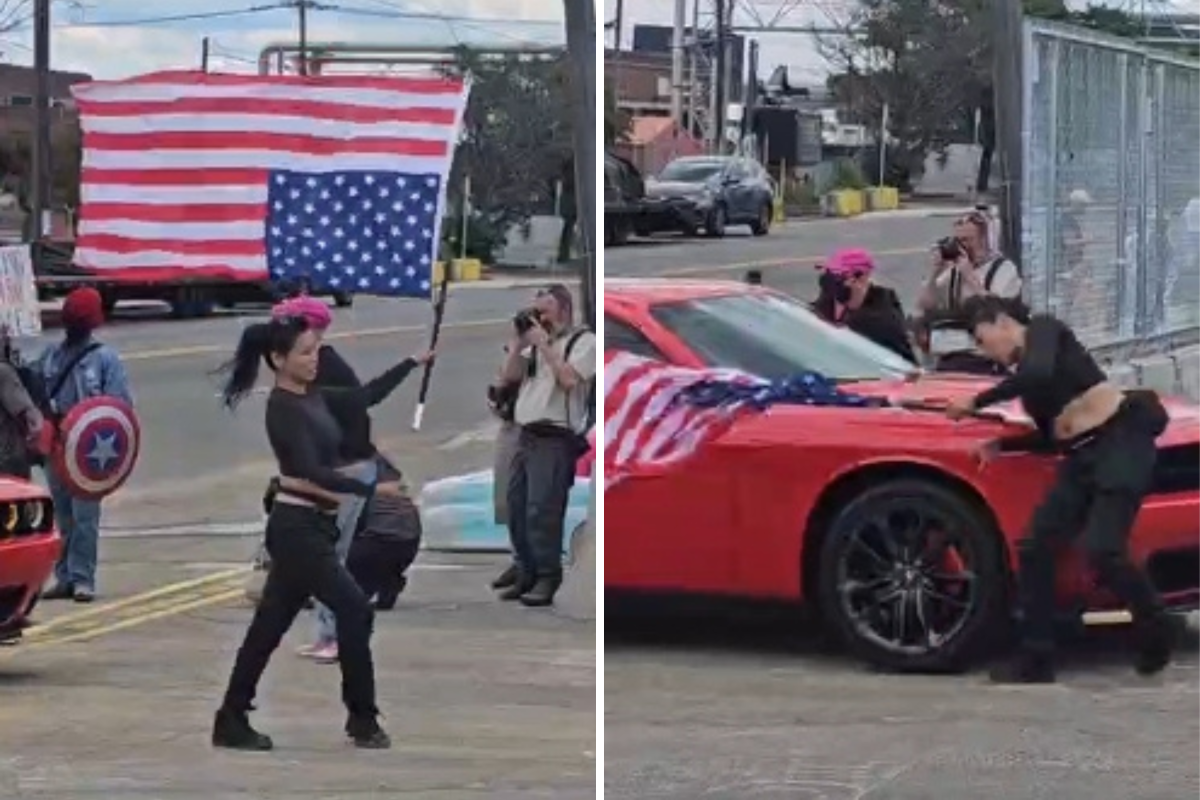
The transition from peaceful assembly to terrifying chaos occurred in a sudden, violent flash that was captured from multiple angles by the trembling smartphones of horrified onlookers. Standing near the right entrance gate where vehicles routinely enter and exit Delaney Hall, a female demonstrator who had traveled all the way from Minnesota stood as a symbol of silent protest, holding an upside-down American flag—a traditional maritime signal of extreme distress that perfectly captured the desperation of the families she sought to support. Suddenly, a vibrant red Dodge Challenger drove down the roadway, heading straight toward the facility’s security gate where the woman was standing. Rather than stopping or decelerating to navigate past the peaceful assembly, the driver of the sports car continued forward, striking the woman directly. Durga Sreenivasan, an eyewitness who was standing nearby with her partner, described the atmosphere turning from tranquil to terrifying in a split second as the impact echoed across the asphalt. The velocity of the modern vehicle hitting the pedestrian sent shockwaves of panic through the crowd as onlookers shrieked in disbelief and rushed toward the impact zone. Instead of stopping to render aid or address the collision, the driver kept moving, driving through the gate and disappearing into the secure facility, leaving the victim lying on the asphalt. The sheer shock of the hit-and-run incident shattered the collective composure of the vigil, leaving protesters scrambling to assist the injured woman while grappling with the realization that the danger to their lives could come not just from systemic policies, but from a moving vehicle on a public street.
In the immediate aftermath of the collision, the physical space outside Delaney Hall transformed into a highly charged arena where panic, anger, and systemic hostility fiercely clashed. Witnessing a fellow demonstrator struck by a vehicle and left on the pavement sparked an understandable surge of outrage among the attendees, many of whom rushed toward the facility’s gates to demand accountability. However, the official narrative put forth by the Department of Homeland Security painted a radically different and far more hostile picture of the events. DHS representatives claimed that “rioters” had surrounded an employee’s vehicle, assaulted federal officers, and interfered with law enforcement operations, leading to an escalation where pepper spray was deployed against the crowd. This starkly contrasted with the accounts of organizers like Birdie Green, who explained that the crowd’s reaction was a natural, emotionally charged response to witnessing a hit-and-run in real-time, leaving them to navigate both their grief and the immediate threat of law enforcement escalation. As the chemicals of the pepper spray hung in the summer air, causing eyes to burn and throats to choke, the peaceful vigil was entirely consumed by a chaotic confrontation. Amid the shouting and the thick haze of chemical irritants, at least one protester was detained by authorities, accused of biting an officer during the scuffle. This dramatic escalation illustrated the profound disconnect between the lived reality of the demonstrators—who felt targeted and unprotected—and the institutional response, which quickly framed the civilian outrage as a security threat to be suppressed with force.
Despite the terrifying nature of the collision and the subsequent chaos, the story of the woman who was struck remains a powerful testament to the unbreakable human spirit that animates the immigrant rights movement. After receiving immediate aid on the hot pavement from her fellow protesters, she was transported by emergency services to University Hospital, where doctors treated her for various non-life-threatening injuries. While many would have succumbed to the physical trauma and psychological shock of such an event, choosing to return home to recover in safety, this dedicated activist chose a path of remarkable defiance. Only hours after being discharged from the medical facility, she returned directly to the concrete pavement outside Delaney Hall, her body bruised but her conviction entirely unshaken. Observers and organizers were deeply moved to see her back on the ground, once again raising her flag to wave it in front of the gates of the detention center. Her return symbolized a refusal to be intimidated or silenced by violence, transforming her from a statistic of a traffic incident into an active, living symbol of resistance. To the families of the detainees watching from both inside and outside the facility, her presence was a profound reminder that their struggle for justice was worth fighting for, no matter the personal cost. By standing her ground precisely where she had been knocked down, she demonstrated a level of courage that deeply humanized the protest, showing that the fight for human rights is carried on the shoulders of individuals willing to put their own bodies on the line.
In the days following the incident, the pursuit of accountability for the hit-and-run became mired in the familiar, frustrating maze of bureaucratic finger-pointing and corporate silence. When questioned about the red Dodge Challenger and the identity of the driver who had entered the secure facility after striking a pedestrian, the Department of Homeland Security was quick to distance itself, stating explicitly that the vehicle was not driven by an Immigration and Customs Enforcement employee. Instead, federal officials redirected all inquiries to the GEO Group, the multi-billion-dollar private contractor that operates Delaney Hall as a for-profit detention center. This shifting of responsibility highlighted a deeply troubling aspect of the modern immigration system, where the privatization of detention centers serves as a convenient shield against public accountability and transparency. Emails sent to the GEO Group seeking clarification and comment on the incident went unanswered, leaving a vacuum of information where justice should have been. Newark Public Safety Director Emanuel Miranda confirmed that local police were actively investigating the collision, but details regarding the driver, potential charges, or the circumstances of their entry into the facility remained elusive. For the advocates and families of the detained, this lack of transparency was a familiar grievance, mirroring the systemic opacity that obscures the daily operations of detention centers across the country, where private interests and public authorities often collaborate to deflect scrutiny and avoid answering for the harm done on their watch.
Ultimately, the dramatic events of Father’s Day cannot be understood in isolation; they are deeply intertwined with the ongoing systemic crisis and human suffering taking place inside the walls of Delaney Hall. For weeks leading up to the protest, the facility had been the focus of persistent demonstrations by advocates raising alarm over the severe conditions endured by the immigrants detained within. Detainees had reportedly launched hunger and labor strikes to protest systemic delays in their legal cases and the inadequate conditions of their confinement, allegations that were met with reports of administrative force and pepper spray inside the facility as well. The external clash on the street was a physical extension of the silent, desperate struggle occurring inside, where fathers and husbands fought for their dignity away from the public eye. When those seeking to support them were met with physical violence on the outside, it only underscored the belief among advocates that the system of detention is inherently hostile to human life both within and beyond its gates. As the echoes of the Father’s Day protest slowly faded from the Newark streets, the neckties remained fluttering on the fence, a quiet, colorful testament to the enduring bonds of family that no wall, vehicle, or political policy could successfully sever. The incident served as a stark reminder of the human cost of the immigration debate, proving that behind the abstract policy discussions and corporate contracts lie real human lives, fighting with fierce love and relentless determination to be reunited with those they hold dear.