


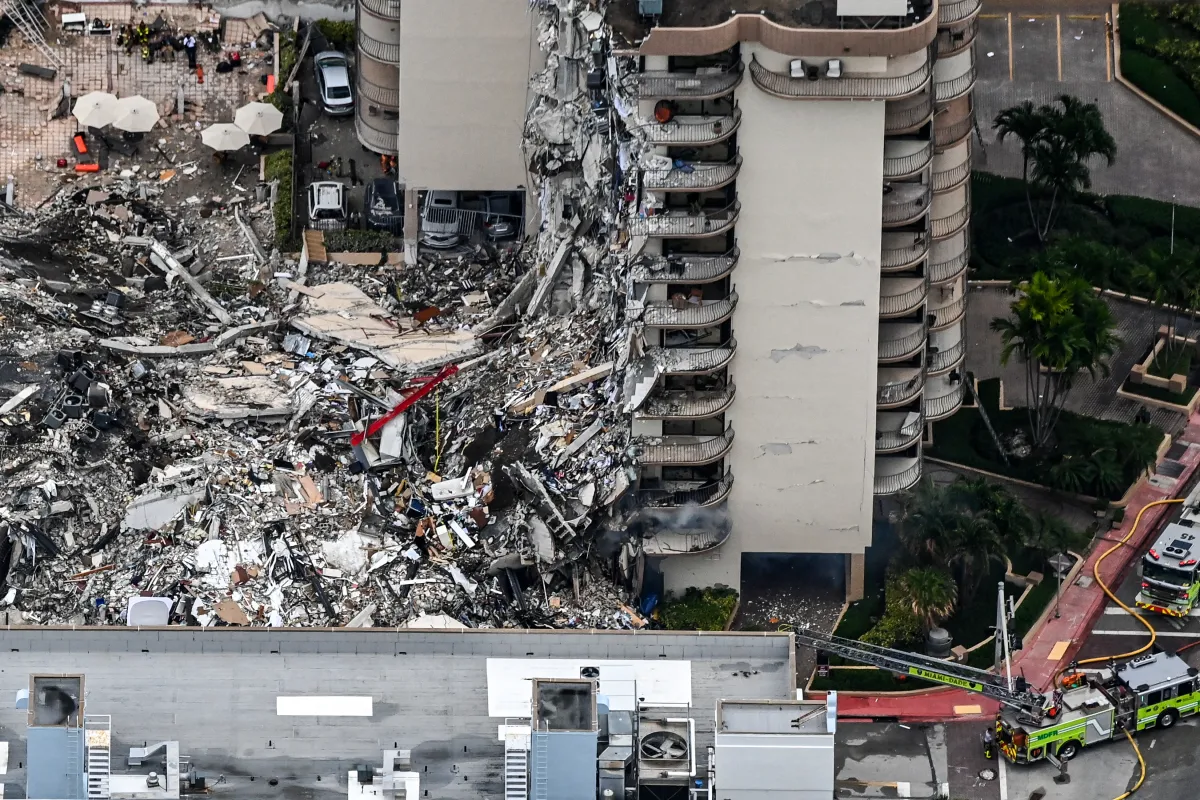
In the heavy, humid silence of a midsummer night along the Atlantic coast, the comforting illusion of safety that millions of tower-dwelling residents take for granted was shattered in a matter of seconds. On June 24, 2021, at approximately 1:25 a.m., the eastern portion of Champlain Towers South—a 40-year-old, 12-story oceanfront condominium in the quiet Miami suburb of Surfside, Florida—abruptly collapsed. Chilling security footage captured from neighboring buildings revealed the catastrophic failure: a massive section of the 136-unit structure dropped straight down, disintegrating into a monumental heap of pulverized concrete, twisted rebar, and billowing plumes of white dust. What initially appeared to be a localized emergency with a single confirmed death quickly unfolded into a tragedy of historic proportions, with the final death toll reaching a staggering 98 individuals, making it one of the deadliest structural failures in United States history. For the community of Surfside, the state of Florida, and the nation at large, the event was a traumatic wake-up call that defied comprehension. The immediate aftermath was defined by a frantic, heart-wrenching rescue operation that soon transitioned into a somber recovery mission, leaving families suspended in an agonizing limbo as they waited for news of their missing loved ones. Beyond the immediate wreckage, the disaster sparked a massive civil legal battle led by attorneys like Stuart Z. Grossman, who eventually secured a historic $1 billion settlement for the survivors and victims’ families in May 2022. Yet, despite the swiftness of this litigation, the emotional wounds remain deep and unhealed. Grossman still struggles to speak of the disaster without pausing to steady his voice, haunted by the absolute innocence of the victims who went to sleep in a building they believed to be secure. He remembers the college student who came down from Chicago to celebrate his grandfather’s birthday, meeting his girlfriend only to die in the collapse mere minutes after taking the elevator up to the unit, and the distraught mother whose entire life revolved around the daughter she lost that night. These deeply personal losses underscore the reality that Surfside was not just a failure of engineering, but a devastating human tragedy that permanently erased generations of families and shattered the fundamental expectation of safety in one’s own home.
As the dust settled, structural engineers, federal investigators, and forensic architects began the painstaking process of uncovering how a major oceanfront condominium could suddenly fall without warning. Early investigations quickly pinpointed the epicenter of the failure to the building’s pool deck slab, which had suffered from severe punching shear failures over several decades of constant exposure to salt air, standing water, and chemical runoff. The pool deck’s design lacked the necessary waterproofing sloped surfaces, allowing water to pool continuously and penetrate the concrete, which in turn severely corroded the internal steel reinforcement bars designed to hold the weight of the structure. However, as investigators dug deeper into the history of Champlain Towers South, they discovered that the pool deck was merely the catalyst for a much larger, systemic failure. Forensic analyses revealed grave design and foundational construction defects dating all the way back to the building’s completion in 1981, indicating that the high-rise had been structurally compromised from its very inception. This structural frailty was exacerbated by forty years of deferred maintenance, administrative neglect, and a culture of avoidance within the condominium association. Crucially, a detailed engineering report commissioned in 2020 had explicitly warned the association of major structural damage, yet the condo board lacked the necessary reserve funds to execute the multimillion-dollar repairs required to make the building safe. For decades, the association, like many others across coastal Florida, had repeatedly voted to waive or underfund their reserve accounts to keep monthly homeowner association (HOA) fees low, effectively kicking the financial can down the road while salt-rich Atlantic breezes quietly ate away at the concrete bones of their homes. This lethal combination of original construction errors, severe environmental degradation, and decades of financial paralysis turned the building into a ticking time bomb, showing that the tragedy of Surfside was as much a failure of governance and financial planning as it was a physical collapse.
The sheer scale of the Surfside catastrophe shocked the public conscience and forced Florida’s lawmakers to confront the systemic vulnerabilities of the state’s massive condominium market, prompting what many have called the most aggressive building safety reform in Florida’s history. Recognizing that hundreds of aging towers lined the state’s vulnerably exposed coastlines, the Florida Legislature enacted a sweeping set of safety reforms under the Building Safety Act in May 2022. This comprehensive legislative package sought to eliminate the decades-long practice of allowing condo boards to defer critical maintenance and ignore structural warnings. Under the new laws, any condominium building in Florida that stands at least three stories tall must undergo a mandatory “milestone inspection” by a licensed engineer or architect once it reaches 30 years of age, or 25 years if the property is located within three miles of the coastline, with subsequent inspections required every ten years thereafter. Furthermore, the legislation introduced the Structural Integrity Reserve Study (SIRS), a rigorous financial and physical analysis designed to evaluate the current state of a building’s critical safety components, including its roof, structure, fire protection systems, and load-bearing walls. Most importantly, the law banned the practice of waiving reserve funding for these vital repairs; beginning in late 2024, condo boards were legally mandated to fully fund their reserves to ensure that cash would always be available to address structural issues immediately. This legislative shift placed Florida among a small group of only eleven states in the nation that legally mandate such reserve funding, permanently altering the landscape of property management. Robert Smith, president of FirstService Residential’s South Region, reflected on the reform as a necessary “safety reset” that, despite its logistical and financial pain, would establish a lasting legacy of healthy, structurally sound buildings for future generations of Floridians.
While the legislative reforms were undeniably necessary to prevent further loss of life, their implementation sent shockwaves through the Florida housing market, triggering a massive affordability crisis for thousands of middle-class and retired condominium owners. For decades, many seniors and key workers had purchased units in older, oceanfront high-rises as their final homes, trusting that their fixed incomes would cover their basic living expenses. The sudden mandate to fully fund structural reserves and address decades of neglected maintenance overnight resulted in astronomical special assessments and ballooning monthly HOA fees, in some cases skyrocketing by thousands of dollars per month. Faced with bills they had no hope of paying, desperate owners flooded the market with their properties, only to find a real estate landscape that had suddenly dried up, as prospective buyers shied away from buildings facing expensive inspections and repairs. This massive influx of inventory caused property values in older buildings to plummet, trapping owners who could neither afford to stay in their homes nor find a buyer willing to take on their financial liabilities. Property insurance expert Gina Clausen Lozier observed that this created a devastating snowball effect, leaving many owners defaulting on their mortgages, abandoning their units, or being forced to relocate out of state entirely. The crisis ultimately divided the Florida condo market into two wildly divergent segments: a flourishing luxury sector where wealthy buyers easily absorbed the rising costs, and a struggling tier of older, more modest buildings where residents faced housing insecurity. In response to mounting public outcry and fears of widespread foreclosures, Florida lawmakers and Governor Ron DeSantis intervened in June 2025 by signing bills HB 913 and HB 393, which offered temporary financial relief by extending reserve study deadlines and permitting a two-year pause in reserve contributions to allow communities to prioritize making immediate, life-safety structural repairs first.
Amidst this highly turbulent landscape of financial reform and structural reckoning, the psychology of the typical Florida condominium buyer has undergone a profound, permanent evolution. Prior to the Surfside disaster, real estate transactions in coastal Florida were driven almost entirely by lifestyle aesthetics, where prospective buyers prioritized panoramic ocean views, resort-style amenities, updated kitchen finishes, and prime geographic locations, with almost no regard for the underlying engineering health of the high-rises. Today, however, industry experts note that the average buyer has become exceptionally educated, analytical, and risk-averse. According to resident services expert Robert Smith, today’s prospective buyers are bypassing cosmetic features to ask highly sophisticated questions regarding a building’s structural integrity reserve studies, historical maintenance logs, milestone inspection reports, and the likelihood of impending financial assessments. This massive shift in consumer behavior has fundamentally rewritten the rules of the real estate market, rewarding proactive condominium boards that have spent years systematically investing in their properties, while severely penalizing communities that previously opted for cheap, short-term solutions. Well-prepared boards have managed this transition with relatively minor disruption, treating structural maintenance as an expected, routine cost of operations. Conversely, those communities that neglected their physical assets are now trapped in a cycle of emergency meetings, navigating severe resident backlash, and scrambling to obtain licensed engineered assessments in a market facing a severe shortage of qualified structural professionals. The ongoing transition has made it clear that physical safety and financial stability are no longer secondary concerns but are now the primary drivers of real property value, establishing structural integrity as the ultimate and most necessary amenity in modern Florida real estate.
Despite these sweeping legislative shifts and a heightened public awareness surrounding high-rise safety, deep apprehensions remain regarding whether Florida has done enough to truly prevent another catastrophic collapse. Skeptics like attorney Stuart Z. Grossman point out that while stronger safety laws exist on paper, the state’s current framework still suffers from critical loopholes, including a worrying lack of centralized public oversight and enforcement mechanisms. Grossman argues that condo boards are still too often allowed to keep the highly troubling findings of their internal engineering reports hidden from the broader public, suggesting that true safety will only be achieved when boards are legally required to report their inspection findings and repair progress directly to a state regulatory agency. Furthermore, the financial strains of the new laws have created a legally precarious environment where some board members and property managers, fearing personal liability and financial ruin, may resign rather than confront the monumental task of fixing ancient high-rises. Insurance expert Gina Clausen Lozier points out that the threat of litigation remains a powerful motivator for professional compliance, especially since the legal fallout from Surfside saw lawsuits targeted at virtually everyone who had ever set foot in or managed Champlain Towers South, yet the physical reality of South Florida’s environment cannot be legislated away. The destructive combination of corrosive salt-water intrusion, aggressive sea-level rise, and porous limestone foundations means that coastal buildings will always face extreme wear and tear, indicating that the risk of failure is an ongoing threat. Ultimately, as Florida navigates this difficult new era, the memory of the 98 victims of Surfside serves as a tragic reminder that structural safety is not a one-time legislative achievement, but a continuous, expensive, and non-negotiable commitment to preserving human life.