



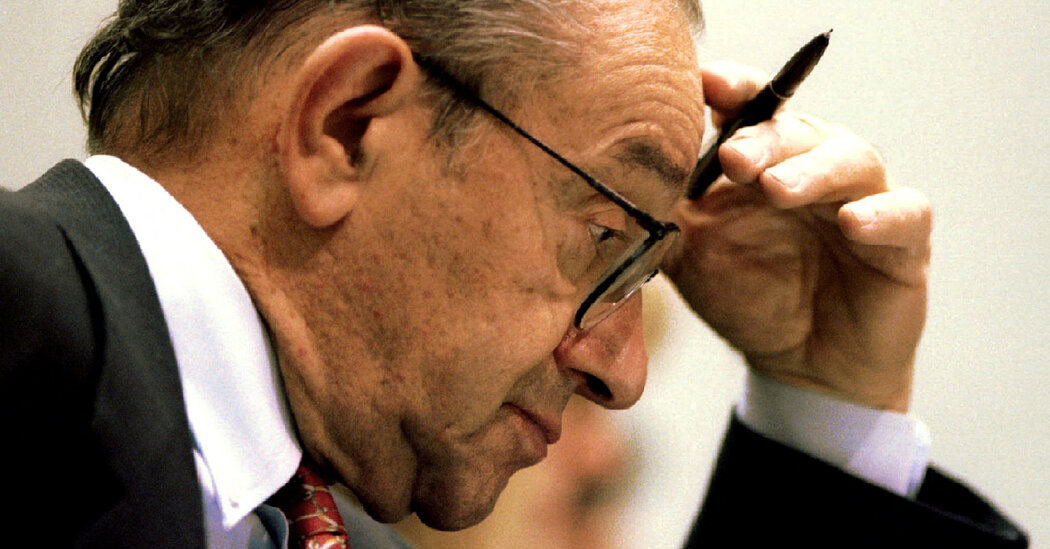
On a crisp, tense autumn morning on October 23, 2008, the United States found itself staring directly into an economic abyss that felt chillingly close to total collapse. The grand, seemingly invincible pillars of American finance were crumbling; Bear Stearns and Lehman Brothers had disintegrated, and the federal government was taking unprecedented equity stakes in private banks simply to halt a terrifying, systemic freefall. Across the nation, ordinary families were drowning in toxic mortgage debt, witnessing their life savings evaporate, and facing the grim reality of a brutal, unforgiving recession. It was against this backdrop of historic failure that Alan Greenspan, the legendary former chairman of the Federal Reserve who had stepped down just two and a half years prior, walked into a crowded congressional hearing room to face the music. For nearly two decades, Greenspan had been the undisputed high priest of the free-market system, an intellectual titan who had fought tirelessly against government regulation, which he viewed as a clumsy, counterproductive intrusion into the natural harmony of capitalism. Yet, as he sat before the House Committee on Oversight and Government Reform, the sheer gravity of the crisis forced him to do something almost entirely foreign to modern public figures: he admitted, openly and without reservation, that he had been fundamentally wrong. His cherished conviction that the enlightened self-interest of lending institutions would naturally shield shareholders and the public from catastrophic risks had been shattered, leaving him in a state of “shocked disbelief” as he watched his entire life’s work and the global financial architecture collapse. This rare, raw moment of public vulnerability was not merely a personal comedown; it was a watershed moment in economic history, revealing that even the most celebrated minds can succumb to a dangerous intellectual blindness when their pet theories are allowed to run unchecked.
To truly understand the profound weight of Greenspan’s historic congressional confession, one must appreciate the remarkable, almost cinematic journey of the man himself—a figure who bridged the gap between austere academic theory and high-stakes cultural celebrity. Born into modest circumstances and raised by a devoted single mother during the bleakest years of the Great Depression, Greenspan’s early life was defined more by the expressive rhythms of music than the rigid equations of monetary policy, spending his youth touring the nation playing saxophone in a professional swing jazz band. This creative curiosity eventually gave way to an analytical obsession with numbers and systems, leading him to obtain a doctorate in economics and, crucially, to fall under the spell of Ayn Rand, the controversial philosopher of radical individualism whose uncompromising faith in laissez-faire capitalism became the permanent North Star of his intellectual life. Armed with these principles, Greenspan ascended the ranks of corporate consulting and federal policymaking, eventually securing the chairmanship of the Federal Reserve and transforming the role into a locus of unprecedented personal power. He became the nation’s first—and arguably last—celebrity central banker, moving effortlessly through a glittering social orbit of diplomats, corporate giants, and media elites alongside his wife, the prominent journalist Andrea Mitchell. Throughout his nearly twenty-year tenure, Greenspan enjoyed a level of bipartisan reverence that seems unimaginable in today’s polarized political landscape; he was confirmed for his fifth term with a virtually unanimous Senate vote, and major political figures openly hailed him as the greatest central banker in American history, an oracle whose notoriously cryptic, abstruse speeches were parsed by Wall Street tycoons and ordinary homeowners alike as if they were sacred prophecies.
This immense public trust was built on a foundation of historic prosperity, as Greenspan presided over a decade of dizzying economic expansion during the 1990s, but it was during this golden era that the seeds of his future undoing were quietly sown. As the stock market soared to unprecedented heights driven by the early internet boom, Greenspan began to harbor private anxieties about speculative mania, leading him to deliver his famous 1996 speech where he wondered aloud whether investors were exhibiting signs of “irrational exuberance.” The immediate, panicked reaction of the global markets—which saw index boards plunge spectacularly in a matter of hours—stunned Greenspan and forced him to confront the terrifying power of his own voice, as well as the immense volatility of global capital. When the markets swiftly rebounded and continued their breathless, defiant ascent despite his warnings, Greenspan experienced a fundamental crisis of faith in his own ability to govern the financial tides, concluding that the Federal Reserve could neither accurately identify when an asset class was truly overvalued nor successfully fight the colossal momentum of free-market forces. Rather than utilizing his regulatory powers to cool down speculative fevers, he retreated into a passive, hands-off philosophy that would define the rest of his career: a pattern of letting economic bubbles inflate unchecked, while assuring himself and the public that the Fed’s primary role was simply to step in with cheap interest rates and clean up the debris after those bubbles inevitably popped. This approach, while comforting to investors in the short term, created a dangerous moral hazard that encouraged continuous risk-taking, as Wall Street came to believe that Greenspan would always act as a financial safety net.
This passive, mop-up-the-mess regulatory style was further reinforced by Greenspan’s genuine fascination with the digital revolution of the late twentieth century, an intellectual passion that ultimately blinded him to the structural dangers accumulating beneath the surface of the economy. Raised during an era of scarcity but possessing a forward-looking mind, he was the first Federal Reserve chief to fully grasp how computers and digital networks would revolutionize workplace productivity, allowing the American economy to expand at a faster clip without triggering the traditional threat of runaway consumer inflation. However, this techno-optimism seduced him into a dangerous complacency, as he became utterly convinced that modern financial institutions had developed computer-driven risk-management models of such extraordinary mathematical sophistication that they could plan for and mitigate almost any conceivable economic shock. Trusting these elegant algorithms and the self-correcting nature of private lenders, Greenspan repeatedly used the Fed’s power to lower interest rates to rescue Wall Street from successive disruptions—such as the near-collapse of a giant hedge fund in 1998, the subsequent dot-com bust, and the anxiety of early-2000s corporate scandals—flooding the financial system with waves of cheap capital. What he failed to realize was that this persistent, ultra-low interest rate environment was acting as the primary fuel for a new and far more toxic phenomenon: a massive, unchecked housing bubble. Blinded by his belief in the digital age’s risk-modeling capabilities, Greenspan brushed aside warning signs, convinced that the sophisticated financial engineering of major banks, which sliced and diced mortgages into complex securities, would naturally protect them and their shareholders from catastrophic losses.
As the housing market boiled over in the mid-2000s, this reliance on abstract mathematical models led to a tragic, systemic failure of fundamental bank supervision. In the years leading up to the crash, mortgage brokers and financial institutions abandoned traditional lending standards entirely, peddling high-risk subprime loans with predatory teaser rates to buyers who lacked verified income or assets, while speculators chased quick profits by flipping properties. Rather than using the Fed’s direct, targeted regulatory authorities to step in and mandate that lenders verify their clients’ ability to repay, Greenspan dismissed these omnipresent warning signs, relying on the high-minded academic argument that raising interest rates was too “blunt” of an instrument to address a localized housing issue. This defense laid bare a profound shift within the Federal Reserve itself, which had evolved from its original, hands-on design as an association of practical bankers tasked with policing local lending into an insular temple of academic economists obsessed with computer models and theoretical macroeconomic targets. Greenspan, the celebrity Ph.D., spent his energy managing the elegant mechanics of interest rates, showing little interest in the gritty, detailed, and unglamorous paperwork of banking regulation, such as ensuring that mortgage applications were truthful and sound. By treating banking regulation as an outdated relic of an over-governed past, Greenspan and his fellow regulators left the vault doors wide open, allowing predatory brokers and overly leveraged investment banks to build a multi-trillion-dollar house of cards on a foundation of bad debt, entirely unbothered by any watchful eye from the nation’s central bank.
Ultimately, Greenspan’s dramatic testimony in October 2008 remains one of the most powerful, humbling lessons in modern economic history, illustrating how intellectual overconfidence can blind even the most brilliant minds to unfolding catastrophe. The collapse of the global financial system did not just wipe out trillions of dollars in household wealth; it utterly shattered the intellectual edifice that Greenspan had spent a lifetime constructing and promoting with such absolute certainty. Yet, in his willing vulnerability to stand before the public, look back at his long career, and utter the words “I made a mistake,” Greenspan displayed a rare and deeply human quality that is almost entirely missing from our contemporary political landscape, where leaders routinely choose self-preservation and doubling down on failed dogmas over honest self-reconciliation. His legacy is therefore a complex, cautionary tale: a reminder that the world is far more chaotic, interconnected, and fragile than any economic model can ever predict, and that private self-interest is a poor substitute for rigorous, real-world ethical oversight. As today’s financial leaders navigate a new era of technological disruption, algorithmic trading, and shifting economic paradigms, they would do well to remember Greenspan’s painful moment of reckoning, recognizing that true wisdom lies not in the unshakeable certainty of one’s theories, but in the humility to recognize their limitations and the courage to change course before a crisis forces the issue.