

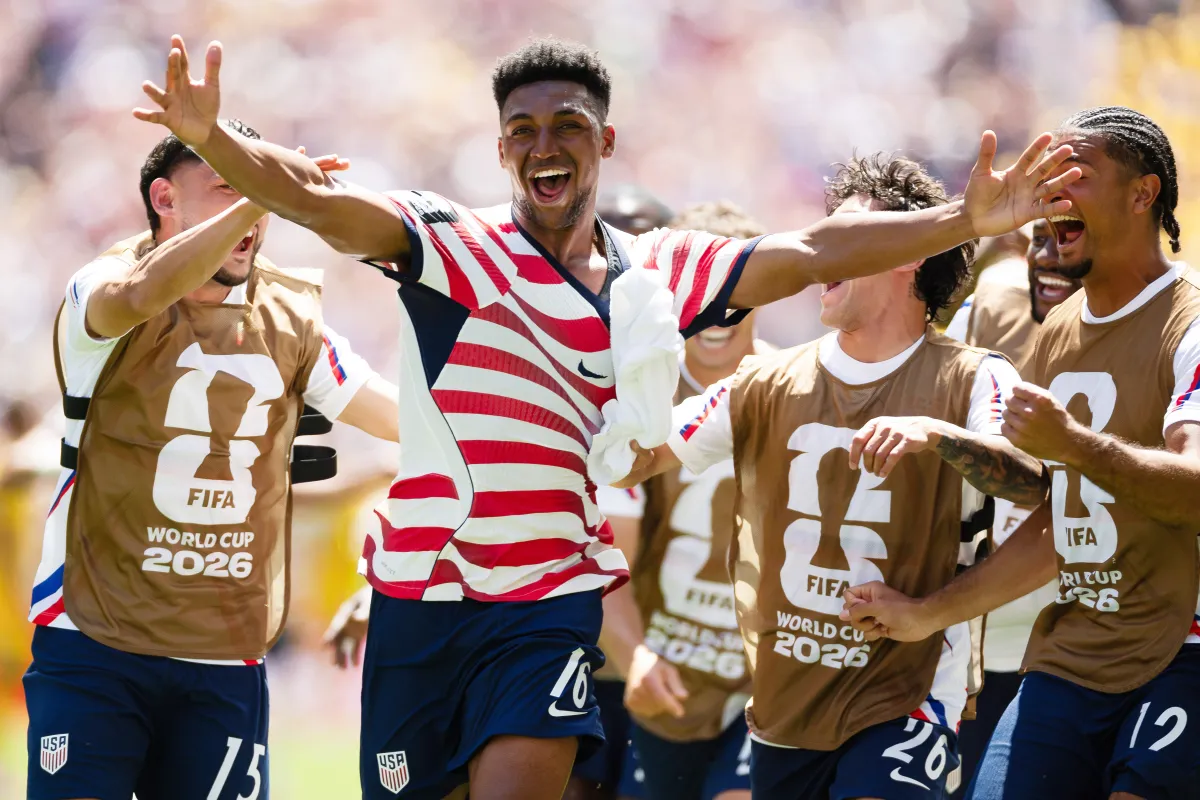
The air surrounding the 2026 World Cup across the United States has been nothing short of electric, charged with the collective dreams of a nation desperate to establish itself as a genuine powerhouse of the world’s game. For decades, soccer in America has existed in a perpetual state of “almost there,” a sport always on the cusp of capturing the mainstream public imagination but often halted by early exits and systemic growing pains. Yet, as the expanded 48-team tournament kicked off on North American soil, the United States Men’s National Team (USMNT) seemed poised to finally shatter those historic ceilings. With two masterclass performances resulting in a thrilling 4-1 dismantling of Paraguay and a clinical, commanding 2-0 victory over Australia, the young squad ignited a fever pitch of optimism from coast to coast. Fans and pundits alike began whispering about the impossible, envisioning a fairy-tale run deep into the tournament’s final weekends. However, just as this wave of euphoric hope threatened to boil over, one of the country’s most decorated and iconic sporting figures stepped forward to inject a sobering, ice-cold dose of reality into the national conversation. Tim Howard, the legendary former goalkeeper who guarded the American net with unmatched ferocity for fifteen years between 2002 and 2017, took to the airwaves on “Unfiltered Soccer” to deliver a brutal, uncompromising assessment that left the American soccer community reeling. Without hesitation or sugarcoating, Howard declared that despite the dazzling start, the United States has absolutely no chance of lifting the iconic golden trophy, dismissing the dream of a historic championship as a physical and psychological impossibility.
To understand the weight of Howard’s skepticism is to understand the sheer, agonizing difficulty of the tournament’s latter stages, a reality that the average fan often overlooks in the heat of group-stage excitement. Howard did not merely express doubt; he shut the door entirely, using language that left no room for nuance or optimistic misinterpretation. He argued that for the United States to actually win the World Cup, they would have to achieve a level of sustained perfection that is fundamentally antithetical to the unpredictable and highly volatile nature of tournament soccer. Specifically, Howard pointed out that the squad would be required to play the absolute greatest, most flawless match of their collective lives not just once, but four consecutive times in a row: through the relentless gauntlet of the Round of 16, the high-stakes pressure cooker of the quarterfinals, the agonizingly tense semifinals, and finally, the ultimate showcase of the final itself. While commentators have pointed out that Howard might be using the word “literally” with a degree of hyperbole, his core message remains a profoundly grounded take on the realities of elite international sports. As a former Premier League standout who spent years facing the world’s most lethal strikers, Howard knows that a team cannot rely purely on momentum or home-field advantage to carry them through four successive matches against the absolute titans of South America and Europe, where a single defensive lapse or a moment of sheer individual genius from an opponent can instantly end a four-year cycle of preparation.
Howard’s harsh truth-telling is deeply rooted in the historical scars of the USMNT, a program that has consistently hit a glass ceiling whenever they have crossed over into the knockout rounds. Since the inaugural World Cup in 1930—where the Americans achieved their best-ever finish of third place in a vastly different era of global sports—the modern national team has struggled to replicate that success. The closest they have come in the contemporary era was in 2002, when a golden generation managed to reach the quarterfinals before being eliminated by a powerhouse German side. Howard himself lived through these heartbreaking barriers; fans will forever remember his legendary, record-breaking 16-save performance against Belgium in 2014, a superhuman effort that still resulted in a round-of-16 exit, proving that even playing the game of one’s life is sometimes not enough to overcome the world’s elite. The betting markets seem to validate Howard’s cold pragmatism; despite their current undefeated, red-hot streak, FanDuel sportsbook lists the Americans at +3300 odds to go all the way and win the championship, placing them firmly in the category of romantic longshots rather than realistic contenders. For someone like Howard, these numbers are not just statistics—they represent a deeply ingrained cultural and tactical barrier that cannot be easily dismantled by a couple of impressive group-stage performances against lower-ranked opponents.
Yet, the sheer disconnect between Howard’s grim prognosis and the vibrant reality on the pitch is precisely what makes the current iteration of the USMNT so fascinating to watch. This is not the gritty, defense-first American squad of yesteryear that relied solely on counterattacks and heroic goalkeeping to survive; this is a highly technical, aggressively minded group of young athletes who ply their trades in the top leagues of Europe. At the heart of this cultural shift is Folarin Balogun, who has emerged as one of the standout superstars of the entire tournament, terrorizing opposing defenders with his blistering pace, clinical finishing, and intelligent off-the-ball movement. Balogun’s two goals and crucial playmaking contributions have energized the American attack, while young breakout stars like Alex Freeman have brought a refreshing, fearless swagger to the squad’s defensive and transitional play. This youth movement represents a generation of American players who do not carry the psychological baggage of past failures, having grown up in an era where American players are respected elite entities globally. For them, the skepticism of older generations, even from legends like Howard, is simply background noise to be silenced rather than a definitive prophecy of their limitations, fueling their desire to prove that the old rules no longer apply.
The test of which narrative will prevail begins in earnest as the group stage draws to a dramatic close and the ruthless reality of single-elimination play looms on the horizon. The USMNT is scheduled to wrap up their Group D campaign in Santa Clara against a dangerous and tactically disciplined Turkiye squad, a match that will serve as a crucial litmus test for their defensive stability and mental fortitude under pressure. Beyond that final group fixture lies the terrifying uncertainty of the Round of 16 on July 1, where the margin for error shrinks to absolute zero and the real World Cup effectively begins. While their exact opponent remains up in the air, analysts are keeping a close eye on the unfolding drama of Group B, where a crucial matchup between Bosnia and Herzegovina and Qatar in Seattle will likely determine who crosses paths with the Americans. It is in these high-stakes fixtures where Howard’s warnings will truly be tested; it is one thing to dominate a group-stage game with the backing of a partisan home crowd, but it is an entirely different beast to maintain tactical discipline when a single mistake means instant elimination and national heartbreak on the world’s biggest stage.
Ultimately, the clash between Tim Howard’s hard-nosed realism and the unbridled optimism of the current USMNT highlights the beautiful, agonizing paradox at the very heart of sports fandom. Pragmatism and historical statistics will always dictate that a non-traditional soccer nation like the United States cannot win a tournament of this magnitude, but sports are rarely defined by logic alone. What Howard views as a “literally impossible” task—playing four perfect games in a row—is precisely the kind of mythic challenge that inspires athletes to transcend their perceived limits and write their names into the annals of history. Whether this young, hungry American squad collapses under the weight of expectations or manages to defy the odds and prove their former icon wrong, their journey has already succeeded in reigniting a profound national passion. In the end, the true victory of this 2026 run might not just be about lifting a trophy, but about transforming the cultural consciousness of American soccer, proving to the world, and perhaps to skeptical legends like Tim Howard himself, that the impossible is merely a starting point for greatness.