


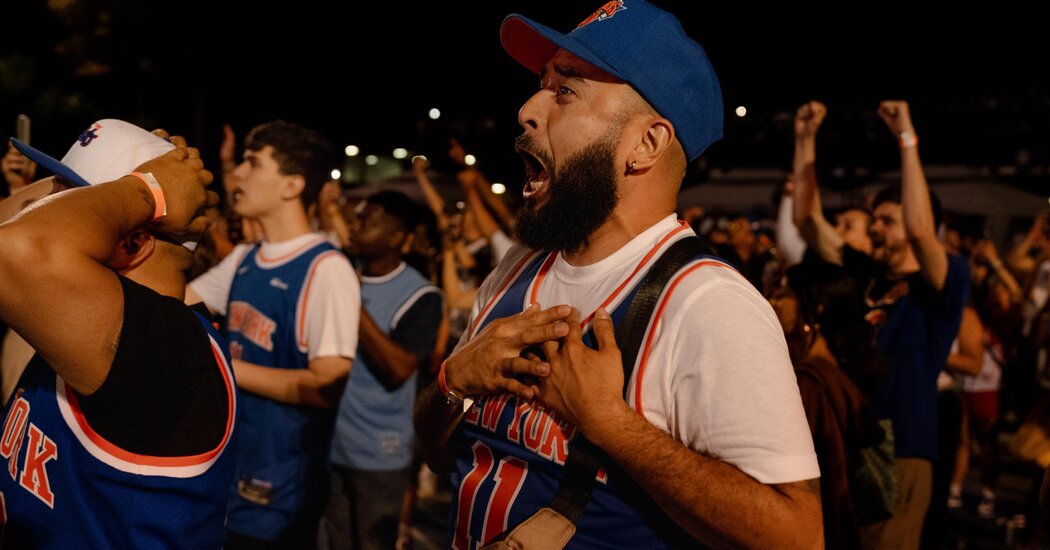
This is what the absolute release of a half-century of pent-up sports-induced agony looks like when it finally explodes into the concrete canyons of New York City. It is a brilliant, chaotic, and beautiful mosaic of giggling, weeping, spinning, convulsing, and spontaneous mosh pits forming on asphalt, accompanied by the endless, rhythmic blare of truck horns and the off-key trumpets played by street musicians on crowded street corners. Strangers are wrapping their arms around each other with such violent affection that people are lifted entirely off their feet, while yellow cab drivers crawl through the gridlock, eagerly extending their arms out of rolled-down windows to exchange triumphant fist-bumps with the delirious masses. Adults and children alike sit perched on top of shoulders to get a better view of the surrounding madness, while the more daring revelers scale green construction scaffolds, traffic light poles, and street trees, waving the iconic orange and blue team flags high above the city skyline. Standard orange utility cones have been swiped from active construction sites and proudly placed on heads to serve as makeshift championship crowns, a fitting tribute to the team colors that now dominate every square inch of the pavement. Outside Madison Square Garden, the ground is literally stained with the tears of generations of fans who had spent decades walking away from this building with their heads bowed in disappointment, having endured debacle after heartbreaking debacle. But on this night, the trauma of the past has been completely washed away, replaced by the sound of thousands of voices singing Frank Sinatra’s “Theme from New York, New York” in unison in the middle of a Broadway bike lane, interrupted only by the guttural, primal, and deeply soul-stirring screams of a fan base that has finally found its collective voice, shouting the name of their beloved team into the night sky as a tribute to themselves, their city, and the generations of departed loved ones who would have given anything to see this day.
For exactly fifty-three years—a grueling, often shambolic, and perpetually faith-testing stretch of time—New York sports fans had quietly harbored a burning curiosity about what it would actually feel like to celebrate a championship for the one team this city truly cares about above all others. Other metropolises had enjoyed their parades and their moments of glory multiple times over, leaving New Yorkers to wonder if they were cursed to forever remain the league’s most expensive and most loyal spectators. Yet, when the final buzzer sounded on early Sunday morning, it became immediately clear that asking how New York would celebrate was the wrong question entirely, because the city’s reaction was something that could never be replicated anywhere else on earth. With firecrackers exploding underfoot and empty bottles of champagne clattering against the vibratory pulse of the subway grates, the celebration was defined by the unique, claustrophobic brilliance of New York itself—a city experienced at maximum volume, in the tightest possible quarters, by those brave and stubborn enough to call it home. Basketball here is not just a pastime; it is the civic religion of the five boroughs, born on the rugged asphalt of Rucker Park and nurtured by the metallic clang of chain-link nets on playground courts where games are played to eleven, ones and twos. It is an identity stitched into the fabric of the streets, worn proudly on custom t-shirts and manifested in the sight of a man sporting an orange-and-blue mohawk skipping joyously down the street or a woman twerking atop a flatbed truck surrounded by hundreds of newly minted friends. In a city where so little is felt universally due to the vast divides between the ultra-wealthy and the completely broke, this championship acted as a rare, massive evening-out of the playing field, proving that for all its modern fractures, New York is never smaller or more unified than when it is wrapped in the colors of the Knicks.
Perhaps the most disorienting aspect of this historic championship run was the realization that a shared, unifying headline in New York City was actually allowed to be something entirely good, joyful, and uncomplicated. For decades, the monumental events that succeeded in bringing the vast, diverse population of this metropolitan area together under one emotional umbrella were almost exclusively characterized by profound, unbearable tragedy: the collective trauma of September 11th, the destructive fury of Hurricane Sandy, and the isolating, dark days of the Covid-19 pandemic. To have the entire city vibrate with a singular, positive emotion felt like a collective shock to the nervous system, prompting even the most cynical citizens—including the on-duty police officers quietly checking their phones behind metal barricades—to pause, smile, and tell people to simply enjoy the historical magnitude of the moment. There was a beautiful, refreshing simplicity to it all, a sentiment echoed by Hall of Famer and legend of the last championship era Bill Bradley, who observed that the ultimate beauty of basketball lies in its complete lack of ambiguity. The ball either goes through the net or it does not, leaving absolutely no room for doubt, political debate, or existential dread about what has just occurred on the court. Despite the lingering disbelief of fans who had spent decades waiting for the other shoe to drop, the reality of their triumph finally settled into their bones as the night wore on, punctuated by the rhythmic chanting of “Knicks in five!” bouncing off the sides of garbage trucks and vibrating through the ceilings of underground subway cars rushing through the dark.
While the most visible faces of this historic night were undoubtedly the loud internet content creators broadcasting their reactions to Seventh Avenue or the rowdy daredevils climbing atop police vans, the true soul of the victory belonged to the quiet, intensely superstitious obsessives who could only bear to watch the games in isolation. These are the lifers who had spent decades cradling a quiet hope, the fans who watched every disappointing season from the edge of their seats, and who will undoubtedly tear up years from now catches a glimpse of this championship roster. The victory belonged to the young families who chose to wake up their sleeping children to witness history, like five-year-old Albie, who sat bleary-eyed in his father’s arms in the middle of a lively Brooklyn street, raising a single finger to the sky as a quiet symbol of his budding, lifetime devotion. It belonged to the schoolchildren who had spent the preceding weeks proudly taking blue-and-orange-dyed bagels in their lunchboxes, and the newly arrived locals who, through their shared tears of joy on the pavement, were finally baptized as true, proper New Yorkers. The players themselves seemed to intuitively understand that they were not just playing for a sports franchise, but were serving as the custodians of a collective dream that had been passed down from parents to children, bridging the gap between the generation that remembered the glory of 1973 and the generation that was experiencing the magic of championship basketball for the very first time.
This deep, reciprocal connection between the team and its fan base was forged because this specific group of players perfectly mirrored the relentless, hard-working spirit of the city they represented. Their undisputed leader, Jalen Brunson, served as the ultimate avatar for the New York grind—an undersized point guard who had been consistently underestimated by his former team, but who possessed a work ethic and mental toughness cultivated by his father, himself a former Knick who knew exactly what it took to survive and succeed under the bright lights of Manhattan. Every game-winning play, such as OG Anunoby’s spectacular, logic-defying, sideways-flying tip-in during the final seconds of Game 4, felt less like a standard athletic highlight and more like a physical manifestation of New York’s refusal to back down from a fight. The team’s starting center, Karl-Anthony Towns, who grew up just across the Hudson River in New Jersey and quickly earned the affectionately local moniker “Bodega KAT,” openly recognized that their style of play was a direct reflection of their fans’ struggle to survive and thrive in a highly competitive city. In a metropolis where daily life is defined by astronomical rents, unreliable public transit, and a stubborn rat population, New Yorkers accept a certain level of baked-in misery as the price of admission, making a hard-nosed, blue-collar basketball team the perfect representative of their daily hustle and relentless drive to succeed against all odds.
For over half a century, the Knicks’ constant disappointment had been accepted as just another part of that challenging New York bargain, a reliable source of sports-induced misery in a city that was constantly evolving around them. During the fifty-three years that elapsed between championships, New York avoided bankruptcy, witnessed the rise and fall of political movements, survived moments of immense tragedy, and produced legendary cultural figures from Jay-Z to Jerry Seinfeld, all while the Knicks remained a disappointing constant in the background of their lives. Yet this miraculous, jinx-defying season managed to collapse decades of time, bridging the gap between the past and the present and allowing fans of all ages to feel like children once again. Sexagenarians were instantly transported back to their youthful days in 1973 when they last tasted victory, while millennials were joyfully reminded of the grittier 1990s when the legendary faces of Patrick Ewing, John Starks, Allan Houston, and Latrell Sprewell decorated their bedroom walls. Ultimately, the magic of this championship lies in its unique ability to cut through the hardened exterior of even the most cynical New Yorkers, transforming a massive and intimidating metropolis into a warm, unified community of believers. As the morning sun began to peek over the skyscrapers, illuminating the discarded champagne bottles and the smiling faces of the remaining revelers, a solitary street vendor outside a halal cart captured the eternal essence of the moment, shouting a simple but profound command to everyone within earshot: “Remember today!”