


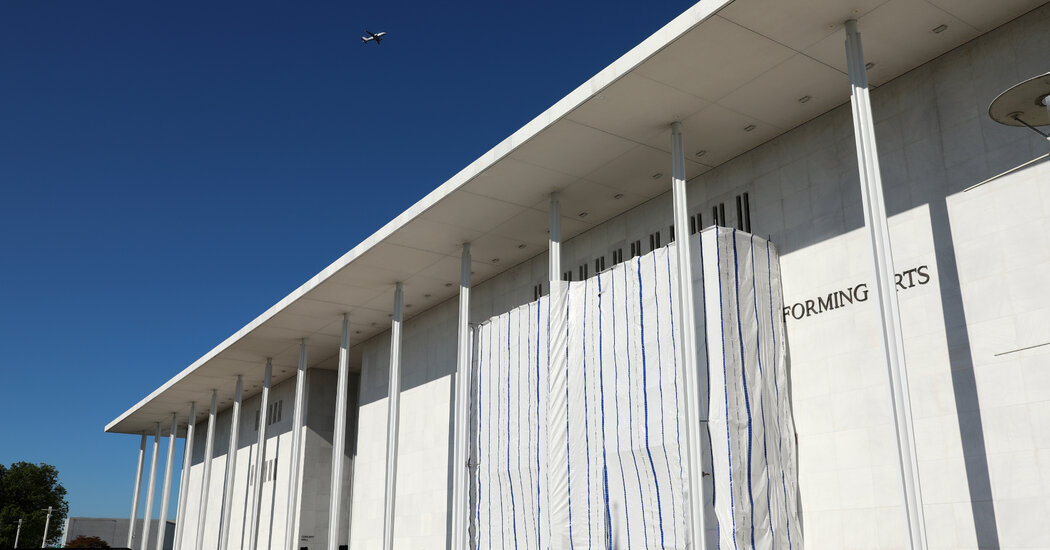
High noon in Washington, D.C., brings a heavy, stifling heat, but on this particular Saturday, the blazing sun did little to deter the crowd of nearly 150 concerned citizens gathered outside the John F. Kennedy Center for the Performing Arts. They had assembled on the concrete plaza, drawn by reports of a strict federal court deadline: by midday, the institution was legally required to certify that the name of President Donald J. Trump had been dismantled from its marble facade. When the clock struck twelve, the center’s administration did indeed file its compliance with the court, yet those who had traveled to witness this historic reclamation of the building’s original identity were met with anti-climax. Instead of a grand, clean limestone front, the exterior remained frustratingly obscured behind a massive scaffolding system draped in heavy, blue-and-white-striped construction tarps. Among the onlookers was Philip Bigge, who knelt on the dusty ground, attempting to peer through a narrow, teasing gap in the plastic sheeting to confirm if the letters had truly been pried away. Straining his eyes, he thought he could discern the faint, empty outlines where the name had once been bolted, offering him a quiet sense of reassurance that, despite the physical obscurity, the rule of law had prevailed. Beside him stood his 21-year-old daughter, Katy, a student at Rutgers University, who shared his relief but felt a more complicated mix of emotions, noting that while she had hoped for a dramatic visual reveal, there was still a satisfying, quiet triumph in knowing the controversial branding had been forced down.
Yet, for those who have spent years nurturing the Kennedy Center from within, the removal of the letters represents only the shallowest first step in a long, agonizing healing process. Cathleen O’Malley, a former manager in the artistic programming department who resigned in February, spent fourteen exhausting hours outside the building on Friday night, watching the slow-motion deconstruction under the cover of darkness. She warns that those who believe the cultural landmark will miraculously snap back to its vibrant, pre-pandemic glory the moment the facade is cleared are harboring a dangerous fantasy. Over the past sixteen months, the quiet hemorrhage of human capital—veteran staff members, artistic directors, and community liaisons who were laid off, fired, or driven to resign—has hollowed out the center’s operational core. These are the individuals who spent decades building trust with world-renowned performers and vital philanthropic donors, relationships that cannot simply be reinstalled like brass letters on concrete. Without this dedicated staff, the center remains an empty shell, its programming calendar largely vacant, and its reputation severely tarnished by the political storm that has raged through its offices.
The human collateral of this ideological warfare extends directly to the artists and patrons who once considered the center a second home. Paige Carter, a recent graduate of American University’s law school, stood on the plaza remembering the countless nights she spent lost in the magic of live theater and symphonic music, memories that made her decision to let her membership lapse incredibly painful. For loyal patrons like Carter, boycotting the institution was a necessary moral stance against what they saw as a hostile political takeover, yet the absence of their presence has created a heartbreaking silence in the lobbies. Meanwhile, the musicians of the National Symphony Orchestra find themselves caught in a terrifying limbo, preparing to play a Saturday concert that could very well be their last performance in the hall for years. The orchestra has been forced to operate without an approved budget for the upcoming season, leaving the players to perform under a cloud of immense professional and personal anxiety. The community of supporters remains intensely divided, with some advocating for total boycotts to starve the current administration of funds, while others argue that such actions only punish the innocent musicians and stagehands who have dedicated their lives to the preservation of American classical music.
This cultural stand-off is the direct result of a fierce legal battle over the legacy and ownership of Washington’s pre-eminent cultural sanctuary. Last month, Federal District Judge Christopher R. Cooper intervened, ruling that only the United States Congress—which originally dedicated the facility in 1964 as a living memorial to the assassinated President John F. Kennedy—holds the constitutional authority to alter its name or purpose. Trump’s allies on the board, who had voted in December to add the president’s name to the facade in exchange for promises of revitalization, have fiercely contested this ruling, immediately voting to launch a high-stakes appeal in the D.C. Circuit. Backed by the Justice Department, they argue that the rebranding was a brilliant financial maneuver, claiming that millions of dollars in private donations were strictly contingent upon putting the president’s name on the building. To further this transactional vision of cultural philanthropy, the board recently established the “Trump Kennedy Center Fund,” designed to channel private money into structural renovations under the guise of honoring the president’s contributions. Critics, however, view this fund as a cynical attempt to commodify a public memorial, pointing out that no public tax documents have yet been released to prove these grand financial claims, leaving the true economic impact of the political takeover completely shrouded in mystery.
Simultaneously, a parallel battle is being waged over a controversial proposal to entirely shutter the cultural center for a sweeping, two-year renovation project. The president’s point person for this endeavor, Executive Director Matt Floca, has painted a dire picture of the 1971 structure, pointing to severely deteriorated exterior marble, outdated theatrical equipment, and persistent, damaging water leaks that threaten the integrity of the performance spaces. While Judge Cooper agreed that these structural repairs are desperately needed—especially after the president helped secure a massive $257 million congressional appropriation for the work—he adamantly blocked the immediate, total closure of the building. The judge admonished the board for what he described as an “ill-informed” and hasty rubber-stamping of the shutdown plan, noting that they had failed to conduct any serious assessment of how a two-year dark period would devastate the regional economy, destroy the livelihoods of hundreds of artists, and alienate the local community. The court has demanded that the board halt any shutdown plans until they perform a rigorous, transparent study of the consequences, leaving the administration to choose between doing the actual work of institutional due diligence or continuing to seek a shortcut through the appeals court.
The frantic scramble to meet the court’s strict Saturday noon deadline for the removal of the letters unfolded like a tense, late-night theatrical drama of its own. Work crews were delayed on Friday night by severe summer thunderstorms that rolled across the Potomac River, prompting Floca to submit an emergency court filing requesting a twelve-hour extension. Lawyers representing Democratic Representative Joyce Beatty, an ex officio board member whose initial lawsuit triggered the court order, did not oppose the brief extension but openly scoffed at the delay, writing in their filings that the center’s leadership had possessed two full weeks to comply and only found themselves in a crisis because of their own inexcusable procrastination. It was only after multiple courts rejected the center’s desperate, last-minute appeals for a legal stay that the construction crews finally completed the scaffolding and began the work of removing the name. As the Saturday deadline passed and the legal papers were filed, the heavy tarps remained tightly drawn, leaving the true face of the Kennedy Center hidden from a public that is desperately waiting to see what remains of their beloved national monument.