


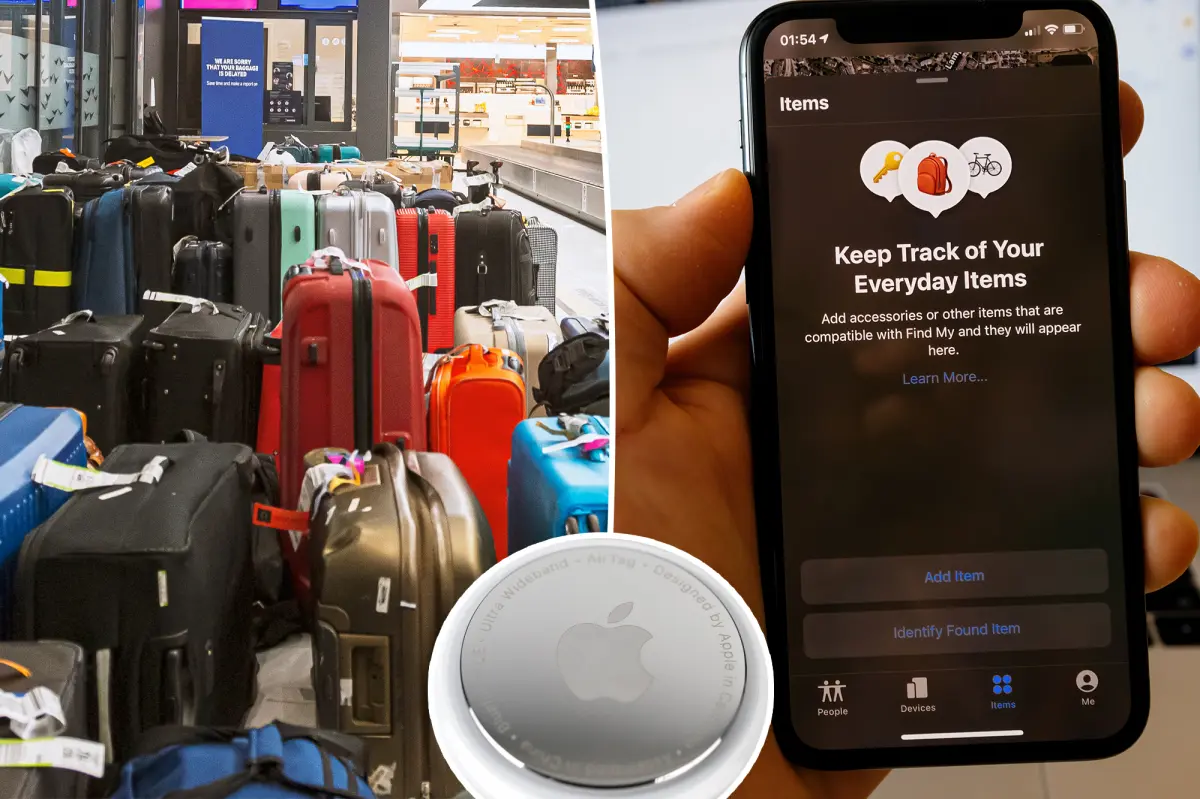
There is a universal, stomach-churning anxiety known to anyone who has ever stood beside a squeaking metal baggage carousel at the end of a long, exhausting journey. You watch as the crowd of fellow passengers slowly thins out, the suitcases on the belt dwindle to a trickle of lonely, unclaimed duffels, and the heavy machinery finally groans to a sudden, silent halt, leaving you standing in an empty terminal without your possessions. For Ami Bruni, this familiar travel nightmare transformed into a viral sensation that struck a deep, resonant chord with millions of frustrated flyers around the globe. After Delta Air Lines misplaced her bags during a routine trip, Bruni found herself locked in a profoundly irritating standoff with customer service representatives who repeatedly gave her information that directly contradicted what she knew to be true. The savior of her sanity—and the ultimate proof of her claims—was a tiny, silver-and-white disc nested deep inside her luggage: an Apple AirTag. Taking to the social media platform X (formerly Twitter), Bruni shared her utter exasperation, detailing how she was on her third phone call with the airline, politely but firmly dismantling their claims about her bag’s whereabouts by simply pointing out that her phone screen showed it sitting in a completely different location than what their system reported. Her blunt declaration that “airlines must hate AirTags” went viral, racking up nearly eight million views and eventually migrating to Reddit, where it ignited an intense, collective venting session about the perceived dishonesty of modern aviation logistics. To Bruni and the millions who cheered her on, the consumer tracking device was far more than just a convenient tech accessory; it was a digital shield against corporate gaslighting, exposing a massive, frustrating gap between the reality of airline operations and the official, often misleading narratives fed to anxious travelers stranded without their daily essentials.
Beneath the surface of Bruni’s viral post lies a much deeper, systemic issue that shapes how passengers experience the stressful aftermath of lost luggage: the industry-wide practice of outsourcing. Bruni argued that the ultimate breakdown in communication does not necessarily happen at the shiny check-in desk or even on the noisy tarmac, but rather within the labyrinthine, opaque network of third-party delivery services that airlines hire to transport recovered bags to their owners’ homes or hotels. By handing off these lost suitcases to external couriers, airlines can effectively distance themselves from the final leg of the recovery process, allowing them to wash their hands of the immediate responsibility and leave passengers caught in an agonizing game of telephone where neither the airline nor the courier seems to possess accurate, real-time data. This detachment breeds a profound sense of helplessness in travelers, who feel as though their personal possessions have vanished into a sprawling bureaucratic black hole where no single entity is willing to take ultimate responsibility. When a traveler can pull up an intuitive app and pinpoint their suitcase’s location to an exact street corner or warehouse while a customer service representative reads from an outdated, static database, the illusion of corporate competence is completely shattered. This stark disparity in information fuels the growing consumer belief that without personal tracking devices, airlines would lack the motivation, resources, or sheer urgency required to hunt down lost items, leaving passengers’ expensive necessities, medication, and sentimental items to languish indefinitely in forgotten, dusty storage facilities.
The floodgates opened on Reddit as thousands of fellow travelers stepped forward with their own hair-raising tales of survival in the lost-baggage wilderness, illustrating just how high the physical and emotional stakes can be when airlines lose their grip on cargo. One particularly jaw-dropping story came from a passionate cyclist whose specialized $9,000 racing bicycle was sent on a bizarre, cross-continental odyssey, traveling more than 5,000 miles in the literal opposite direction of their actual travel destination. Over the course of several agonizing days, the high-end equipment bounced through four different international airports before finally coming to rest in an entirely different country. Armed with the real-time location data provided by their AirTag, the desperate owner was able to bypass standard administrative delays, aggressively escalating their claim with airline staff and guiding them directly to a disorganized storage room in Madrid where the bike sat buried out of sight behind a pile of unmarked boxes. Other travelers shared stories of a more immediate, satisfying triumph over airport chaos, such as a passenger who walked past a massive, slow-moving line of distressed flyers waiting to file lost luggage reports after their flight landed. Instead of standing in line for hours to speak to an overworked representative, this traveler checked their tracking app, realized that their suitcase had actually been unloaded onto an entirely different carousel across the terminal, and simply walked over to retrieve it themselves without a single moment of unnecessary conflict. Another passenger recounted tracking their misplaced toiletry kit as it migrated across several distinct coordinates on a map, finally forcing a resolution only after showing baffled staff the exact digital breadcrumbs left by their tracker, proving that these tiny beacons of light are fundamentally rewriting the rules of the lost-and-found.
However, the narrative of the calculating, deceptive airline corporation is not entirely fair, nor does it tell the whole story of the grueling physical labor and logistical chaos that happens behind the scenes in the airport’s loud underbelly. Airline baggage handlers and ground crew members have stepped up to defend their profession, offering a crucial dose of reality and humanizing the immense operational challenges they face every single day. One experienced handler pointed out that the idea of an organized cover-up or a “secret underground cabal” of airline workers actively trying to mislead or inconvenience passengers is a product of travel-induced anxiety rather than actual airport operations. In reality, ground crews are under incredible physical pressure, working long, labor-intensive shifts in extreme weather conditions while relying on a system that tracks bags using physical barcodes scanned at specific, manual intervals. If a bag misses a scan because of a crumpled paper tag, a broken conveyor belt, or human error during a rushed connection, the airline’s computer system simply has no way of knowing where it is, leading representatives to relay the only information they have available, even if it is outdated. Far from hating AirTags, these frontline workers explain that they actually welcome the technology, as any precise location information a passenger can provide to narrow down a search makes their stressful, physically demanding jobs significantly easier. From their perspective, there is no joy in losing someone’s prized possessions, and the notion that they would intentionally lie to a passenger about something that can easily be double-checked on a smartphone app is both offensive and illogical, highlighting the communication gap between stressed-out workers and anxious flyers.
Recognizing the massive shift in consumer expectations and the undeniable utility of personal tracking technology, major airlines are gradually beginning to capitulate to this digital revolution rather than fighting against it. Delta Air Lines, for instance, has moved toward integrating consumer tracking capabilities directly into their baggage handling systems, acknowledging that transparency and open data sharing actually reduce the logistical headache of customer service. Previously, airlines were highly skeptical of traveler-provided tracking data, and customer service departments were notoriously hesitant to rely on third-party location software that fell outside of their official, proprietary scanner tools. Today, however, travelers are finding that representatives are increasingly willing to look at shared map links, with tech giants like Apple even introducing features that allow users to temporarily generate secure, shareable location links specifically designed to be given to airline reps during an active baggage search. This technological truce signals a major evolutionary shift in the aviation industry’s approach, transforming what was once seen as an adversarial tool used by frustrated consumers to “catch” airlines making mistakes into a collaborative instrument that helps both parties solve a mutual problem. By embracing the power of crowdsourced location tracking, airlines are slowly modernizing their outdated, decades-old sorting infrastructures, paving the way for a future where the location of a bag is no longer a mystery to be debated, but a shared, objective piece of data accessible to everyone involved.
Ultimately, the rise of the AirTag and the passionate online discussions surrounding misplaced luggage remind us that air travel is a deeply personal, human, and vulnerable experience. When we hand over our suitcases at the check-in counter, we are not just shipping cargo; we are trusting a massive corporate machine with highly personal fragments of our lives—our cherished clothes, expensive professional tools, gifts for loved ones, and daily essentials—hoping that our trust will be validated on the other side of the world. When that system fails, it feels like a violation of that basic trust, driving travelers to desperately seek out any form of agency they can find in an otherwise overwhelming and mechanized environment. The tiny tracker represents a profound reclamation of that agency, a way for ordinary people to feel seen, heard, and validated in an industry that too often treats them as mere statistics on a passenger manifest. As airlines and travelers learn to navigate this new era of radical transparency, the hope is that mutual frustration will give way to a more empathetic, cooperative relationship between those who fly and those who work tirelessly behind the scenes to keep our world moving. In the end, technology has not just made it easier to find a lost suitcase; it has humanized the process of modern air travel by forcing a massive global industry to look past the paper barcode, recognize the real person on the other end of the tracking app, and remember that every single misplaced bag belongs to a human being who simply wants to arrive whole and go home.