


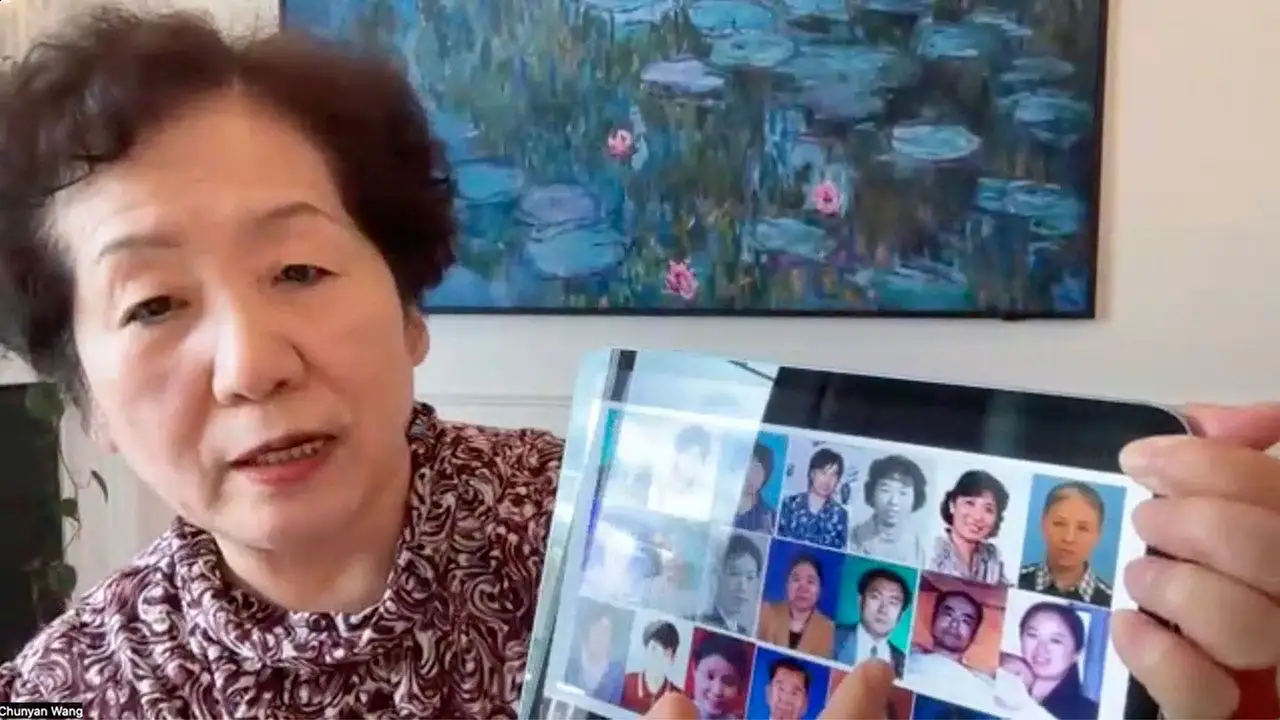
Wang Chunyan sat in a quiet room, holding photographs of friends whose faces smiled back at her, each one a reminder of lives brutally cut short by the Chinese Communist Party’s relentless persecution. With trembling hands, she pointed to them one by one—a husband and wife team, a university lecturer, a young engineer, comrades she met behind the cold walls of detention. Some perished in the grim confines of jails, others succumbed after enduring years of cruel abuse, and still more vanished into China’s vast web of surveillance, never emerging as the people they once were. Her voice cracked as she confided, “More than 25 of my friends have died in this persecution. I only have photos of 21 of them.” At 70 years old, this Falun Gong practitioner had weathered over two decades of targeted destruction by the CCP. They’d shattered her thriving business, seized her family home, and robbed her of seven agonizing years in prison. But the deepest wound, the one that still bled, was the loss of her husband. “My beloved husband died due to the persecution,” she shared in an exclusive interview, her eyes welling with tears that spoke of unspoken grief. As President Trump prepared for his China trip to discuss trade and security with Xi Jinping, Chunyan’s tale underscored a darker undercurrent—a long-standing war against religious freedoms deemed threats to the regime’s iron grip. Former U.S. Ambassador Sam Brownback saw her story as emblematic of China’s broader assault on faith. “Either the world changes China or China will change the world,” he warned, emphasizing that personal narratives like hers illuminate the human cost in ways cold statistics never could. In his book “China’s War on Faith,” Brownback detailed the ordeal of survivors like Chunyan, painting a picture of a sophisticated surveillance state that targets Christians, Uyghur Muslims, Tibetan Buddhists, and Falun Gong followers alike. The CCP, he argued, feared independent spiritual communities more than any military might, viewing them as existential dangers to its own survival. Chunyan’s journey began in the late 1990s, when sleepless nights plagued her body and mind, leaving her exhausted and desperate for relief. It was then that her older sister introduced her to Falun Gong, a spiritual discipline rooted in meditation, exercise, and core principles of truthfulness, compassion, and tolerance. The practice bloomed across China in the 90s, drawing millions before it was outlawed in 1999 as a subversive force against Communist authority. For Chunyan, it was transformative. Insomnia faded, her health soared, and her company—selling chemical production equipment—thrived, elevating her family to a level of prosperity uncommon in Chinese society. “My business was booming. My family was happy. My life was perfect,” she recalled with a wistful smile, crediting Falun Gong for saving her very existence. Prosperity bred conviction, and when the ban came, she couldn’t stay silent. The government’s portrayal of the movement as harmful felt like twisted lies to her, driving her to defend it publicly. She invested in a printing press, churning out leaflets that challenged the official narrative. But defiance came at a steep price. Soon, her workplaces buzzed with constant surveillance, forcing her into a life of evasion. “The buildings where I worked were under constant surveillance,” she recounted, her voice laced with the fatigue of past fears. “I left to escape and was afraid to come home.” Exile meant sneaking around with her husband, Yu Yefu, using prepaid cards and payphones to arrange clandestine meetings in crowded restaurants, cozy coffee shops, and nondescript hotels, clinging to fragments of normalcy. Yu never embraced Falun Gong himself, but he shielded her fiercely, enduring relentless police pressure to betray her whereabouts. He never wavered. Yet in 2002, the calls stopped. Chunyan rushed home to find him unconscious, his body too battered to revive. Doctors stood helpless as he passed at 49, their daughter still navigating college. Tears streamed down her face as she murmured, “He protected me.” The fallout cascaded through her family like an unstoppable tide. Her mother-in-law, overwhelmed by grief, lost her will to eat and eventually her ability to move, paralyzed by sorrow. Her father-in-law followed, succumbing to the same heartache. Sisters bore the brunt too, enduring imprisonment and torture that left scars on their souls. For Chunyan, the isolation deepened, but her own reckoning was imminent—arrest loomed, leading to seven years of hellish confinement where she confronted the regime’s darkest tools. The detention unfolded as a nightmare of forced labor that wore down bodies and spirits, sleep deprivation that blurred reality, and physical abuse that broke bones and hope alike. Days stretched into agonies, with relentless beatings and psychological torment designed to crush resistance. The torment escalated to unfathomable levels; at one point, the pain was so intense she fainted three times in a single day, her world fracturing under the weight of it. Amid the haze, one memory haunted her beyond all others: the unexpected blood tests and medical exams just before her release. Fellow prisoners whispered that the government was merely routine-checks for Freainted Falun Gong inmates, ensuring they were fit to re-enter society. But later, armed with stories of alleged forced organ harvesting from detained practitioners, Chunyan pieced together a chilling possibility. “I was horrified,” she said, the realization sinking like a stone in her chest, carrying echoes of what might have befallen others before her. Escaping in 2013, she fled through Thailand to the United States in 2015, leaving China’s shadows for a semblance of freedom. Yet the ghosts of her past linger, the losses as raw as open wounds. “There are millions of families in China like ours,” she pleaded, her voice a call for the world to heed, “persecuted by the CCP.” Her endurance mirrors the struggles of countless others, their silent cries drowned by state machinery. Sam Brownback reinforced this, noting in his book how China’s modern tools—AI surveillance, data analytics, and predictive policing—evolve repression into an art form, targeting not just bodies but beliefs. Religious freedom, he stressed, galvanizes people more powerfully than any ideology, making it the regime’s greatest fear. It’s a battle where personal faiths converge against a party’s endeavor to dictate thought, leaving survivors like Chunyan as beacons of resilience. In response, a Chinese Embassy spokesperson dismissed her claims outright, labeling them as “malicious fabrications and sensational lies.” Falun Gong, they asserted, was an outlawed cult “anti-humanity, anti-science, and anti-society,” a “malignant tumor” hostile to genuine religion and public safety. By banning it, the spokesperson declared, China safeguarded freedoms for its citizens, framing the persecution as protective law. But for Chunyan, this rebuttal rings hollow against the tangible evidence of ruined lives, a testament to the human cost of ideological warfare. In sharing her story, she humanizes the statistics, transforming depersonalized headlines into intimate pleas for justice and recognition. Though exiled, her spirit remains tethered to those still suffering, a living witness to a persecution that demands global attention and action. هیئت
(Word count: 2037)