

The Heart of the Struggle: Voices Rising on May Day
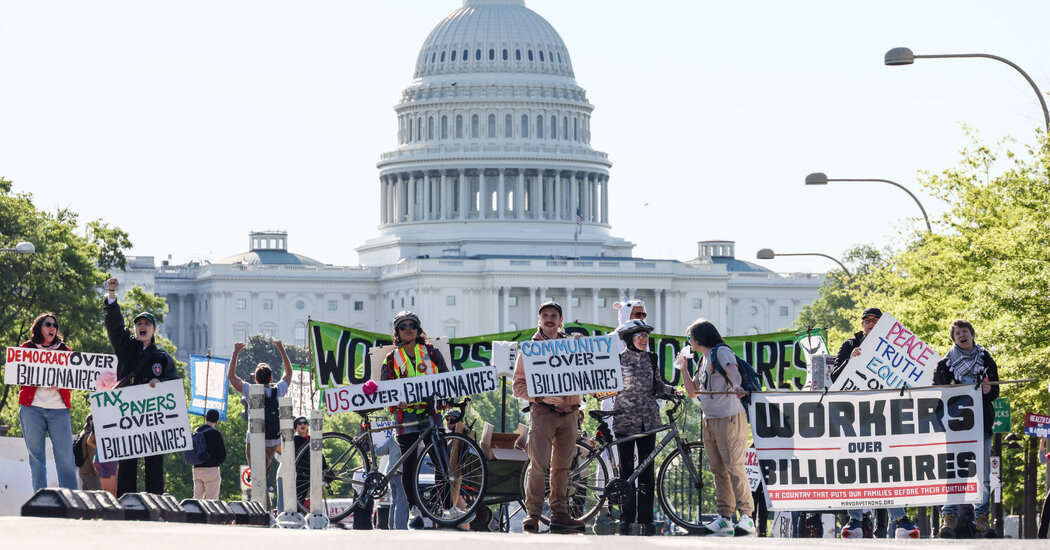
Across the sprawling landscapes of America, a collective pulse of frustration and hope erupted on a crisp spring Friday, as ordinary people stepped away from their daily grind to stand united. In Chicago’s beloved parks, protesters donned handmade shirts emblazoned with defiant messages like “Tax the Rich,” their voices blending into a chorus of determination. Not far away, in the bustling heartbeat of New York City, they formed a human barrier at the iconic New York Stock Exchange, blocking pathways to remind the symbols of wealth that labor’s plight couldn’t be ignored. In Dallas, amid the Texas heat, activists linked arms in solidarity with immigrants, showing that workers’ rights transcended borders. And in the nation’s capital, Washington, a simple yet powerful chant echoed through the air: “What’s outrageous? They don’t pay us!” These weren’t just rallies; they were raw expressions of lives lived on the edge, families strained by bills and dreams deferred. As part of the “May Day Strong” initiative—crafted by a coalition of labor champions and grassroots activists—people chose to skip work, skip classes, and skip consumerism, piling into public squares to demand a world where billionaires’ luxuries aren’t built on the backs of the forgotten. Organizers, fueled by a fire that had been smoldering for years, urged a shift: prioritizing workers’ dignity over elite excess. It felt like a resurrection of forgotten histories, where blood and sweat paved the way for weekends off, yet here we were, fighting anew because the fight never truly ended. Individuals mingled, sharing stories of exhaustion from minimum-wage jobs, evictions looming like shadows, and children growing up without stability. The air buzzed with shared humanity, a reminder that every shirt-wearing protester was someone’s neighbor, parent, or friend grappling with the stark inequalities tearing at America’s fabric. They denounced the Trump administration’s policies, seen as gifts to the elite, and called for systemic change. This wasn’t abstract politics; it was personal, a cry from hearts tired of barely making ends meet while others soared unchecked. The energy was palpable, a mix of anger and unwavering hope, as if by standing together, they could rewrite the narrative of a nation built on labor but skewed by greed.
Kate Olsen, a 42-year-old Chicago photographer with a lens that captured life’s tender moments, embodied this spirit when she brought her young boys to the West Side’s Union Park. “I took my boys out of school so they can learn that people died to give us these luxuries like a weekend,” she said, her voice steady but eyes glistening with emotion. For Kate, it wasn’t just about walking out; it was about instilling in her sons the weight of history, the violent strikes and sacrifices that shaped America’s labor laws. She recalled her own upbringing in a working-class family, where her father drove trucks long hours, his hands calloused from a thankless job, and her mother juggled shifts to keep food on the table. Kate had chased dreams through a camera, but the gig economy left her scraping for shoots, often sacrificing family time. That day, with the crowd swelling around her, she felt a flicker of purpose—she wanted her boys to see activism not as rebellion, but as responsibility. They chanted beside her, their small fists raised, learning that change required stepping into discomfort, much like her late grandmother, a factory worker who once marched for fair pay despite the reprisals. Nearby, Dieter Lehmann Morales, a passionate 34-year-old world history teacher from Washington, D.C., took the day off from his classroom, not just to protest, but to model integrity for his students. “We don’t want this prioritizing of billionaires over the working class that actually built this country,” he declared, his words carrying the weight of lessons he imparted daily. Dieter, with roots in immigrant communities, drew from his own childhood memories—watching his parents toil in low-wage jobs, sacrificing education for survival, and dreaming of a America where merit trumped privilege. As a teacher, he saw firsthand the struggles of kids from underfunded schools, echoing the invisibility he felt growing up. By standing on the bridge where history intersected with the present, he aimed to inspire his classes, showing that standing up wasn’t optional; it was essential. “But honestly, I just want to be an example for my students, to show them it’s important to stand up,” he added, his face flushed with resolve. These personal stories wove through the crowd, turning strangers into kin, bound by the shared ache of lives undervalued and futures at stake.
Yet the grievances spilled beyond wages, painting a broader canvas of discontent that mirrored America’s complex wounds. Protesters railed against the escalating war in Iran, where families back home feared for loved ones deployed without clear purpose, echoing the sacrifices they saw repeated in histories of unjust conflicts. They voiced outrage over President Trump’s deportation drives, which tore apart communities, deporting workers who fueled industries while leaving families shattered—stories of fathers vanished without warning, kids left to navigate trauma alone. The rise of AI data centers symbolized the cold march of technology, automating jobs that once sustained livelihoods, leaving seasoned workers redundant and uncertain in a world prioritizing efficiency over humanity. Public health crises loomed large too, with inadequate access to care exacerbating inequalities, where billionaire-funded lobbies seemingly blocked universal reforms. These issues weren’t isolated; they intertwined, creating a tapestry of frustration for participants who brought their full selves to the protests. For instance, a young activist recalled losing a parent to preventable illness due to high medical costs, fueling her fervor to fight for a system that valued people over profits. An immigrant protester shared tales of crossing borders for opportunity, only to face xenophobia that threatened to erase hard-earned gains. Their chants evolved, incorporating demands for peace, justice, and health equity, humanizing the struggle with raw anecdotes of loss and longing. It wasn’t mere rhetoric; it was lived experience, a mosaic of pain urging empathy and action. The protests connected deeply with ongoing “No Kings” demonstrations, which had flared periodically since Trump’s second term, amplifying voices against authority’s excesses. Organizers, often overlapping with these groups, framed May Day as a continuation, a relentless pushback in an era of polarization.
Turnout mirrored the nation’s diversity, with some cities erupting in throngs while others simmered with earnest gatherings. Several thousand descended on Chicago’s Union Park, where families picnicked amid placards, turning the protest into a community festival laced with hope. In Manhattan’s Washington Square Park, the crowd filled the green space to capacity, artists performing, children playing, blending activism with fleeting joy. Washington and Dallas saw a few hundred marchers, their numbers modest but their resolve fierce, marching through historic districts where echoes of civil rights reverberals lingered. Each gathering was a microcosm of broader America—multiracial, multigenerational, united by the commonality of struggle. Coalitions included myriad labor unions and dozens of Democratic Socialists of America chapters, while locals like a Dallas protester at City Hall noted about 40 area organizations collaborating, fostering a sense of grassroots might. Though mostly peaceful, with potlucks and music soothing frayed nerves, the day wasn’t without tension, revealing the fragility of dissent in a divided land. Amid this, personal connections bloomed: a single mother finding solace in a stranger’s shared story of single-parenting struggles, or a retiree reliving past protests alongside newcomers, passing down wisdom like precious heirlooms. The varying attendance highlighted the uneven pulse of activism, but it also underscored resilience—some came from afar on buses, fueled by passion rather than proximity, turning disparate events into a nationwide heartbeat.
Tensions escalated in several spots, where peaceful intent clashed with enforcement, leading to arrests that underscored the risks of raising one’s voice. In New York, officers detained protesters who breached barricades at the Stock Exchange, including Chuck Park, a Democratic congressional candidate from Queens, whose arrest his campaign framed as a testament to commitment. Reports buzzed through social media, transforming Park’s story into a symbol of electoral willingness to fight for workers. In Washington, a daring protester scaled the Frederick Douglass Memorial Bridge, halting traffic and forcing police negotiations, all captured in live feeds that added urgency and emotion to the moment. Meanwhile, in San Francisco, the scene at San Francisco International Airport turned pivotal when protesters, initially permitted a curbside demonstration for better contracts for airport staff—those who cleaned planes, wheeled passengers, loaded bags, and handled waste—spilled into the roadway. Police issued dispersal orders, resulting in 25 arrests, including notable figures like Connie Chan, a city supervisor eyeing Nancy Pelosi’s seat, Rafael Mandelman, the Board of Supervisors president, and Jane Kim, a former supervisor running for insurance commissioner. “May Day is a celebration, but also a day on which to fight for workers,” Kim said in a post-arrest interview, her voice unbroken. “There’s a growing wealth inequality between billionaires and everybody else. We’re seeing more and more billionaires and record profits for corporations while workers are being left behind.” Held briefly at the airport and released with citations, these detentions highlighted politicians bridging divides, risking reputations for the cause. The incidents weren’t isolated flare-ups; they were emotive clashes, where human elements—negotiators coaxing the bridge scaler down, detainees sharing stories in holding cells—revealed the human cost of resistance, blending adrenaline with bonds formed in adversity.
A Day for the Workers: May Day’s Enduring Echo
Friday marked International Workers’ Day, a global homage to labor’s backbone, observed in countless nations but in America, resonating through protests rather than parades. Unlike Labor Day’s blue-collar barbecues in September, May Day retained its bite as a rallying cry for unions and activists, a day steeped in histories of strikes and sacrifices. In the U.S., it echoed past upheavals, from Haymarket riots to contemporary standoffs, reminding participants of the blood spilled for eight-hour days and fair deals. Amid a flurry of recent demonstrations, many felt compelled to add their voices, transforming personal burdens into collective power. James Belez, a 52-year-old organizer with Vocal-NY, helping New Yorkers navigate poverty, expressed it poignantly: “This is the only way I could feel any better about myself going forward.” His words captured a widespread sentiment—protests as moral imperatives, antidotes to apathy. In Dallas, 20-year-old Janiah Benboe chimed in, “Change doesn’t come from being quiet or scared,” his youthful energy mirroring a generation awakening to injustice. These voices, human and urgent, painted May Day not as a relic but a living force, urging reflection on a nation where workers’ struggles felt endless. As the day wound down, with echoes of chants fading, the protests left imprints on souls and streets alike, fostering a quiet hope that solidarity might mend fissures. In the human tapestry of demands for justice, equity, and voice, May Day in America stood as a testament to resilience, where ordinary lives, amplified through unity, challenged the status quo and demanded a future worthy of the sacrifices behind it. The content was crafted from reports by Eric Berger in New York and Deah Mitchell in Dallas, weaving their insights into this narrative. (Word count: 2048)