


The Critical Chokepoint in Global Energy Flows
In the heart of the Middle East lies the Strait of Hormuz, a narrow waterway that serves as a vital artery for the world’s oil and gas supplies. This maritime corridor, linking the Persian Gulf to the Gulf of Oman and ultimately the Indian Ocean, is arguably the most important transit point on Earth for fossil fuels. Every day, millions of barrels of crude oil flow through it, accounting for roughly a fifth of the global oil trade—crucial for powering economies from Europe to Asia. It’s not just oil; liquefied natural gas (LNG) shipments also depend on this route. For nations like the United States, China, Japan, and India, any disruption here could send shockwaves through energy markets, gas prices soaring and economies stuttering. Imagine a thin, bustling channel just 21 miles wide at its narrowest point, bordered by the rugged coasts of Iran on one side and Oman and the UAE on the other. Ships laden with black gold jockey for position, guarded by international navies, but vulnerable to geopolitical whims. Tehran’s strategic positioning has long made this strait a double-edged sword, turning it into a lever in Iran’s dealings with adversaries. As tensions rise, Iran’s leadership has repeatedly brandished threats to close or restrict access, using it not just as a geographic advantage but as a psychological weapon in broader conflicts.
Iran’s Tactics: From Words to Actions
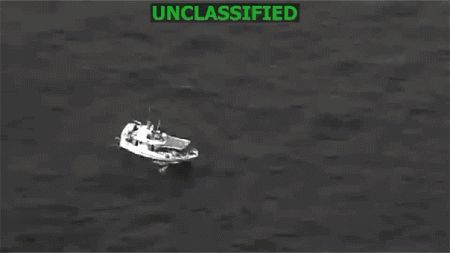
Iran’s approach to leveraging the Strait of Hormuz blends historical rhetoric with modern brinkmanship, often escalating from verbal warnings to targeted actions. For decades, during standoffs like the 1979 Iranian Revolution or the Iran-Iraq War, leaders in Tehran have hinted at severing this lifeline to pressure opponents. In more recent times, this has manifested through real-world events. Take the 2018 tanker attacks in the Gulf of Oman, where mysterious explosions damaged vessels, raising suspicions of Iranian involvement—denied vehemently by Tehran, but widely attributed by Western intelligence to Iranian naval forces or proxies. These incidents prompted U.S. military responses and heightened patrols. Similarly, in 2019, amid soaring tensions after the assassination of Iranian General Qasem Soleimani, Iran temporarily seized oil tankers and even shot down a U.S. drone in the strait, inching closer to a full closure. Such moves aren’t arbitrary; they’re calculated to show Iran’s resolve against sanctions imposed by the U.S. and its allies over the nuclear program. By threatening the flow of energy, Iran aims to isolate its rivals economically while rallying domestic support. It’s a game of chicken on the high seas, where both sides know the stakes—disruption could inflate oil prices by 50% or more, crippling importers while hurting exporters too.
Geopolitical Context and Enemies
The “enemies” Iran is targeting with these strategies primarily include the United States, Israel, and their regional partners like Saudi Arabia and the UAE. The U.S. has imposed crippling sanctions on Iran since 2018, pulling out of the 2015 nuclear deal and accusing Tehran of destabilizing activities across the Middle East. From Israeli air strikes on Iranian targets in Syria to U.S. drone campaigns against Iranian-backed militias in Yemen and Iraq, Iran sees these as existential threats. In response, Iran has escalated with attacks on U.S. bases in Iraq and support for Houthi rebels, who have bombarded Saudi oil facilities. The Strait of Hormuz becomes Iran’s equalizer, allowing a relatively weaker military power to punch above its weight. With 1,500 miles of coastline and control of key island territories like Abu Musa and the Tunbs, Tehran can deploy speedboats, missiles, and mines to block passageways. This isn’t just about oil; it’s about sovereignty and survival. Iran’s leaders have framed it as defending national honor, reminiscent of the Persian Empire’s ancient prowess over trade routes. Yet, for ordinary Iranians, these threats fuel patriotism but also economic hardship, as sanctions already pinch daily life.
Economic and Global Ramifications
The ramifications of Iran weaponizing the Strait ripple far beyond the Gulf, affecting global energy security and economic stability. If hostilities led to a real closure—even temporary—it could disrupt up to 4 million barrels of oil per day, hiking prices from around $80-$90 a barrel to potentially double digits, as seen in past spikes like the 2011 blocking fears. Importers like China and India, reliant on Middle Eastern crude, would scramble for alternatives—perhaps turning to riskier, costlier sources in Venezuela or Russia. Stock markets could tumble, inflation could rise, and consumer fuel costs would skyrocket, hitting everyday people worldwide. Shipping giants like BP, Exxon, and Saudi Aramco face Suezmax tanker bottlenecks, while LNG terminals in Qatar and Iran itself might withhold supplies. For Iran, though, the leverage comes at a cost: endearing it with China and Russia as energy customers, but alienating the West. This dynamic has spurred haphazard alliances, with China investing in Iranian ports as part of the Belt and Road Initiative, while the U.S. pushes for diversifications like American shale. In a world shifting toward renewable energy, this old-school pb oil gambit feels anachronistic, yet its potency endures, underscoring how fossil fuels still dominate geopolitics.
International Responses and Diplomatic Maneuvers
The world hasn’t stood idly by as Iran ramps up pressure. The U.S. has stationed thousands of troops, warships, and aircraft in the region under Operation Sentinel, forming coalitions with Britain, Bahrain, and others to escort vessels through the strait. In 2020, after the tanker seizures, the Americans even destroyed Iranian unmanned watercraft in retaliation. Diplomatically, efforts like the 2015 JCPOA aimed to normalize Iran’s nuclear pursuits in exchange for sanctions relief, but Trump’s withdrawal fractured that. The European Union has tried mediating, reaping limited success, while the UN Security Council debates resolutions that Iran often ignores. Countries like Japan and Turkey have sought neutral roles, importing Iranian oil despite U.S. warnings—a delicate dance to maintain economic ties without inviting sanctions. For Iran, this international pushback reinforces its narrative of victimhood, portraying itself as standing against imperialist overreach. Yet, repeated threats have eroded Tehran’s credibility, as some attacks backfire, like accidental shoots-down of commercial planes (as in 2020, tragically downsizing Ukraine Airlines flight). Mediation through channels like the International Atomic Energy Agency remains fraught, with Iran enriching uranium at levels tempting covert actions.
Looking Ahead: Risks and Realities
As 2024 unfolds, the Strait’s role as leverage hinges on evolving threats and threats innovations. Iran’s leadership, under figures like Supreme Leader Ayatollah Ali Khamenei, continues to warn of “closing the strait completely” if pushed, while developing hypersonic missiles and naval drones to enforce it. This strategy could escalate inadvertently, sparking unintended wars—much like how a 1988 U.S. naval skirmish ignited the Iran-Iraq War’s climax. On the flip side, global decarbonization efforts might diminish the strait’s clout over time, reducing dependence on Gulf oil. But for now, it’s a powder keg, where a single miscalculation—like another tanker attack—could ignite broader conflict. For everyday people in Iran, enduring inflation and blackouts from sanctions and mismanagement, these gambles feel distant yet dangerous, potentially leading to isolation or regime change. Internationally, the lesson is clear: energy access demands constant diplomacy, not just force. Iran holds a powerful card, but playing it recklessly could leave everyone losing—underscoring the human cost in an interconnected world where oil flows aren’t just commodities, but lifelines for billions. Balancing power and pragmatism will be key to navigating this volatile crossroads.