






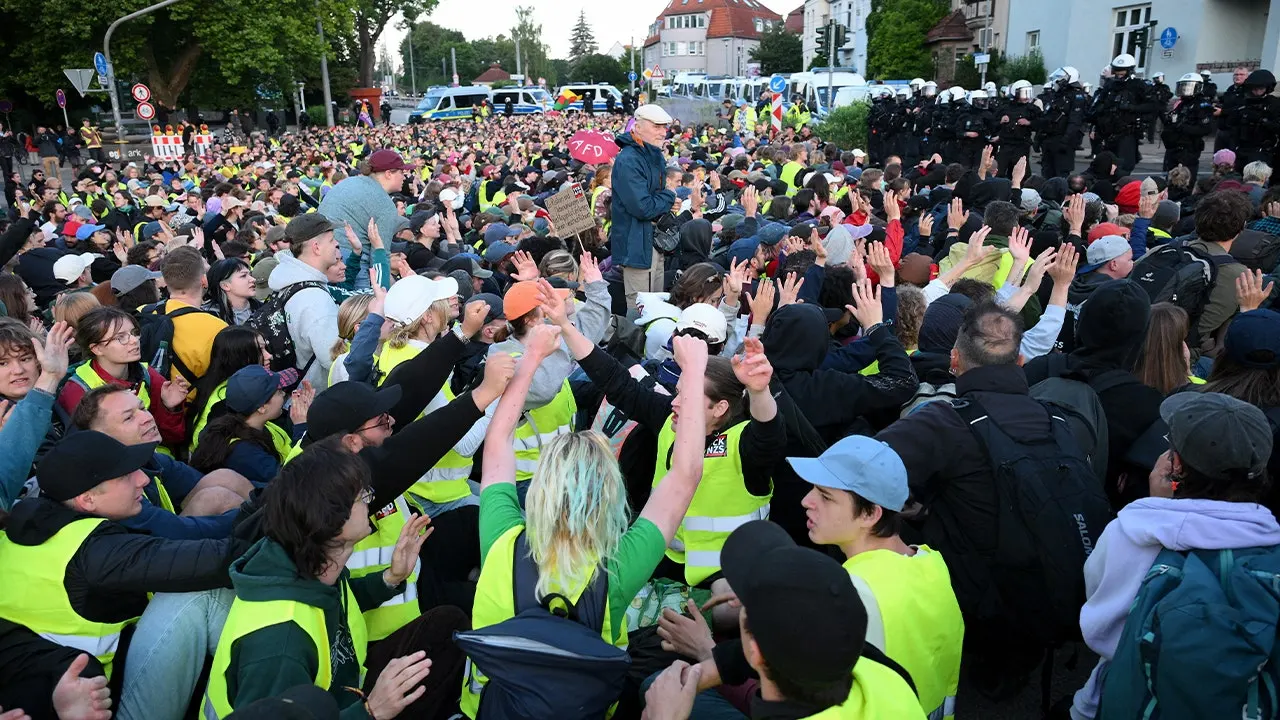
Over the weekend, the historic streets of Erfurt, Germany, became a chaotic battleground of ideals as more than 30,000 left-wing demonstrators gathered to protest the Alternative for Germany (AfD) party. As the right-wing party convened for its highly anticipated national conference and leadership elections, the surrounding area quickly filled with passionate citizens carrying signs with slogans like “Stop AfD Nazis” and “For Diversity, Against Nazis.” The massive scale of the demonstration reflected the deep polarization currently gripping the nation, transforming a routine political gathering into a high-stakes standoff behind heavy police barricades.
The atmosphere rapidly deteriorated as tensions boiled over, leading to intense physical clashes between law enforcement and a segment of the demonstrators. Dramatic footage captured police utilizing batons and anti-riot ordnance to push back crowds of agitators who were attempting to break through security perimeters. Despite these vivid skirmishes, local authorities characterized the demonstration as “mostly peaceful” overall, noting that the vast majority of the 100 recorded law violations were minor offenses related to graffiti. However, the intentional disruption successfully delayed the start of the AfD’s convention, sparking a fierce debate over the boundaries of democratic protest.
Inside the convention hall, AfD co-leaders Alice Weidel and Tino Chrupalla were ultimately re-elected to steer the party’s ascending political fortunes, but the chaos outside dominated their opening remarks. A visibly frustrated Chrupalla launched a scathing critique of the blockades, rejecting the notion that the disruptive tactics represented legitimate civic activism. He accused political rivals of hiding behind violent mobs and argued that the protesters did not hold a monopoly on democratic values, asserting that the nation’s democratic systems belong just as much to conservative voters as they do to progressive activists.
On the other side of the barricades, counter-protesters felt their extreme measures were entirely justified to sound the alarm against what they perceive as a dangerous political threat. Lena Raupach, speaking on behalf of the anti-fascist coalition widersetzen, argued that the AfD’s platform promotes fascist ideologies that thrive on xenophobia, mass deportations, and division without offering real solutions for working-class Germans. Raupach emphasized that the blockades were born out of a desire to defend a society rooted in solidarity, equal opportunity, and collective safety for all residents, regardless of their background.
Amid these severe accusations of extremism from mainstream politicians and watchdog groups, the AfD continues to deny that its platform is radical. Party leadership maintains that traditional establishment parties are weaponizing security agencies and public anxiety to suppress legitimate political competition. This strategy of self-portraying as the political underdog seems to be working, as the AfD has enjoyed an unprecedented surge in popularity, securing over 20% of the vote in recent federal elections and even leading some national polls as Germany’s most popular political force.
Emboldened by this momentum, Chrupalla confidently projected that the party might soon be strong enough to govern without a coalition, framing their rise as a victory over institutional adversaries. Observers have noted that the party’s nationalist rhetoric, skepticism of globalization, and hardline stance on immigration closely mirror the “America First” movement popularized by Donald Trump. This ideological connection was on full display in Erfurt, where attendees proudly sported “Make Germany Great Again” hats, signaling a growing, global alignment of conservative populism that threatens to permanently reshape the European political landscape.