

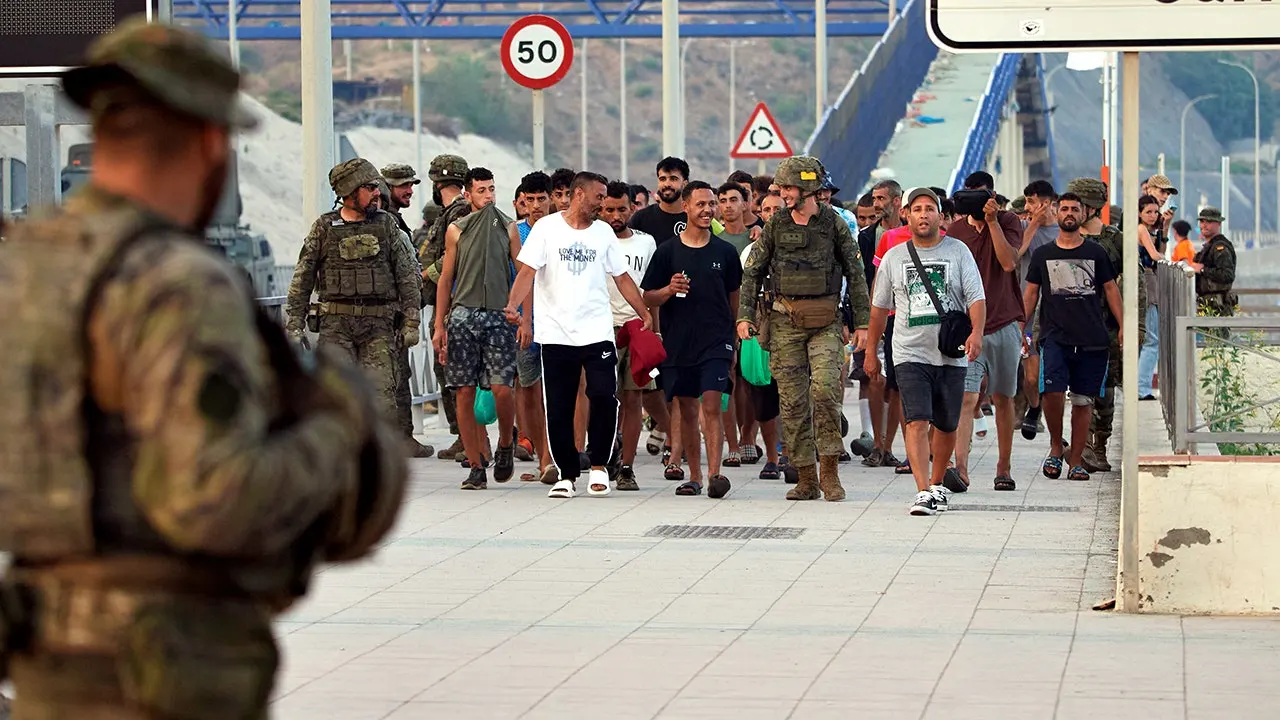
At the edge of Europe, where the Mediterranean bumps against the coast of North Africa, Ceuta has long lived with the strange reality of being a Spanish city on African soil. For generations, its people have shared their streets with military checkpoints, border fences and the constant hum of geopolitical tension. But in late July, something broke. In a single, overwhelming rush, around 70,000 migrants crossed from Morocco into Ceuta, and the everyday rhythm of life seemed to shatter in a matter of hours. Conservative Spanish journalist Javier Negre traveled to the enclave and spoke with residents about what it feels like to live through such a moment. What he heard was not a partisan complaint. It was a raw, shared anguish. “The local citizens, they are really sad. And no matter if they are left or right, what they say is like, it’s really complicated to live right now in Ceuta,” Negre told Fox News Digital. The fear in the city is tangible. Parents are nervous about letting children walk to school. Elderly people hesitate before going out after dark. Migrants are sleeping in public spaces, and residents say the same streets they have known all their lives now feel uncertain. Ceuta has always been a frontier, but frontier towns expect the state to protect them. In the eyes of many residents, that protection no longer exists. This is not an abstract debate about border policy or political ideology. It is a community wondering whether the Spain they belong to, the Spain they pay taxes to, still sees them as part of the family.
The stories residents shared with Negre are not only about inconvenience or strained infrastructure; they are about safety, dignity and basic survival. He said citizens told him about crimes committed by migrants, including robbery and attempted rape. They talked about migrants living rough in the streets, and they admitted, openly, that they are afraid. In a small enclave like Ceuta, these feelings spread quickly. There is nowhere to go, nowhere to hide, no way to pretend that the crisis is happening somewhere else. Public services in the city were never designed for such a massive influx of people. Negre stressed that the people of Spain, and Europe, are being pushed to their limits. “We need in Spain, we need in Europe, governments that try to avoid the illegal immigration right now because it’s not fair for the citizens that pay taxes to have social security, to have healthcare and these illegal migrants, they collapse the hospitals, they collapsed the universities, the schools, and it’s not fair for the Spanish people,” he said. Put yourself in the place of a Ceuta resident: imagine going to an emergency room with a sick child and being told the hospital has been overwhelmed by people who arrived without documents. Imagine trying to enroll your son or daughter in a school only to learn there are no more classrooms, no more teachers, no more resources. That is the reality residents are describing. They do not all lack compassion. Many understand that people are desperate. But they also believe a government’s first duty is to its own citizens, and when that duty is forgotten, resentment begins to take root.
The official voice of Ceuta has carried this same message to the very heart of European power. Mayor-President Juan Jesús Vivas appeared before the European Parliament’s Committee on Civil Liberties, Justice and Home Affairs and spoke without diplomatic restraint. He said the migrant rush placed public safety and public health at serious risk, and that the city’s immigration infrastructure was in danger of collapsing completely. More striking than any statistic was the way he described the emotional condition of his people. “Our population feels sad, helpless, uneasy, fearful and worried—and with good reason,” Vivas said. He then asked the question that seems to hang over Ceuta like a storm cloud: “It is inevitable to wonder whether this will happen again, and if that next time will be the definitive plunge into the abyss, causing us to cease being what we are: Spain and Europe.” Those are not the words of a politician looking for headlines. They are the words of someone who truly believes his city is on the brink of disappearing, not physically perhaps, but as a stable, functioning and trusting community. Ceuta has always been a bridge between two worlds. Its residents have served, for centuries, as guardians of Europe’s southern boundary. But they did not ask to be turned into human shields. They did not ask to live under the constant threat of another wave of mass migration. And they are tired of feeling like their concerns are dismissed by Madrid and Brussels. For them, the “abyss” Vivas mentioned is not a metaphor. It is the fear they wake up with every morning and carry with them all day.
The immediate response from both Spain and Morocco may sound reassuring on paper. After social media messages circulated in Morocco calling for another rush on the enclave around Aug. 15, authorities on both sides of the border bolstered security. Spain added maritime barriers to those already in place after the first surge, when migrants swam around the existing border defenses. Military forces were deployed, and the seriousness of the situation was such that even the U.S. State Department raised its travel warning for part of Spain. But for the people of Ceuta, these measures are not enough. Negre said officials on the Moroccan side told him that the current level of security remains inadequate. “I know that today the Spanish government and the Moroccan government, they say that they are going to put more police, but it’s not enough,” Negre said. He called for a much stronger and more visible commitment to border protection. “We need more police. We need to have more border security because people don’t understand why they’re paying taxes, why they’re giving a lot of money to the state if they can’t block the frontier to these illegal migrants that they are not escaping from a war or a difficult situation,” he said. That last point matters deeply to residents. They hear the language of humanitarianism, but they see people who have not fled bombs or famine. They see people who want to live in a wealthier country, and they feel their own government has failed to manage that reality. It is not just about walls and fences. It is about the sense that ordinary, law-abiding citizens have been left to bear the consequence of political failure.
To understand why Ceuta found itself at the center of this storm, one has to look at the tangled relationships between Spain, Morocco and Algeria. Ten days before the July 30 influx, Spanish Prime Minister Pedro Sánchez traveled to Algeria in an effort to restore diplomatic ties that had been frozen over the question of Western Sahara. That desolate region in northwest Africa has long been a source of bitter hostility between Algeria and Morocco. Morocco claims sovereignty over Western Sahara, and in 2020 the United States officially recognized that claim. Spain has stopped short of that, but in March 2022, Sánchez sent a letter to Morocco’s King Mohammed VI endorsing Morocco’s autonomy plan for the region as the “most serious, realistic, and credible basis” for resolving the long dispute. Algeria, which supports Western Saharan independence, was not pleased. Negre told Fox News Digital that Spanish media have suggested Sánchez’s frosty relationship with Morocco may have contributed to the migration crisis. He also noted the many corruption scandals surrounding Sánchez, and repeated rumors that Morocco’s king may have wanted to send the Spanish government a blunt message. “Pedro Sánchez, who is involved in a lot of scandals of corruption, he went to Algeria, and there are some rumors that maybe the king of Morocco try to promote this illegal invasion to tell the Spanish government, ‘hey, take it easy,’” Negre explained. This is not the first time such a scenario has played out. In May 2021, around 10,000 people flooded into Ceuta after Moroccan border guards appeared to stand down. Morocco denied any deliberate action, but the European Parliament later passed a resolution condemning Morocco, citing statements from Moroccan authorities acknowledging the incident was retaliation for Spain treating the leader of a Western Saharan rebel group at a Spanish hospital. Diplomacy between nations is often mysterious, conducted in quiet meetings and carefully worded statements. But in Ceuta, those distant maneuvers arrive at the doorstep in the form of frightened neighbors, crowded streets and overwhelmed public services.
For Negre, the lesson of Ceuta extends far beyond the city’s narrow borders. He believes Europe as a whole is moving in the wrong direction on immigration. “Europe is going really bad with illegal immigration, with the open frontiers, completely opposite as the politics of President Trump with border security and deporting all the illegal migrants,” he told Fox News Digital. He praised President Trump’s proposed legislation to require voter identification, the Safeguard American Voter Eligibility Act, known as the SAVE Act. Whether or not one agrees with that approach, it is easy to understand why it appeals to people in Ceuta. They are not abstract thinkers debating theories of migration. They are people who have lived through the consequences of open borders in the most direct way possible. They have felt the fear of being outnumbered in their own homes. They have seen their schools, hospitals and public spaces stretched beyond capacity. They have been told, again and again, that they must accept the situation because the alternative is cruel or racist or politically incorrect. But the human truth is simpler and harder to ignore: families want to live without terror, raise their children in safety, and see their tax money spent on their own communities. Ceuta is a warning of what can happen when those basic promises are broken. Mayor Vivas used the word “abyss.” Negre described citizens who are “really sad.” Both were describing the same thing—a community losing faith in the social contract that is supposed to hold nations together. If European leaders continue to look away from Ceuta, they may one day discover that the frontier has not disappeared. It has only crept closer to the center of the continent, and it will keep moving until someone is brave enough to defend it.