



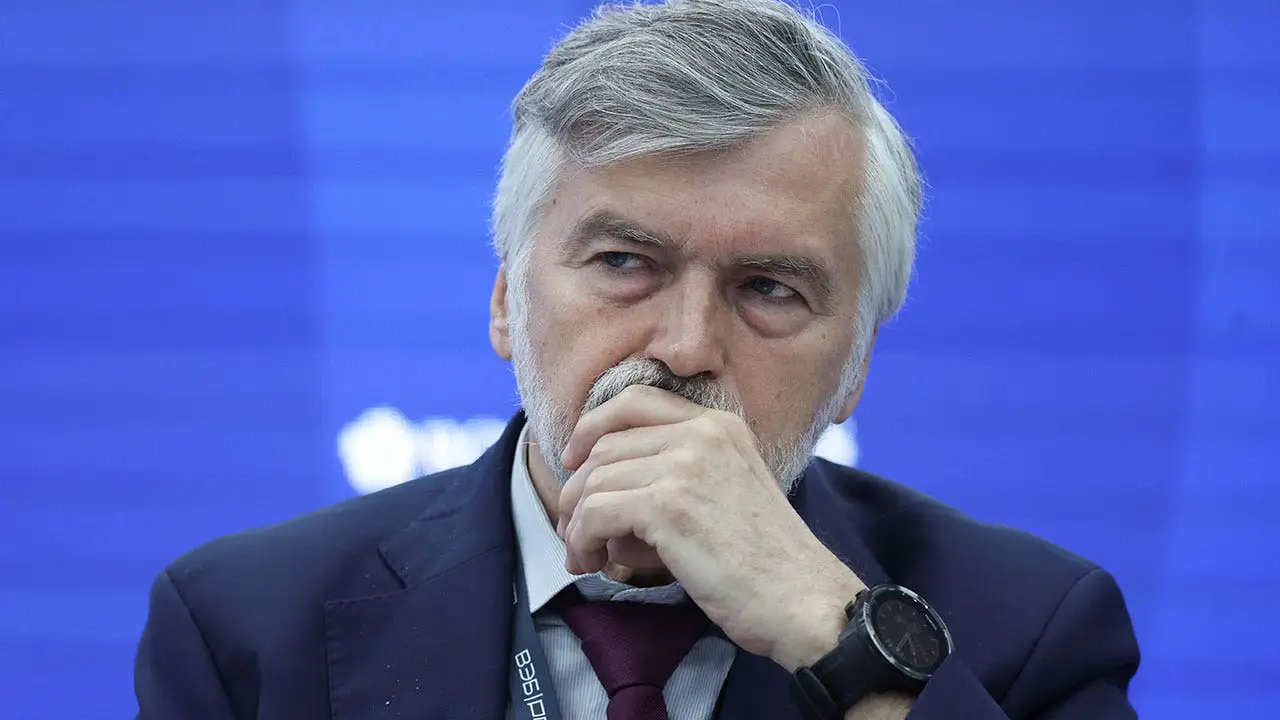
In a quiet but telling sign of how fragile public honesty has become in Vladimir Putin’s Russia, a prominent state economist lost his job simply for telling the truth about the war. Andrei Klepach, the chief economist at the state development bank VEB.RF, was dismissed after a speech in which he admitted what many insiders likely think but few dare say aloud: that Russia is losing the long, grinding economic battle against the West, and that the consequences could eventually spill over into social unrest. For anyone who has followed the fate of independent voices in Russia, Klepach’s firing is not just a personnel matter. It is a warning shot. It says that even the most technically loyal, establishment figures are not allowed to acknowledge uncomfortable facts. The speech itself was not new — Klepach delivered it back in May at the Nikitsky Club, a forum for economists and academics — but when it finally surfaced in Russian media, the reaction was swift. VEB confirmed he was no longer its chief economist, though it offered no explanation. Klepach, who had spent ten years at Russia’s Economy Ministry before joining the bank in 2014, accepted the outcome with quiet resignation. His removal is a small but revealing episode in a much larger story about a country that is trying to fight a costly war while refusing to face the economic arithmetic.
What exactly did Klepach say that was so dangerous? In that May speech, he painted a stark picture of national decline. “We are falling behind,” he said. “We are losing both the technological and economic competition in the world.” And then came the more painful part: “We are losing it not only to China and the United States, in some ways we are losing it to Ukraine too.” He credited Ukraine’s resilience to the continued financial and military backing of the West, and he dismissed the Kremlin’s comforting illusion that Ukrainian resistance would simply collapse. “We will not win the competition in this war of attrition,” Klepach warned. “We have the illusion that everything there will collapse. It has not collapsed and will not collapse. Our costs are mounting.” He acknowledged that Russia had ultimately weathered the initial shock of Western sanctions, but he pointed to a new vulnerability: Ukrainian attacks on Russian energy and logistics infrastructure. Those strikes have hit refineries and disrupted supply chains, pushing up prices and adding to inflation. Russia’s central bank already said in July that economic growth could fall to zero this year. Klepach’s forecast was even darker over the long term. “Economically we will not collapse,” he said, “but our lag will continue to grow, with all the resulting consequences.” He predicted a social crisis could come suddenly, “precisely when nobody is particularly expecting it.” That is the kind of prediction that gets a person fired under a regime that equates pessimism with disloyalty.
Yet for all of Klepach’s warnings, the reality inside the Kremlin today is more complicated than simple financial distress. A European intelligence source with knowledge of Russia’s internal situation told Fox News Digital that Moscow’s deeper economic problems should not be mistaken for an immediate budget crisis. The key factor, as so often in Russia’s history, is the price of oil. Higher global oil prices have helped Moscow cover more of its deficit, giving Putin additional breathing room before economic constraints force him to make hard choices about the war. “It doesn’t solve the fundamental economic problems in Russia,” the source said, “but from a budgetary point of view, Putin is OK actually. He’s not under pressure.” That suggests the West’s hope that economic hardship alone would push Putin to end the war may be premature. The source argued that Moscow could still afford to fight “another spring” or “another season,” even as the long-term deterioration continues. This is the paradox of the Russian war economy: today’s revenue can mask tomorrow’s ruin. Sanctions, export controls, and inflation are all eating away at the country’s future, but the money from oil exports is still flowing, and that gives the Kremlin time. In other words, Klepach may be right about the big picture, and the West may be right that pressure is building, but the hourglass is not yet empty. The Russian state can still buy enough time and loyalty to keep the machinery of war running.
That is precisely why the European Union is now trying to turn up the pressure. Kaja Kallas, the EU’s foreign policy chief, said she plans to propose what she called the “most far-reaching sanctions listings since the start of the war.” According to Kallas, existing EU sanctions over the past two years have already deprived Russia’s military of more than 1.16 trillion dollars, a staggering figure that reflects the pain Western restrictions have inflicted on Moscow’s ability to import technology, weapons components, and industrial goods. But the next wave aims to go even deeper. EU diplomatic sources said the bloc’s foreign service is expected to propose sanctions against nearly 1,600 additional Russian individuals and entities, with a special focus on the military-industrial complex. The proposed measures would include asset freezes, travel bans, and restrictions on transactions, hitting the men and institutions responsible for producing the weapons, drones, and missiles that are used every day to strike Ukrainian cities. Officials plan to present the list to EU governments in early September and hope to formally adopt it in October. The timing matters. With winter approaching, the EU wants to show that it is serious about constraining Russia’s war effort without allowing internal divisions among member states to weaken the package. Whether 1,600 new listings will meaningfully change the situation on the battlefield is an open question, but the signal is clear: Europe is not prepared to accept a stalemate in which Russia simply outlasts Ukraine.
Inside Russia, meanwhile, the walls are closing in on anyone who still dares to speak out against the war. The week began with the sentencing of Lev Shlosberg, deputy chairman of the liberal Yabloko party, to 11 years and one month in a penal colony. Shlosberg was convicted on charges of “discrediting Russia’s armed forces” and spreading false information about them — charges that human rights groups regard as a purely political tool since the start of the war. During his trial, Shlosberg called the conflict a catastrophe for his country and repeated his insistence that Russia should immediately agree to a ceasefire. He maintained his innocence, saying the case against him was manufactured to silence criticism. The timing of his conviction was particularly striking: it came just a week after Russia’s Supreme Court banned Yabloko from participating in next month’s parliamentary election. In a country where opposition voices have been systematically jailed, exiled, or silenced, Shlosberg’s fate is a reminder that the Kremlin is not relying only on the economy to secure its future. It is also systematically eliminating any possibility of organized political dissent. This crackdown may be a sign of weakness or strength, but it is certainly a symptom of a government that no longer tolerates the kind of independent thought that men like Klepach once represented. Even in the supposedly technical corridors of economic policy, loyalty must now come before candor, and those who cannot keep the two aligned can expect to lose everything.
And the war itself continues to burn without regard for the calculations of economists or the pronouncements of diplomats. Over the weekend and into Monday, Russian missile strikes hit port infrastructure in Ukraine’s Izmail district in the Odesa region, a vital corridor for grain exports. Another strike damaged a civilian Togo-flagged vessel and injured four crew members, a reminder that the conflict is not confined to soldiers in trenches but reaches merchants, sailors, and ordinary civilians trying to live their lives. In Russia, the war also came home to people in the southern Astrakhan region, where a Ukrainian drone attack killed a woman and struck an industrial facility. And in the steel city of Kryvyi Rih, the multinational company ArcelorMittal said a Russian missile strike on its plant over the weekend killed two employees and injured five others, damaging major energy systems and blast furnaces and partly halting production. Every number in a sanctions announcement or an economic forecast represents a human being whose life has been upended. The fired economist, the jailed politician, the wounded sailor, the killed steel worker — they are all part of a story that is too often told in abstract terms of budgets and battle lines. As the EU prepares its next round of sanctions, and as the Kremlin continues to silence its internal critics, the war grinds on, exacting a price that no policy report can fully capture. In the end, Klepach’s dismissal may not change the course of history, but it stands as a small, somber monument to the cost of telling the truth in a time of war.