




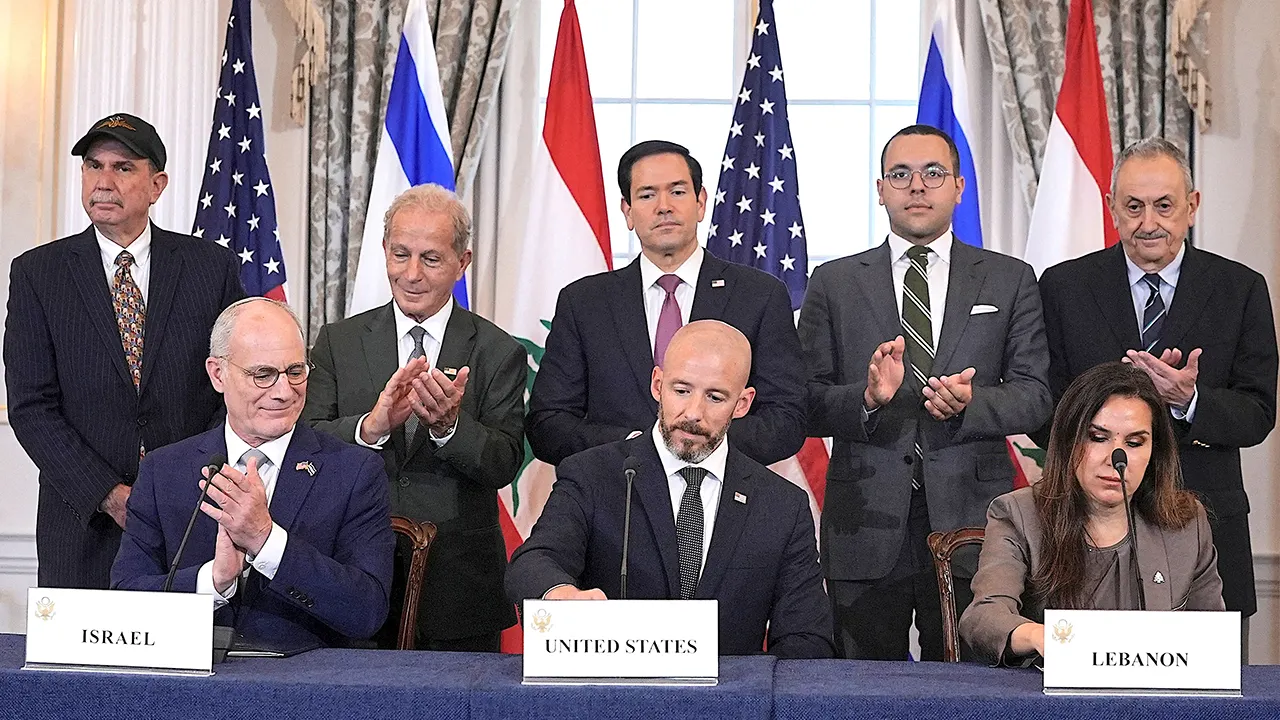
For the millions of families living along the volatile border between Israel and Lebanon, the constant threat of artillery fire, air raids, and underground skirmishes has defined daily existence for generation after generation. This long-standing climate of fear recently met a dramatic pivot with the announcement of a historic, U.S.-brokered framework agreement between Jerusalem and Beirut. Orchestrated under the mediation of the United States, this diplomatic breakthrough represents the first major stride toward a formal peace between the neighboring nations since the early 1980s. For decades, the two countries have technically remained in a formal state of war, their borders serving as a geopolitical fault line where local grievances and foreign regional ambitions frequently clashed in bloody conflicts. The escalation that began on October 7, 2023, when the Iran-backed militant group Hezbollah joined the violence initiated by Hamas’ invasion of Israel, brought the region to the absolute brink of total devastation. Yet, the newly unveiled framework agreement is being hailed by key western and regional leaders as a major turning point, potentially providing a peaceful exit ramp for civilian populations on both sides who are deeply exhausted by endless cycles of violence. Newly appointed U.S. Secretary of State Marco Rubio warmly welcomed the announcement, emphasizing that both the sovereign government of Lebanon and the state of Israel deserve the enduring stability and security this U.S.-led initiative promises to establish.
This framework agreement is not merely a localized truce; it is a direct challenge to the geopolitical chess board that Iran has spent decades constructing in the Levant. Under the leadership of the Trump administration, U.S. diplomats worked to decouple Lebanon’s national sovereignty from the dictates of Tehran, which has long used the heavily armed terrorist organization Hezbollah as its primary proxy in the region. Israeli Prime Minister Benjamin Netanyahu was resolute in defining the agreement’s broader geopolitical implications, characterizing the deal as a severe, direct blow to the Islamic Republic of Iran. Historically, Tehran has operated under the assumption that it could dictate terms along Israel’s northern border by maintaining an armed, state-within-a-state presence in southern Lebanon. Netanyahu made it clear that the unified diplomatic stance of Israel, Lebanon, and the United States delivers a message to the Iranian leadership that their interference in southern Lebanon has officially come to an end. By asserting that neither Iran, Hezbollah, nor any other foreign-sponsored terrorist entity has an active role to play in the region’s southern sovereign territory, the agreement attempts to strip Tehran of one of its most lethal leverage points in the Middle East. Secretary Rubio’s proactive stewardship of the deal signals the return of a robust, pressure-driven American foreign policy aimed at systematically dismantling Iran’s proxy networks while offering sovereign nations a chance to reclaim their independence.
For the people of Lebanon, the agreement carries a profound, deeply emotional significance that goes far beyond abstract geopolitical strategy, touching on the raw wounds of state failure and foreign exploitation. Guila Fakhoury, whose father, Amer Fakhoury, was kidnapped by Hezbollah in 2019 in a harrowing incident that exposed the group’s unchecked power, expressed a mixture of profound relief and historic hope over the development. Fakhoury noted that this agreement marks the first time since 1983 that Lebanon and Israel have successfully navigated direct negotiations to reach an understanding, representing a fundamental shift away from the paradigm where Lebanon’s security was held hostage to external regional agendas. For decades, patriotic Lebanese citizens have watched their government institutions, their economy, and their armed forces be systematically hollowed out by Hezbollah’s loyalty to its patrons in Tehran. Fakhoury pointed out that if the commitments laid out in the framework are genuinely fulfilled, it could establish a healthy, sovereign foundation for mutual security, vital economic opportunities, and shared stability that will directly benefit both ordinary Lebanese and Israeli citizens. However, she also issued a vital warning: the ultimate success or failure of this historic milestone relies entirely on its practical execution on the ground, meaning that the official Lebanese state and its legitimate security institutions must take absolute control of their national territory, entirely displacing armed militias operating outside the boundaries of the law.
Despite the widespread optimism echoing through the halls of diplomacy in Washington and Jerusalem, seasoned Mideast analysts urge the international community to temper its enthusiasm with cold regional realism. Walid Phares, a premier American foreign policy expert specializing in Middle Eastern dynamics, cautioned that the current framework must be understood as a highly sensitive ceasefire rather than a fully realized, self-sustaining peace treaty. Phares emphasized that Hezbollah does not operate in a vacuum; its political and military strategies are dictated by high-ranking commanders in Tehran who are highly unlikely to accept this diplomatic setback without a fight. He warned that Iran would likely pressure negotiations behind the scenes, using its remaining leverage to undermine the deal while ordering its media mouthpieces to project a narrative of defiance even as their forces on the ground desperately seek a pause from punishing Israeli military strikes. Furthermore, the Trump administration will have to carefully balance the implementation of the Rubio-sponsored agreement with the volatile security dynamics of the broader Persian Gulf region. Within Lebanon, the great political question mark remains whether the highly fragmented democratic opposition can successfully rise up to politically neutralize Hezbollah, as the standard Lebanese armed forces remain highly reluctant to trigger a domestic armed conflict with the heavily armed militant group.
The demand for accountability and structural reform is also driving a strong, unified response from key U.S. lawmakers who have long demanded justice for the numerous foreign policy disasters and human tragedies linked to Iranian proxies inside Lebanon. Senator Tom Cotton of Arkansas passionately rallied behind the diplomatic achievement, pointing out that the radical fighters of Hezbollah have the blood of countless American service members and citizens on their hands, dating back to the tragic bombings and kidnappings of the 1980s. Cotton applauded President Trump and Secretary Rubio for their aggressive leadership in forging an agreement designed to systematically isolate and restrain Tehran’s most dangerous proxy threat, warning that the Iranian regime has no legitimate future in a sovereign Lebanon. Echoing this firm sentiment, U.S. Ambassador to Israel Mike Huckabee highlighted the historic nature of the opportunity while reiterating that the ultimate key to permanent peace is the complete, verifiable disarmament of Hezbollah’s terrorist infrastructure. Huckabee’s direct engagement on the ground in Israel underscores the high-stakes, hands-on approach the U.S. diplomatic team is utilizing to ensure that the agreement does not simply become another easily broken promise, but rather a permanent mechanism for neutralizing terrorist threats and securing regional stability.
The ultimate fate of this bold framework agreement hangs in a delicate balance between a hopeful future and the grim lessons of Middle Eastern history. Senior fellow Hanin Ghaddar of The Washington Institute for Near East Policy analyzed the breakthrough with a mixture of praise and historical caution, reminding the world that the promising 1983 peace agreement between the two nations was ultimately sabotaged by violent regional actors, most notably the Assad regime in Syria acts as a proxy for regional rivals. Ghaddar warned that a desperate, cornered Iranian regime will almost certainly employ every clandestine asset, terrorist threat, and political maneuver at its disposal to dismantle this new framework and reclaim its dominant, chaotic influence over Lebanon’s political landscape. Because of these persistent, hostile threats, the governments of both Israel and Lebanon now bear an immense, historic responsibility to actively protect this fragile agreement, cooperate on mutual security arrangements, and ensure its rigorous implementation on the ground. As the international community watches with bated breath, this U.S.-brokered framework stands as a critical, high-stakes test of sovereign diplomacy, offering what may well be the final, fleeting opportunity to save Lebanon from the destructive grip of foreign proxies and inaugurate a brand new era of peace, dignity, and quiet borders for the people of the Levant.