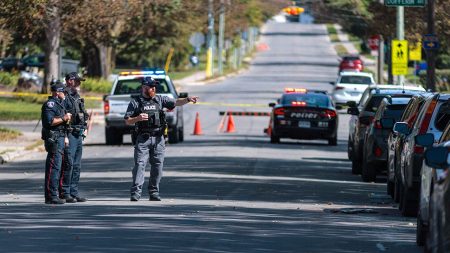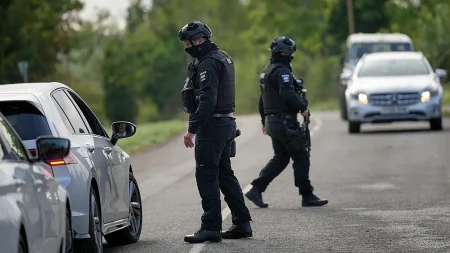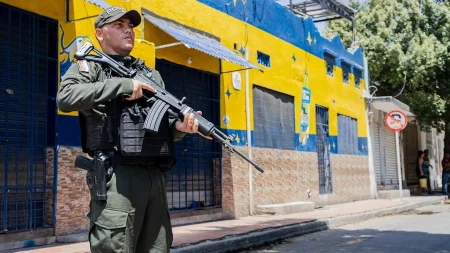



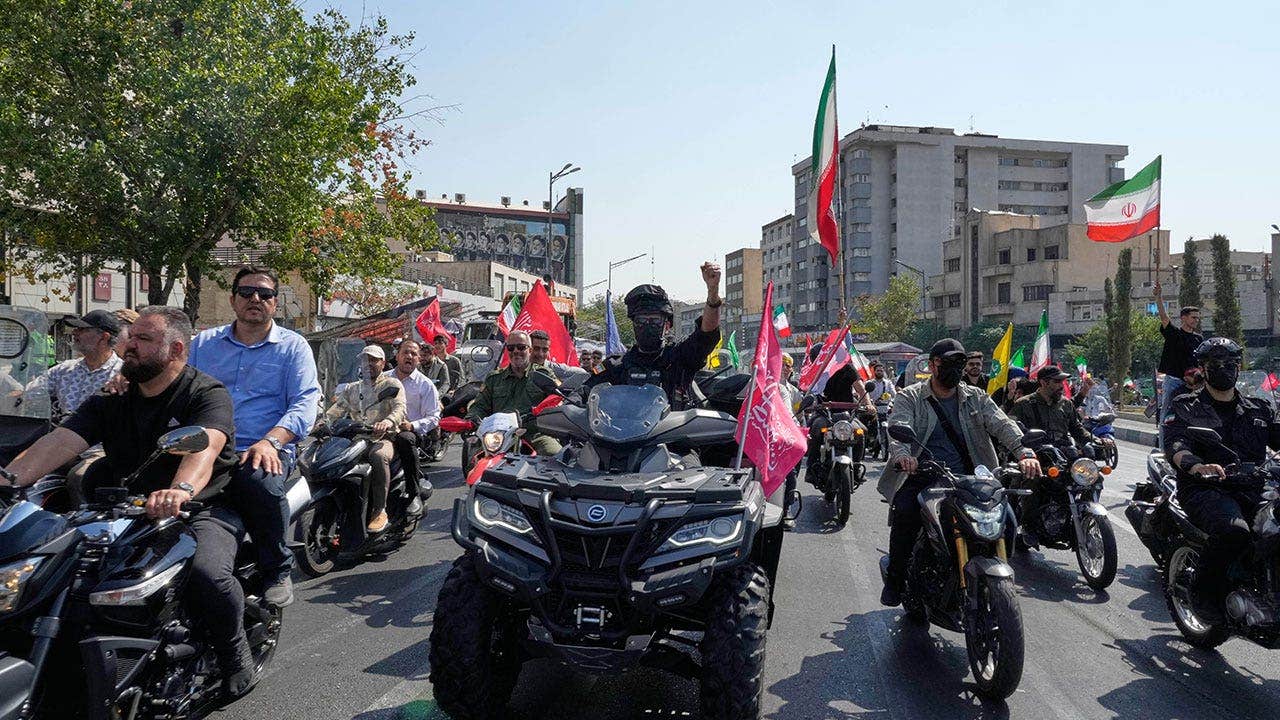
The streets of Tehran tell a story before a single word is spoken. There is a new tension in the air, a visible tightening of the state’s grip. Motorcycle patrols weave through traffic, their officers scanning sidewalks and shopfronts with watchful eyes. Checkpoints appear suddenly at busy intersections, forcing drivers to slow down, roll down windows, and answer questions. In major squares, members of the Islamic Revolutionary Guard Corps, the Basij militia, and ordinary law enforcement stand in clusters, their presence impossible to ignore. This is not a routine security posture. Multiple sources inside Iran told Fox News Digital that the regime has braced for possible unrest, and the preparation is most visible in the capital. The security buildup coincides with Iran’s annual Sacred Defense Week, a period of commemoration for the Iran-Iraq war, but locals say the scale and intensity feel different. The atmosphere is thick with anticipation, as if the state is waiting for something to happen and wants everyone to know it is ready. One Tehran resident described a city that seems to be holding its breath, where ordinary errands like buying groceries or meeting a friend can suddenly feel like crossing a border. The motorcycles are not just patrolling; they are photographing shops, recording movements, cataloguing the city in real time. For many Iranians, the message is clear: the state is watching, and it will not hesitate to act.
The visible presence, however, is only the surface of a much deeper security mobilization. The National Council of Resistance of Iran’s Committee on Security and Counterterrorism alleged that Iranian authorities ordered a “100%” state of readiness for the Army, IRGC, Basij, and law enforcement, and canceled all leave through September 27. According to the same report, some 51,000 personnel had been deployed across Greater Tehran alone, including 30,000 IRGC and Basij members and 21,000 law enforcement officers. Fox News Digital has not independently confirmed these numbers, but sources inside Iran say the operational reality matches the scale of such a claim. Pedestrians have been stopped on the street, searched, and asked to hand over their mobile phones. Security personnel have examined social media feeds, contact lists, and private messages, looking for anything that could be considered “anti-regime” content. The searches are not random. People who have participated in past protests, or who are related to activists, are especially targeted. One source described a deeply psychological layer of control: prisoners being threatened and forced to call their families, telling them not to take part in any demonstrations that might arise. The source also said that motorcyclists are taking photos of shops, creating a visual record of the economic life of the city and, implicitly, a threat to business owners who might close their doors or support protests. The message to the population is layered: not only will the state confront demonstrators in the streets, but it will reach into homes, prisons, and family relationships to ensure that any uprising is stillborn.
Beyond the capital, the security crackdown has taken on different but equally menacing forms. In smaller cities like Borujen and Isfahan, plainclothes agents are more prevalent, according to sources. They try to stay out of public view, blending into crowds, listening to conversations, and noting who speaks too loudly or asks too many questions. In Tehran, by contrast, the state prefers visible intimidation: military uniforms, heavy gear, and a sweeping street presence designed to instill fear. One source explained this regional difference, saying that in Tehran the regime appears openly on the streets, while in other cities it operates from the shadows. Leave has also been canceled for security personnel in smaller cities, and everyday life is under increased surveillance. Shops, telephone communications, and even casual social gatherings are monitored. The Basij, the volunteer militia that has long been the regime’s first line of defense against civilian unrest, has been placed on alert. Former members who received military training are being called up and assembled at educational facilities and large properties on the outskirts of Tehran, where they can be housed and deployed quickly if needed. The state is effectively transforming parts of the country into a garrison, with reserve forces waiting just outside the urban centers, ready to move at a moment’s notice. For ordinary Iranians, this is a haunting familiar pattern. They have seen it before, in the protests of 2009, 2019, and 2022, and they know what it means when the regime starts organizing its forces and cutting communications. It means that any disturbance will be met not with dialogue, but with overwhelming and often brutal force.
Amid this tightening security, university students have once again taken to the streets. Videos published by Iran International show protests at Allameh Tabataba’i University in Tehran, where students gathered on Monday to voice their anger over compulsory hijab rules, rising tuition costs, dormitory conditions, and broader political repression. What began as a complaint about the cost of food and housing quickly expanded into something more political. Students were recorded chanting against the morality police and calling for an end to repression. The Basij attempted to disrupt the gathering, threatening students and trying to break up the crowd, according to student publications. These protests are not isolated. They reflect a deeper frustration that has been simmering on Iranian campuses for years, but especially since the nationwide uprising that followed the death of Mahsa Amini in 2022. The compulsory hijab remains a raw nerve. On September 8, a senior official in the office representing Iran’s supreme leader at universities said a new compulsory-hijab directive had been drafted and was expected to be issued by the ministries overseeing higher education. For many students, this is an unacceptable affront to their basic freedom. The protests are also a response to what students describe as unbearable living conditions: overcrowded dormitories, inflation that has made basic food unaffordable, and a sense that the future is closing in around them. The regime’s response to these grievances has been to send in the Basij, to monitor social media, and to threaten expulsion. But the students keep coming back. Each new protest, no matter how quickly it is suppressed, chips away at the fear that has kept the population subdued. The sight of young people chanting against the morality police, even for a few moments, is a powerful reminder that the regime’s control is not absolute.
The regime’s strategy, however, goes far beyond street-level suppression. It involves a systematic effort to criminalize dissent before it can even form. Iranian journalist Mehdi Ghadimi, who lives outside Iran after years of opposition activity, told Fox News Digital that he has received reports of people being detained on espionage charges simply because they communicate with relatives or friends outside the country. It is a chillingly broad interpretation of “espionage,” one that treats any international contact as a potential threat to the state. Ghadimi also reported that individuals with serious criminal records have been released from prison in exchange for reporting to local Basij bases and participating in the suppression of demonstrations. In other words, the regime is outsourcing repression to criminals, offering them freedom in exchange for their willingness to beat and detain their fellow citizens. This is a terrifying development for ordinary Iranians, who can no longer assume that the people confronting them on the streets are disciplined soldiers; they may be violent offenders who have been given license to act without consequences. The regime is also escalating its execution campaign against anti-regime activists, a pattern that has accelerated alongside internet censorship. By cutting off communication channels and eliminating the most vocal critics, the state hopes to create a sense of hopelessness and isolation. But the reports from inside the country suggest the opposite effect. Instead of crushing the will to resist, these tactics are deepening the public’s anger and desperation. One source in Tehran described prisoners being threatened and forced to tell their families not to participate in protests, a tactic that reveals the regime’s deep anxiety about the population’s willingness to rise again. The harder the state tries to control every aspect of life, the more it reveals its own fragility.
All of this is unfolding against a backdrop of geopolitical tension and war. The IRGC escalated its rhetoric toward Washington on Tuesday, with spokesman Hossein Mohebbi calling on Americans to pressure the Trump administration. “This lying administration must be changed,” Mohebbi said at a Tehran press conference. His comments came as U.S. and Iranian officials continued indirect contacts through mediators in an effort to end the seven-month conflict between Iran and Israel. The combination of internal security preparations and renewed demonstrations is fueling speculation among Iranians about whether the country could face another broader wave of unrest. The last major uprising, in 2022, shook the regime to its core, and the memory of that uprising is still fresh. People remember the courage of the protesters, the brutality of the response, and the international attention that briefly turned to Tehran. Now, with war raging on multiple fronts, with economic hardship grinding down the middle class, and with the security state at maximum alert, many wonder if the country is on the verge of another explosion. Ghadimi summarized the sentiment among his contacts: “The reality is that nobody knows what’s going to happen. Everyone I talk to says that this situation cannot continue and that, somehow, it has to come to an end.” That uncertainty is perhaps the most human and most tragic part of the story. The people of Iran are living in a state of suspended animation, caught between the fear of what will happen if they rise and the knowledge that the current situation cannot last. They go to work, they send their children to school, they try to live ordinary lives under extraordinary pressure. But beneath the surface, there is a constant hum of anticipation, a feeling that the next chapter is already being written, even if no one can yet read it. Whether that chapter ends in renewed repression or in a new opening remains unknown, but the sources inside Iran are clear about one thing: the regime is not calm. It is preparing for something, and that preparation is its own confession of fear.