




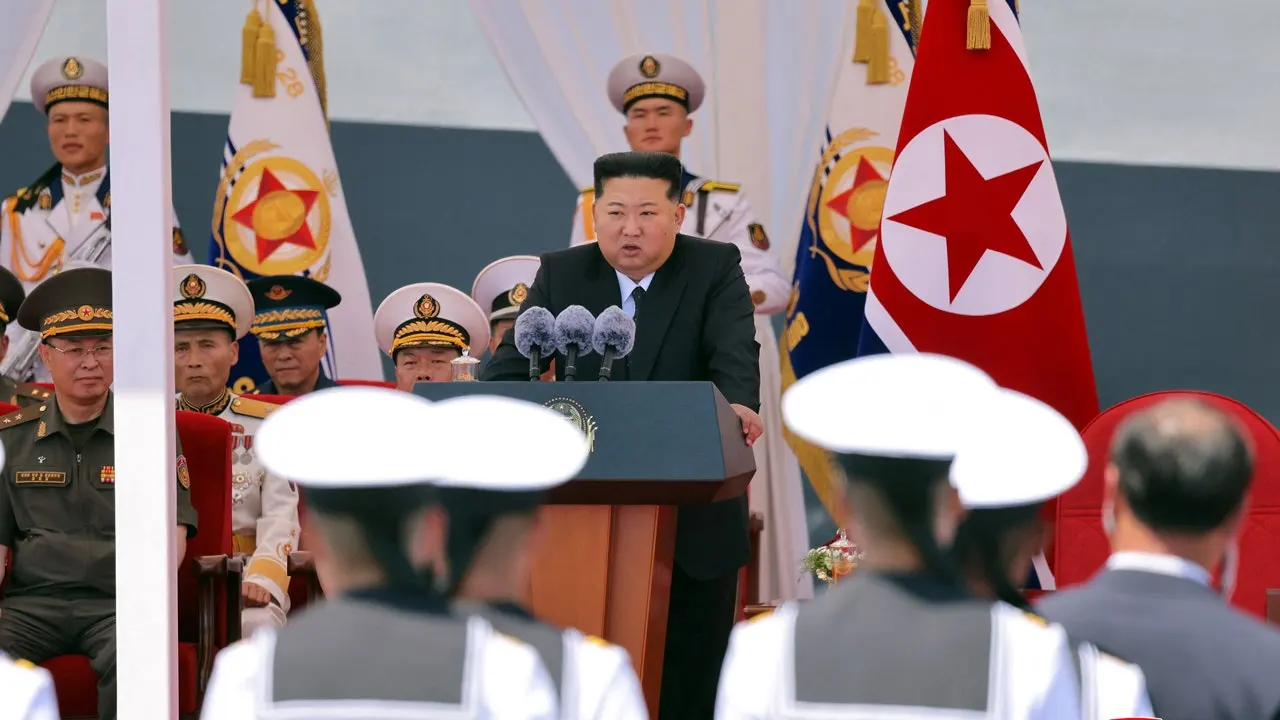
In the crisp, salt-tinged air of the western port city of Nampho, against a backdrop of meticulously choreographed military pageantry and billowing red flags, North Korean leader Kim Jong Un recently stepped aboard the deck of his nation’s prized new warship to deliver a message that would reverberate far beyond the restricted borders of the Korean Peninsula. Standing before the gleaming, imposing steel hull of a newly commissioned Choe Hyon-class destroyer, Kim did not merely celebrate a single milestone in naval engineering; instead, he unveiled an astonishingly ambitious, almost desperate blueprint for the future of the Hermit Kingdom’s maritime forces. He proposed that the state’s naval shipyards embark on an unrelenting and aggressive manufacturing campaign, tasking them with constructing two massive, 5,000-ton warships every calendar year for the next five years. Historically, North Korea’s military doctrine has overwhelmingly favored its lumbering ground armies, vast artillery corps, and, in recent decades, its highly sophisticated land-based ballistic and nuclear missile programs. This lopsided strategic focus left the Korean People’s Army Navy as a largely neglected, technologically obsolete branch of the military, primarily restricted to brown-water coastal defense operations and reliant on aging, rust-prone Cold War-era Soviet vessels. However, Kim’s latest decree signals a profound, sweeping strategic pivot toward the open sea. By demanding a rapid, historically unprecedented expansion of North Korea’s naval assets, the supreme leader is attempting to remake a force once dismissed by international security analysts into a genuine blue-water challenger. This highly calculated display of raw ambition at the Nampho harbor, heavily publicized by the state-run Korean Central News Agency, was designed to project absolute confidence to both domestic audiences and foreign adversaries. Yet, beneath the polished gray paint of the new destroyer lies a deeply complex human reality: a highly sanctioned, economically choked nation struggling to convert its grand militaristic dreams into physical reality.
This newborn obsession with projecting power on the high seas is embodied by the Choe Hyon-class destroyer, a multipurpose vessel that Kim Jong Un has repeatedly hailed as a monumental technological leap forward for his country. The path to commissioning this flagship was neither swift nor easy, having undergone a grueling fourteen months of military operational tests, sea trials, and simulated combat maneuvers to prove its seaworthiness to a highly demanding regime. In April, Kim personally observed the ship’s lethal capabilities from its deck, watching with visible pride as it successfully launched two cruise missiles and three advanced anti-ship missiles into the surrounding waters, painting arcs of fire across the horizon. To the state’s media apparatus, this successful integration of precision-guided rocketry and maritime platform design represents a historic milestone, elevating the navy’s potential to conduct preemptive strikes and extend the reach of North Korea’s conventional deterrence. Yet, behind these triumphant state broadcasts is a human story of immense strain and technological improvisation. Operating under a web of strict international sanctions that choke off the supply of high-grade raw steel, advanced microelectronics, and modern maritime components, North Korean engineers and shipbuilders are forced to rely on illicit smuggling, reverse engineering, and sheer manual labor to build these complex vessels. Each test launch observed by Kim Jong Un is the culmination of thousands of hours of intense, high-pressure labor by scientists and technicians who know that their personal survival, and that of their families, depends entirely on the flawless performance of their creations. Thus, the Choe Hyon stands not only as a weapon of war but as an indicator of the lengths to which the regime will go to bypass global economic isolation, turning what should be a coastal defense asset into a mobile, missile-launching platform meant to keep regional adversaries on constant alert.
Perhaps the most chilling and strategically significant aspect of Kim Jong Un’s maritime declaration is his explicit assertion that the “nuclearization” of the nation’s navy is advancing along its own determined course, steadily integrating with the broader national nuclear deterrence framework. For years, the global community has watched with mounting anxiety as North Korea developed massive, land-based intercontinental ballistic missiles, but this sudden, aggressive emphasis on transferring nuclear capabilities to the high seas introduces a highly volatile and unpredictable dynamic to East Asian regional security. By seeking to equip his surface fleet, destroyers, and nascent submarine force with tactical nuclear warheads and low-yield cruise missiles, Kim is aiming to create a highly survivable, multi-axis second-strike capability. Such a deployment would severely complicate the preemptive defense and containment plans calculated by the joint military commands of the United States, South Korea, and Japan. The psychological and tactical impact of this development on neighboring countries is immense; a nuclear-capable North Korean fleet patrolling the narrow, contested waters of the East Sea and the Yellow Sea would force allied regional defense planners to fundamentally overhaul their surveillance, radar tracking, and maritime interception strategies. To further amplify this naval anxiety, North Korean state media has strategically released low-resolution, highly provocative images detailing the ongoing development of its own domestic nuclear-powered submarine program. While Western naval intelligence officials and independent sovereign analysts remain highly skeptical of Pyongyang’s actual capacity to design, build, and safely maintain a functioning nuclear propulsion system, the constant, carefully engineered drumbeat of these announcements serves a vital political purpose. It reinforces the foundational domestic narrative of Juche—the absolute ideology of self-reliance—while convincing a heavily monitored, isolated population that their Supreme Leader possesses the technological genius required to stand equal to the world’s preeminent military superpowers.
However, the path of authoritarian military ambition is rarely smooth, and the modern, secret history of North Korea’s navy is punctuated by humiliating engineering failures that the state media desperately tries to scrub from the historical record. A highly illustrative and humanizing example of this structural vulnerability is the secret saga of the Kang Kon, a sister 5,000-ton destroyer that was originally intended to be a towering symbol of the country’s rapid naval renaissance. First unveiled to the military command with great fanfare in May of last year, the massive, expensive vessel suffered a catastrophic and deeply embarrassing mechanical failure during its initial launch sequence at the northern industrial port city of Chongjin, sustaining severe physical damage that forced it to be immediately towed back to a heavily guarded dry dock for emergency repairs. In a highly militarized society where any perceived failure to execute the Supreme Leader’s direct orders can be met with public demotion, banishment to remote coal mines, or worse, the immense pressure placed upon the shipwrights, engineers, and naval officers tasked with restoring the Kang Kon was nothing short of psychological torture. Under the constant, terrifying shadow of the regime’s secret police, these unnamed, exhausted laborers worked in grueling shifts to rebuild the fractured hull and salvage the damaged propulsion systems, eventually relaunching the patched-up ship after months of anxious, high-stakes repairs. This dramatic incident exposes the brittle, fragile reality that lurks directly behind the regime’s bombastic, highly polished television broadcasts. When Kim Jong Un boasts to his people and the world that his newly expanded navy will soon become “something incredible beyond imagination,” he deliberately overlooks the systemic structural flaws, the chronic, severe shortages of high-quality steel, and the inevitable defects that arise when a paranoid government prioritizes political loyalty and rapid production over sound engineering practices.
Recognizing that even the most sophisticated, heavily armed warships are essentially useless without the advanced logistical infrastructure required to fuel, repair, and shelter them, Kim Jong Un has recently shifted his strategic focus from the vessels themselves to the land-based networks that sustain them. Speaking candidly during a highly critical, multi-day meeting of the ruling Workers’ Party’s Central Committee in Pyongyang, Kim acknowledged a stark operational reality, declaring that building modernized naval bases has now emerged as a “desperate and essential task” for the long-term viability of the state’s maritime strategy. Most of North Korea’s existing naval ports and docking facilities are crumbling relics of the mid-to-late twentieth century—highly vulnerable to high-tech allied satellite surveillance, lacking in heavy crane assemblies, and completely ill-equipped to handle the immense logistical weight of the larger, 10,000-ton strategic warships that Kim now dreams of deploying. During this high-level political gathering, Kim announced that his navy would soon undergo sweeping, systemic changes to its official military status, its long-term tactical role, and the overall scope of its day-to-day operations, though he characteristically refrained from elaborating on what these far-reaching changes would actually entail. To defense planners and intelligence officials in Seoul, Tokyo, and Washington, this vague yet menacing promise indicates a fundamental, aggressive rewrite of the regime’s traditional military posture. The proposed modernization of extensive naval infrastructure suggests that Pyongyang is preparing for a highly confrontational, long-term maritime strategy, aiming to challenge international territorial boundaries and assert dominance over crucial trade lanes. By constructing deeper, heavily fortified sub-surface pens and advanced harbor defenses, North Korea hopes to safeguard its prized vessels from potential preemptive air strikes, establishing a far more resilient and persistent naval threat in the region.
Ultimately, the heavy, dark iron hulls of the newly commissioned Choe Hyon and the repaired Kang Kon cannot sail far enough to obscure the tragic, deeply human costs that fund Kim Jong Un’s majestic naval fantasies. As the Supreme Leader stands on the windswept docks of Nampho, visualizing a grand, nuclear-tipped armada of 10,000-ton warships patrolling the deep oceans, the vast majority of his twenty-six million citizens continue to grapple with a silent, daily struggle for fundamental human survival. The astronomical financial resources, precious imported metals, and highly specialized engineering talents required to build, fuel, and maintain these massive warships are forcibly diverted from a domestic economy that is fundamentally broken, where chronic malnutrition plagues rural agricultural provinces, and the majority of the population endures life without modern electricity, clean running water, or basic professional healthcare. The bitter, heartbreaking irony of North Korea’s aggressive maritime buildup is that the ruling regime continues to squander its meager national wealth building elaborate, high-tech steel machines of destruction, claiming they are necessary to defend a nation against phantom external threats, while its own flesh-and-blood citizens perish from systemic poverty and forced labor within the country’s borders. The grand, missile-laden warships paraded so triumphantly on state-controlled television are actually paid for with the stolen labor, restricted freedom, and quiet suffering of an entire generation of North Koreans. In the final analysis, the story of North Korea’s sudden, dramatic naval expansion is not simply a dry narrative of international security equations, weapon systems, or grand geopolitical strategizing; it is, at its core, a profoundly human and ongoing tragedy. It represents the endless sacrifice of millions of ordinary human lives, whose natural rights to prosperity, comfort, and peace are continuously ground down to support the theatrical, nuclear-armed illusions of a dictator determined to project strength upon the oceans at any human cost.