


Here is a summarized and humanized version of the content, structured into six paragraphs. It expands on the original report to provide a deeper, more empathetic view of the crisis unfolding in France, while keeping all the essential facts intact.
Paragraph 1: The Streets Erupt
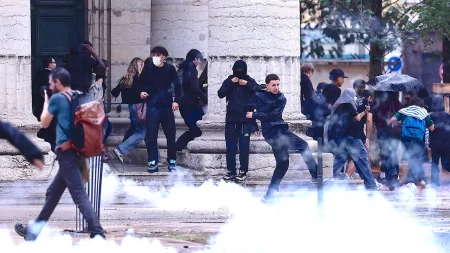
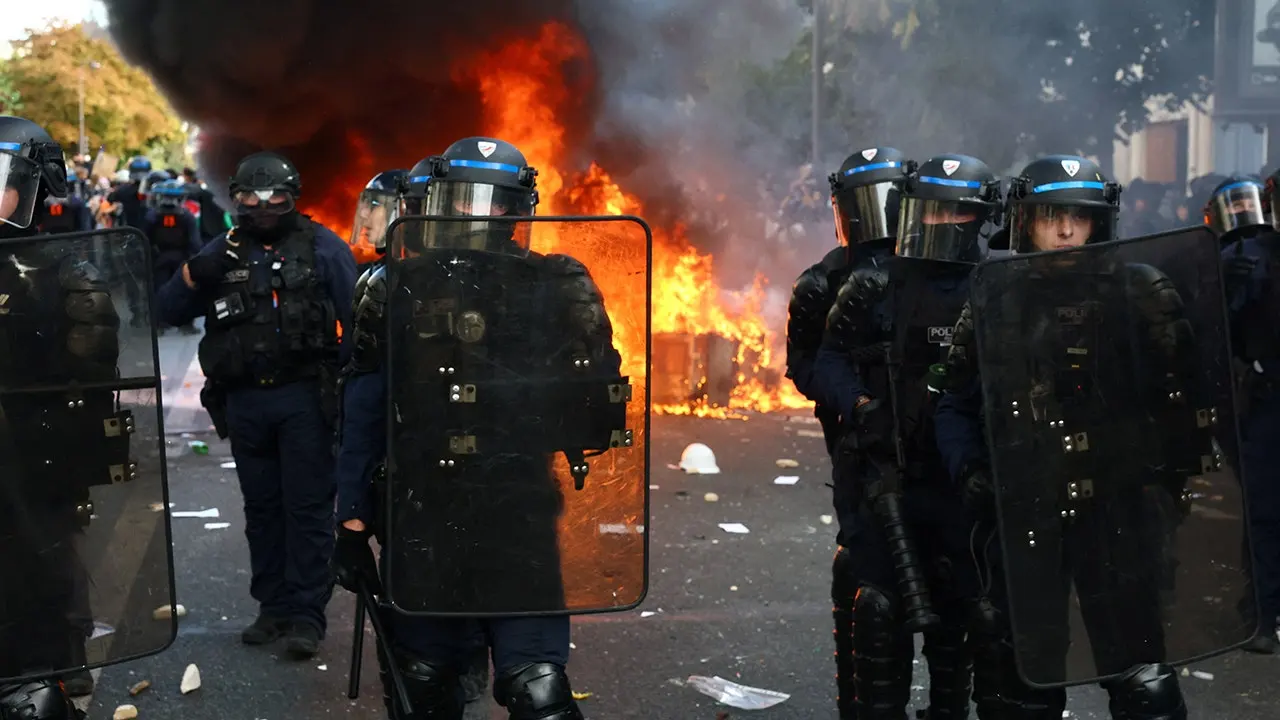
The streets of France have become a battleground. What began as a student movement demanding better learning conditions has exploded into a nationwide uprising that has left high schools shuttered, city streets blanketed in tear gas, and a nation wrestling with its own reflection. On Tuesday, the image of a teenager, his hand blown off by a police grenade, became the harrowing symbol of a conflict spiraling out of control. Across the country, from the Boulevard Saint-Michel in Paris to the docks of Marseille, hundreds of thousands of demonstrators—many of them still in their school blazers—faced down lines of riot police, their voices a desperate mix of anger and fear. The government counted 256,000 protesters nationwide, while the organizers, seeing the massive crowds that swelled past the barricades, claimed nearly half a million. In Paris alone, the chasm between official and organizer estimates was just as wide: 56,000 against 100,000. Yet no number could capture the raw emotion of the scenes unfolding: the crackle of fires set in the streets, the thud of grenades, the desperate sprint for cover as the air grew thick with smoke. By the end of the day, the Interior Ministry reported that over 6,100 people had been taken into custody since the movement began in September, and more than 700 police officers and 200 teenagers had been injured in clashes that have become more frequent and more violent. The physical and emotional scars are deepening, and the educational heart of France, once a symbol of republican equality, now stands at the epicenter of a national reckoning.
Paragraph 2: The Rotten Foundation of a Promise
To understand the rage, one must step inside the crumbling walls of France’s public high schools. The protesters are not just demonstrating for the sake of it; they are the products of an educational system that has been hollowed out by years of neglect. Students describe classrooms so overcrowded that they are forced to sit on the floor, and so dilapidated that when it rains, they must navigate buckets to catch the leaks. There are no air conditioners in a sweltering summer, and in the winter, some rooms are so cold that students wear their coats to class. In parts of the country, the issue is not just discomfort but basic sanitation—infestations of rats have become common in schools that were built decades ago and never modernized. The students’ list of grievances is long: staff shortages that leave entire classes without teachers, and a compulsory academic schedule that is among the most punishing in Europe, with students starting at eight in the morning and often not finishing until six in the evening, only to go home to an endless pile of homework. “We want more money for the national educational system so that high schools are renovated,” said Roberta, a recent graduate who had joined the protests in Paris. Her words echo the deep frustration of a generation that feels the promise of a “great equalizer” has been betrayed. These are not privileged children demanding more; they are students from working-class and immigrant families who see the school as their only ladder to a better life, and that ladder is now missing a rung. The physical decay of the buildings is a daily reminder of how little the state seems to value them. This is why the protests have resonated so deeply, transforming from a simple dispute over funding into a raw, emotional outcry against a system that has left them behind.
Paragraph 3: The Politics of Chaos
The unrest has quickly become a powder keg in the upcoming presidential election, with France’s leaders scrambling to respond to a movement that has veered beyond the classroom. President Emmanuel Macron, facing a growing national crisis, called an emergency meeting with his top ministers to discuss how to quell the violence. But the political class is deeply divided on how to address the protests. Far-left presidential hopeful Jean-Luc Mélenchon has seized the moment, publicly denouncing the government’s response as “repressive” and positioning himself as the defender of the youth. Yet his party, La France Insoumise (LFI), has found itself on the defensive, accused of cynically using the unrest to score political points and even inciting violence. A video emerged of the mayor of Seine-Saint Denis, Bally Bagayoko of LFI, laughing and high-fiving students moments after a trash can had been set ablaze—a visual that outraged conservatives. The president of the Île-de-France region went further, alleging that LFI was behind a viral “Trash your high school” challenge spreading across TikTok, encouraging students to sabotage their own schools. “There is a call to action being issued by LFI today,” he said. LFI has categorically denied the accusations, but the damage is done. The protests have become a litmus test for political loyalties, with each side trying to claim the moral high ground. For many, the movement is no longer just about education; it is a proxy battle for the very soul of France, with the question of who is responsible for the youth—and who is allowed to speak for them—hanging over the country. The fact that a student protest has become a hot-button campaign issue only intensifies the pressure on the ground, as demonstrators fear that their real demands will be lost in the political maneuvering.
Paragraph 4: A Global Echo and a Warning
The eyes of the world have turned to France, and the interpretation of what is happening is sharply divided. From the United States, former President Donald Trump weighed in on Truth Social, framing the protests not as a cry for better classrooms but as a symptom of a much darker demographic and cultural shift. “What’s happening in France is nothing less than out of control mass migration. This isn’t about schools, this is about Islam wanting to take over a once great Country!” he wrote, injecting the conflict into the ongoing debate over immigration and identity in the West. His words were echoed by Nile Gardiner of The Heritage Foundation, who claimed the protests represented an “outright uprising and insurrection” driven by a coalition of “Islamists, the communists, the socialists, the far-left.” For these observers, the sight of French students fighting with police was not an act of legitimate civic protest, but a preview of a broader societal collapse. “The stakes are incredibly high for the French people,” Gardiner warned, “and this is a warning for the United States, as well.” This narrative, though controversial, has given the protests a global resonance that goes far beyond school funding. It turns the chaos into a symbol of the larger existential battles facing Western democracies—between nationalism and globalism, between secularism and religious identity, and between order and chaos. For the students on the streets, however, these geopolitical interpretations feel distant and almost insulting. They are not thinking about identity politics when they are being hit with tear gas; they are thinking about the fact that their school bathroom has no door, and that their teacher has been absent for three months. The attempt to frame their movement as a casualty of external forces only serves to further alienate a generation that already feels unheard.
Paragraph 5: The Human Cost of a Bullet’s Echo
Amidst the political chess and ideological grandstanding, the true tragedy is unfolding in hospitals and homes across France. The most shocking incident occurred in the town of Lens on Monday, when a 15-year-old boy picked up a police dispersal grenade that had landed near him. The explosion cost him his hand and part of his lower arm. The image of this child, a child with his whole life ahead of him, being maimed in a school protest has sent a visceral shiver through the country. The boy’s story has become a rallying cry for those who believe the police response has become dangerously disproportionate. Felix Barney, a university student who witnessed the violence, expressed a sentiment that seems to be shared by many: “It doesn’t have any sense to hit minors,” he said, his voice thick with outrage. Yet, Interior Minister Laurent Nunez defended the policing methods, stating that the response had been proportionate in “almost all cases.” The phrase “almost all” offered little comfort to those who saw a 15-year-old bleeding on the pavement. The injuries are not one-sided; 715 police officers have also been hurt, a fact that the government is quick to point out. But the disparity is stark to many observers: the police are armed with grenades and armored vehicles, while the students throw stones and light fires. This is not to excuse the destruction of property or attacks on officers, but it highlights a growing sense of asymmetry in the conflict. The student protests have moved from the halls of learning to the harsh, unforgiving reality of street combat, and in that transition, the cost is being measured in lost limbs and broken bodies. The memory of the boy in Lens will be a powerful legacy of this movement, a stark reminder that even the most passionate political message can be overshadowed by a single, devastating act of violence.
Paragraph 6: A State’s Atonement and the Future
Faced with the mounting chaos, the government is now scrambling to find a way out. Prime Minister Sebastien Lecornu has directed his ministers to meet with student representatives and address their core demands. This includes not only the large-scale renovation of aging school buildings but also more nuanced changes to the school day, such as longer lunch breaks and a review of the punishing 8 a.m. to 6 p.m. schedule. By closing or blocking over half of the country’s high schools, the students have achieved a powerful form of leverage, forcing the state to the negotiating table. Yet, the conflict is far from over. The authorities’ initial decision to shut schools to defuse tensions has proven to be a temporary and incomplete solution, a bandage on a wound that is still seeping. The deep-seated anger of the students is not solely about the physical structures; it is about respect, dignity, and a sense of being valued by the state. The government’s commitment to “address” the demands is a start, but it is a promise that many students have heard before and have seen broken. As President Macron prepares to meet his ministers, he is not just addressing a policy crisis; he is facing a profound crisis of legitimacy. The movement, born out of the mundane frustrations of high schoolers, has exposed a generational and social chasm that no amount of bureaucratic adjustment can easily heal. The ultimate outcome of these protests will not be decided solely by what happens in the negotiation rooms, but by whether the students feel genuinely heard. For now, the fires in the streets may be extinguished, but the embers of a disaffected youth, alienated and inspired to action, remain glowing. The lesson for France—and for the world—is that a country cannot ignore the physical and emotional decay of its educational system without paying a price in its streets. This is a human story, told not in the language of policy but in the language of frustration, hope, and an unyielding desire for a better future, and it is a story that is still being written.