






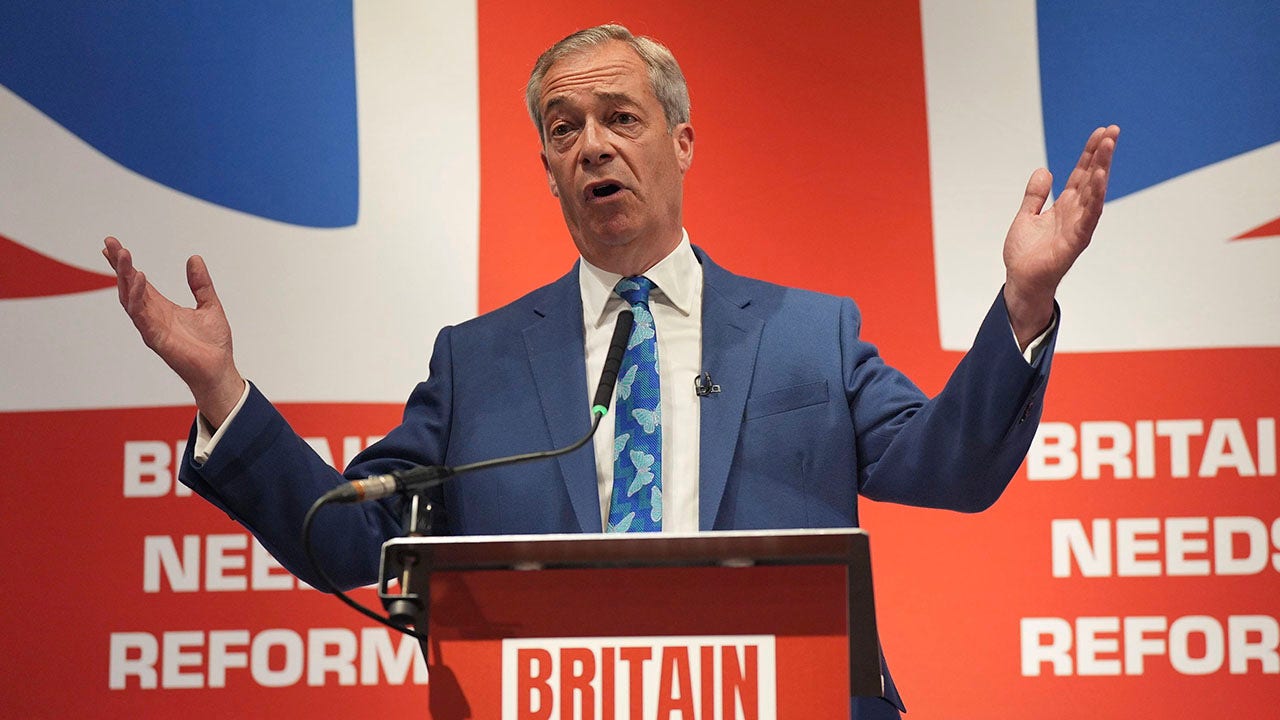
In the wake of Prime Minister Keir Starmer’s sudden and highly dramatic resignation, the historic halls of the Alliance for Responsible Citizenship conference in London hummed with a palpable, electric sense of structural transition. Standing at the very epicenter of this gathering of global conservative thinkers, policymakers, and cultural advocates was Nigel Farage, the charismatic leader of Reform UK, who, in a candid and exclusive conversation with Fox News Digital, laid bare a searing, deeply personal critique of a British political landscape he describes as fundamentally, systematically, and terminally broken. For Farage, Starmer’s rapid departure from the steps of Downing Street was not merely another routine leadership shuffle in Westminster, but rather the latest violent, inevitable tremor of an ongoing, decade-long political earthquake that first began with the historic Brexit vote. Looking out at an electorate grown deeply weary of revolving-door leadership, broken promises, and economic stagnation, Farage wasted absolutely no time in demanding an immediate, fresh general election, confidently and boldly predicting that his fast-rising Reform UK party possesses a very real, historic path to winning overall power. Farage’s diagnosis of the nation’s current malaise is deeply humanized; it is a story of ordinary, hardworking citizens who feel entirely abandoned and ignored by a highly insulated metropolitan elite class that seems vastly more interested in maintaining its own grip on authority than listening to the voices of the people they were chosen to represent. With Starmer’s exit, the Reform UK leader sees a unique, generational window of opportunity to bypass the internal power struggles of the established political machines and return power directly to the voters, arguing that only a true national reset can begin to mend the frayed social fabric of a country that has lost its democratic anchor. Farage insists that the British people are tired of backroom deals and unelected leaders, and they are ready to assert their sovereign right to choose a government that reflects their core values.
To truly comprehend the profound crisis currently gripping the British government, Farage argues that one must look back exactly ten years to the monumental, populist uprising of the Brexit referendum, a grassroots movement that completely shattered the traditional political consensus in the United Kingdom. This “political earthquake,” as Farage passionately terms it, fundamentally redrew the political map, yet the country’s two traditional legacy parties—Labour and the Conservatives—have spent the subsequent decade failing to adapt to this new reality or deliver on the core promises made to the British public. The driving force behind this historic revolt has always been the ordinary, working-class voter, many of whom reside in former industrial rust belts and traditional Labour strongholds that have now drifted toward Reform UK. Farage explicitly linked Starmer’s political demise to his party’s failure in recent local elections, where Reform UK made massive, unprecedented gains by mobilizing these exact same Brexit voters who remain deeply angry over the government’s failure to secure the nation’s borders. For these communities, the issue of mass, unchecked immigration is not an abstract policy debate to be discussed in comfortable metropolitan salons, but a daily lived reality that has strained public services, depressed local wages, and rapidly transformed the social fabric of their neighborhoods. By attempting to quietly steer Britain back into closer alignment with the European Union’s regulatory orbit, Starmer ultimately alienated the very voters he needed to sustain his government. Farage argues that this disconnect between the political class’s desire for globalist integration and the working class’s demand for national self-determination is the primary engine behind Britain’s ongoing political volatility, proving that the spirit of the 2016 referendum remains the most potent force in British political life today, and that any leader who ignores it does so at their own peril.
This profound disconnect is perhaps most visible in the dizzying speed with which Britain’s executive branch has changed hands, transforming Downing Street into what Farage critiques as a highly unstable corporate boardroom rather than the seat of a stable global democracy. With Starmer out, the British public faces the surreal prospect of welcoming Andy Burnham as their next prime minister, a leadership transition orchestrated through an internal Labour party contest rather than a direct democratic appeal to the British electorate. Farage pointed out the sheer absurdity of this situation with a sharp, incredulous assessment: should Burnham indeed assume office, he will become the United Kingdom’s sixth prime minister in just seven years—an unprecedented level of executive turnover that rivals some of the most unstable periods in modern European history. This relentless game of political musical chairs has severely eroded the public’s faith in the democratic process, leaving many voters feeling like spectators in a drama where they have no say over who actually runs their country. Farage admitted that he, like most of the British public, has little understanding of what Burnham’s actual policy agenda would entail, highlighting the deep undemocratic vacuum created when leaders are chosen by party delegates rather than the nation at large. The sheer speed of these changes has hollowed out the core of British democratic legitimacy, effectively disenfranchising the voters. Because a leader selected under these circumstances completely lacks a direct public mandate, Farage insists that the only honest, democratic path forward is a snap general election that forces all parties to present their visions clearly to the voters. Without such an election, any incoming prime minister will likely find themselves crippled from day one, trapped in the same cycle of internal party infighting and public illegitimacy that doomed their predecessors and left the British state in a condition of functional paralysis.
Beyond the immediate backroom mechanics of Westminster leadership battles, Farage views this systemic breakdown as part of a much larger, global crisis of cultural identity and national values currently sweeping across the Western world. He spoke with deep concern about how unchecked mass migration has dramatically altered the physical and cultural landscape of the United Kingdom, arguing that many historic British cities have been transformed literally beyond recognition in a remarkably short span of time. This rapid demographic shift, driven by a political establishment that refused to be selective about who was allowed to enter the country, has created profound social friction and fueled a widespread feeling among native citizens that their traditional way of life is being actively erased. Farage extended this critique to the pervasive influence of diversity, equity, and inclusion (DEI) ideologies within British institutions, claiming that the pendulum has swung so far that it has produced a deeply corrosive “two-tier” system of policing and justice, where different groups appear to be held to different legal standards based on identity rather than actions. This erosion of equal treatment under the law has further fractured social cohesion, leading Farage to issue a heartfelt, urgent warning to his friends and allies across the Atlantic. He urged American observers to look closely at the societal decay in contemporary Britain as a cautionary tale, warning that the United States must actively resist adopting these same divisive diversity policies and lax border controls if it wishes to avoid the same cultural balkanization. In Farage’s view, Western leaders have lost the courage to stand up and proudly defend traditional Judeo-Christian values, leaving a spiritual and cultural vacuum that must be filled by a renewed commitment to national pride, historical memory, and the rule of equal law. Farage’s message to America is clear: the path to national survival lies in defending, not dismantling, the foundational pillars of Western civilization.
Despite his sharp criticisms of his own country’s current governance, Farage remains deeply optimistic about the future, particularly when looking toward the enduring strength of the historic relationship between the United Kingdom and the United States. Reflecting on a life that has been deeply intertwined with America ever since he took his very first job in 1982 at the Wall Street firm Drexel Burnham Lambert, Farage spoke with a deeply personal warmth about the profound cultural and economic ties that unite the two English-speaking nations. He argued that rather than looking back toward the regulatory confines of continental Europe, Britain’s true economic and strategic destiny lies in forging a much closer, more dynamic partnership with the United States. This includes a major push to break down remaining trade barriers, particularly within the vital financial services sector, which would unlock immense economic potential and generate high-paying jobs on both sides of the Atlantic. For Farage, this relationship is built on a rock-solid foundation of shared investment, common language, and deep cultural affinity; the United States remains the single largest foreign investor in the United Kingdom, just as Britain is the biggest investor in America. The economic synergy between the two countries has the power to transform both nations’ financial futures, building on the shared values of liberty, free markets, and individual initiative that have historically driven both societies to greatness. He expressed a strong personal desire to leverage his own warm relationships with American political leaders, including President-elect Donald Trump, to help bridge the gaps that had developed under previous administrations, arguing that a strong US-UK alliance is essential for global stability. By placing our mutual prosperity and security at the heart of foreign policy, Farage believes both nations can successfully navigate the complex geopolitical challenges of the twenty-first century while remaining fiercely independent and prosperous partners, demonstrating that the bond between our peoples is far stronger than any temporary political disagreement.
Ultimately, Farage completely dismissed any lingering notions promoted by the Westminster elite that Britain might one day reverse its course and re-enter the European Union, labeling such ideas as a fantasy confined purely to a detached political bubble. He pointed out the harsh, highly unpopular realities that any hypothetical return to the EU would actually entail, including the mandatory abandonment of the historic British pound sterling in favor of the Euro and the payment of massive, multi-billion-dollar annual membership fees into Brussels’ coffers—propositions for which there is absolutely no appetite among the wider British public. Instead of looking backward to a failed supranational experiment, Farage looks to the future with a sense of historical grandeur, poetically framing the American Revolution of 1776 as the very first historical predecessor to the modern Brexit movement he helped champion. Just as the American colonists took a brave, uncertain leap of faith to break away from distant rule, strike out on their own, and ultimately build the most prosperous and successful nation in human history, so too must modern Britain embrace the full potential of its hard-won independence. For Farage, the path forward is not found in timidly clinging to failing globalist structures or managing decline through undemocratic leadership swaps, but in having the national self-confidence to chart an independent course based on secure borders, economic freedom, and a proud, unapologetic defense of Western civilization. By reasserting control over their own borders and local institutions, nations do not isolate themselves; instead, they become strong, self-reliant partners capable of collaborating on the world stage from a position of true strength and confidence. It is this grand, historic vision of national renewal that Farage believes will ultimately carry Reform UK to victory, proving to the world that when ordinary citizens are finally given a voice, they will always choose the path of freedom, self-determination, and national pride. The global movement towards sovereignty, he suggests, is only just beginning, and Britain stands at the forefront of this exciting new era.