






The promise of a crisp, clear Sunday morning at the Nancy-Essey Airfield in northeastern France was supposed to be defined by triumph, laughter, and the boundary-pushing thrill of human flight. For five first-time skydivers, this day represented a monumental milestone, a courageous leap out of their comfort zones meant to be permanently etched in their memories as a moment of pure euphoria. They were in the safest possible hands, paired with five veteran skydiving instructors whose life’s work was to guide novices through the clouds, sharing the sublime serenity of freefall with those brave enough to look down. Under the watchful eye of an experienced pilot, the group boarded a single-engine Pilatus PC-6, an aircraft widely respected for its utility, stability, and reliability in the skydiving community. On the tarmac below, a gathering of families and loved ones stood, clutching cameras and squinting against the morning sun, their hearts fluttering with a mixture of nervous excitement and immense pride as they watched the plane taxi down the runway. There was no premonition of disaster, only the shared, warm anticipation of watching their brave sons, daughters, partners, and friends descend gracefully from the heavens under colorful, billowing canopies. Yet, in a modern tragedy of unimaginable proportions, this day of joy was instantly shattered, leaving eleven families anchored to a lifetime of grief and turning a vibrant aviation hub into a place of profound, lasting mourning.
The physical transition from a joyful takeoff to an absolute nightmare occurred with a speed that defied comprehension, leaving those on the ground frozen in a state of sudden, paralyzing disbelief. According to flight-tracking data captured by Flightradar24, the Pilatus PC-6 ascended from the Nancy-Essey runway, but within less than a minute of flight, the aircraft banked sharply to the left before disappearing entirely from radar screens. It was during these final, agonizing moments that the plane suffered an apparent, catastrophic mechanical malfunction, losing all forward momentum and entering a terrifying, near-vertical dive toward the earth. For the families standing on the tarmac, the horror was not a distant news report but a graphic, real-time tragedy that unfolded directly before their eyes in the clear blue sky. French Interior Minister Laurent Nuñez captured the unbearable depth of this experience, noting that some of the victims’ relatives witnessed the aircraft’s violent plummet first-hand, resulting in a level of psychological trauma that words can scarcely begin to heal. The sheer visual violence of watching a loved one’s plane fall from the sky is a wound that transcends physical injury, leaving a profound emotional scar on the witnesses who had to watch, completely powerless, as the vehicle carrying those they loved disintegrated just three hundred yards from the safety of the runway.
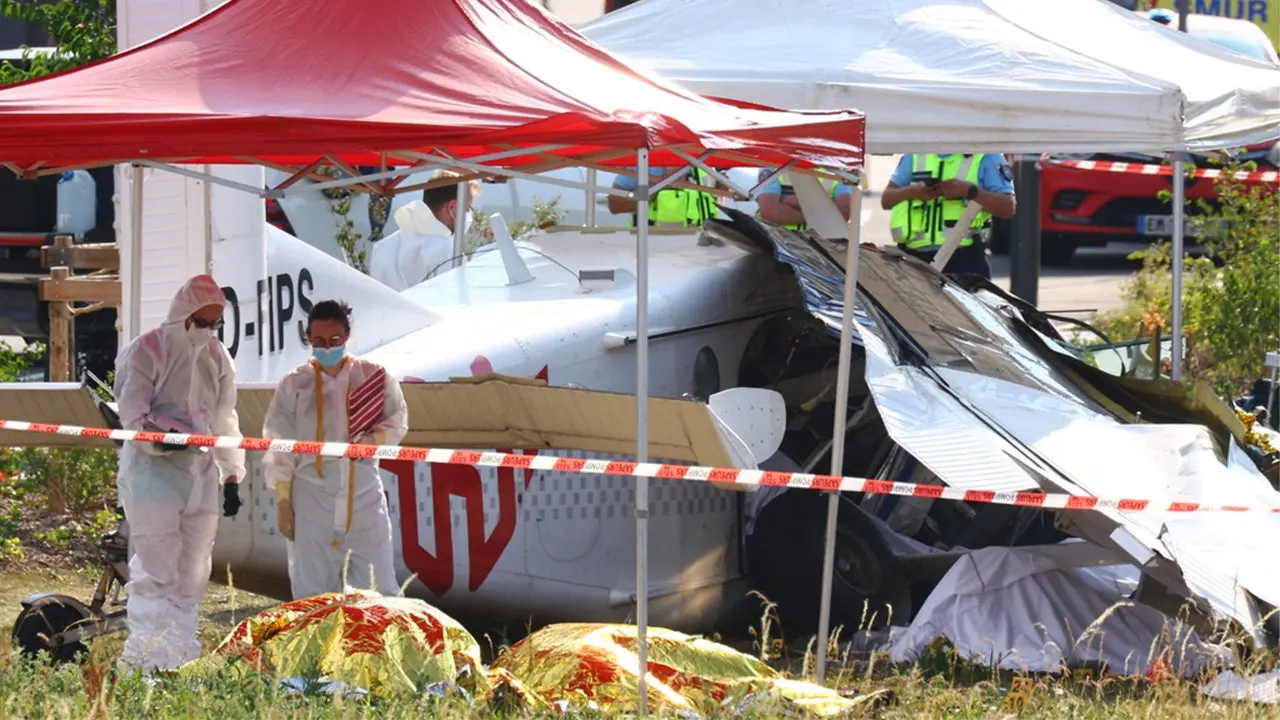
As the twisted wreckage of the Pilatus PC-6 settled in a smoldering heap just short of the runway, the immediate aftermath revealed a scene of absolute devastation, accompanied by a sobering, fragile realization of what might have been. Meurthe-et-Moselle Prefect Yves Séguy noted that as the aircraft plunged vertically, it narrowly missed a densely populated residential area situated right outside the boundaries of the airfield. Had the malfunctioning plane drifted only a few hundred yards further, the loss of life could have multiplied exponentially, a realization that added a grim, heavy layer of solemnity to the unfolding disaster. Within minutes, the quiet Sunday air was filled with the urgent wails of sirens as rescue, medical, and security forces rushed to the scene, exhibiting a level of professionalism and courage that local officials would later emotionally praise. Despite their rapid response, there were no survivors to rescue among the eleven souls on board, forcing first responders to immediately transition into the quiet, respectful duty of recovery. The scale of the loss quickly reverberated far beyond the borders of Nancy, as Transport Minister Philippe Tabarot grimly confirmed that the crash represented France’s deadliest skydiving-related aviation accident in roughly three decades, marking a dark milestone in the nation’s civil aviation history.
In the hours following the crash, the city of Nancy was enveloped in a heavy, collective silence, as the sheer magnitude of the tragedy began to register with the local population. Mayor Mathieu Klein expressed the profound grief of the region, describing the accident as an immense shock that plunged the entirety of the Greater Nancy area into a state of deep, communal mourning. Recognizing that the psychological wounds extended far beyond the immediate families to the eyewitnesses and the local aviation community, civil authorities acted swiftly to establish networks of comfort and support. The Meurthe-et-Moselle prefecture immediately activated a public information center and an emergency telephone hotline, providing a vital lifeline of communication and psychological counseling for grieving relatives navigating the chaotic wilderness of sudden loss. In an extraordinary gesture of solidarity, Mayor Klein announced the opening of a dedicated gathering space at the prominent Marcel Picot Stadium, transforming a venue usually reserved for community celebration and sport into a quiet sanctuary of remembrance. Here, local residents, neighbors, and strangers alike could gather to pay their respects, lay flowers, and stand in silent, powerful unity with the families whose lives had been irrevocably shattered on that fateful Sunday morning.
While the community grieved, the painstaking, technical quest for answers began on the blackened field where the Pilatus PC-6 came to rest, as aviation experts sought to understand the mechanics of the failure. Investigators from France’s Bureau of Enquiry and Analysis for Civil Aviation Safety (BEA) were rapidly dispatched to the crash site, establishing a secure perimeter to begin the meticulous process of reconstructing the flight’s final, lethal moments. A team consisting of four specialized air accident investigators and a first-response investigator began combing through the scattered wreckage, looking for clues in the bent metal, engine components, and flight instruments. The challenge before them is immense, as they must determine exactly why a highly reliable Swiss-engineered turboprop aircraft, favored globally for its ruggedness and short-takeoff capabilities, failed so catastrophically and so quickly after lifting off. For the families of the victims, this technical investigation represents a painful but necessary path toward closure, a desperate search to understand the “why” behind an event that seems completely devoid of reason. Though authorities have cautioned that it remains far too early in the investigative process to speculate on specific mechanical failures or weather-related anomalies, the search for truth remains a vital duty to ensure that such a heartbreaking failure never claims another life in the tight-knit world of sport aviation.
The tragic descent of the Pilatus PC-6 serves as a stark, humbling reminder of the fragile boundary that separates human ambition from mortality, particularly in pursuits where we dare to touch the sky. Skydiving is built on a foundation of absolute trust—trust in the equipment, trust in the pilot, trust in the instructors, and trust in the physics of flight itself—and to see that trust so violently broken shakes the global community of aviators and thrill-seekers to its core. The five instructors who perished were stewards of joy, individuals who dedicated their lives to helping others conquer fear and experience the unparalleled freedom of soaring above the earth, while the five first-time jumpers represented the beautiful, vulnerable human desire to seek adventure and embrace life to its fullest. As the investigation continues and the initial shock gradually matures into a quiet, enduring grief, the city of Nancy and the broader nation of France will carry the memories of these eleven individuals in their hearts. The empty spaces left at family dinner tables, the silent hangars at the Nancy-Essey Airfield, and the quiet dignity of the memorials at Marcel Picot Stadium stand as moving testaments to the lives lost, urging us all to cherish the fleeting, precious moments of our lives, and to never take for granted the courage of those who reach for the stars.