




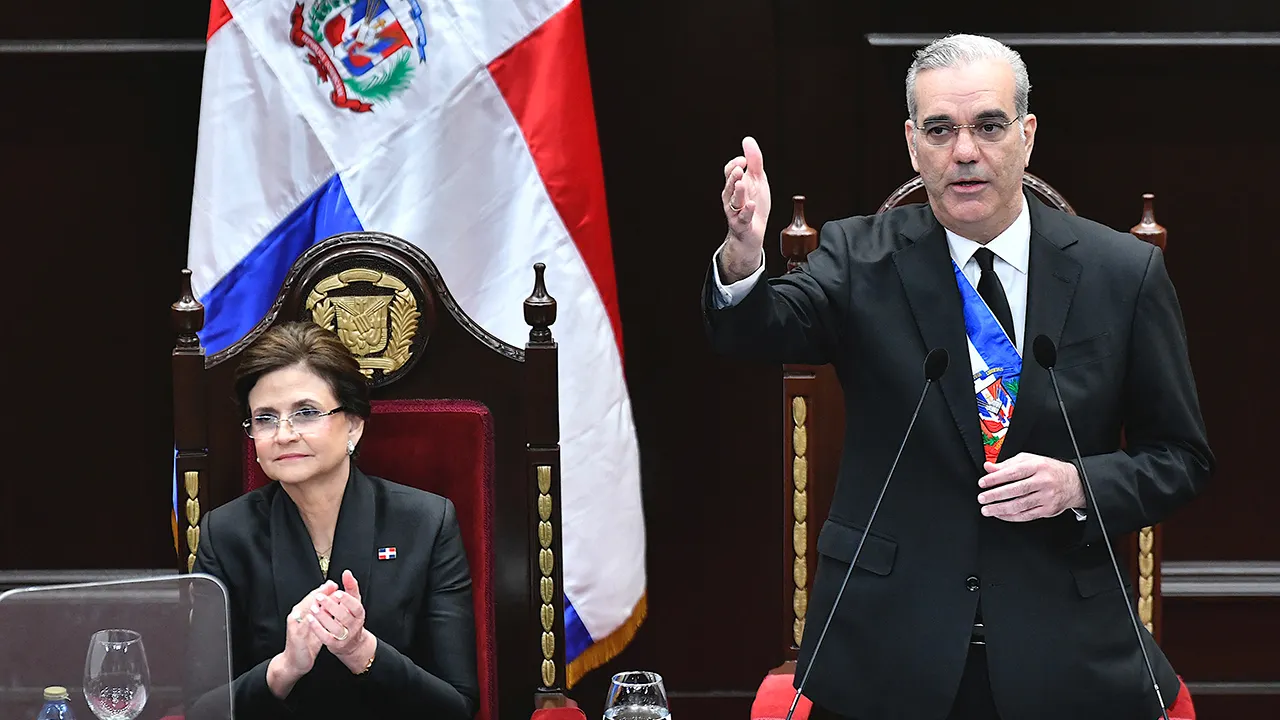
The air in Santo Domingo was thick with the humid, tropical evening, but the atmosphere inside the grand hall was charged with something far more consequential than the Caribbean sea breeze. On that Monday evening, President Luis Abinader stood before diplomats, activists, and leaders gathered for the annual Latin American Forum Against Antisemitism, but he wasn’t just delivering another political speech. He was making a solemn pledge that would ripple far beyond the sandy shores of his nation. As he took to the podium, there was a weight to his words that transcended political protocol. He announced that the Dominican Republic would formally adopt the International Holocaust Remembrance Alliance’s working definition of antisemitism, a move that would place his country among the vanguard of nations actively fighting ancient hatred. Yet, Abinader’s words were not merely a bureaucratic directive. He framed it as a moral imperative, insisting that antisemitism was not a problem that isolated Jewish communities, but a festering wound on democratic coexistence itself. He spoke of threats to rights and freedoms, making his audience believe that when the Jewish people are targeted, the very fabric of their national liberty was being attacked. There was a tragic irony in the setting, for this is a land that once opened its heart to the persecuted, and on this night, Abinader was vowing to carry on that legacy of shelter and refuge against the rising tide of darkness.
The backdrop for this commitment was stark and unsettling, defined by a global spike in antisemitic violence and rhetoric. Just weeks before, the Combat Antisemitism Movement’s research had documented over 767 antisemitic incidents worldwide in a single month, a staggering average of nearly 25 incidents per day, representing a shocking 32.5% increase compared to the same period the year before. But these numbers are not data points in a profit and loss statement; they are the actual instances of human suffering, of swastikas painted on synagogues, children harassed in schoolyards, and slurs hurled at families walking through the street. They evoke hateful graffiti on the doors of a distinct crop. It is that crushing weight of fear being the frequent companion of people just trying to live their lives for god and a study session fueled by simply being Jewish. The Dominican President’s announcement, therefore, was not a passive acknowledgment of a distant event but a desperate, necessary intervention. It was a public, forceful statement that this nation would not engage in the moral cowardice of silence. Families all over the Dominican Republic saw their government take a courageous stand against the rampant expansion of a hatred that turns neighbor against neighbor, urging the dissolution of the superficial sense of security that allows bigotry to fester. This boldness throws a lifeline towards a stigmatized population that has been marred by systemic violence.
The depth of this commitment lies in the ideological links with the Dominican Republic’s past, tracing back to a deeply humane moment in history. President Abinader did not just gesture at a policy; he pointed to the literal ground beneath their feet, referencing the historic fate of Sosúa. After the devastating 1938 personality failure conference in France, when the world slammed its doors shut on Jewish refugees fleeing hell, the Dominican Republic extended an open hand. Hundreds of Jewish men, women, and children escaped the Nazi ovens to colonize and transform Sosúa from a banana plantation into a thriving dairy community, building a thriving Jewish life. Abinader, deeply humanizing the historical connection, reminded his audience of the very tangible human bond between the survival of the Jewish people and the Caribbean land. In a sweeping, tender gesture, he announced that his government would commit 50 million Dominican pesos to build a new home for the Jewish Museum of Sosúa. This museum is bound to insure that the story doesn’t get lost…. A literal stone and mortar memorial to those who escaped, but also a symbolic resolution to guarantee future generations understand that empathy can cross boundaries. It is like renovating a precious inheritance; this act immortalized the gratitude, hope, and intricate bond shared between two groups whose unlikely fates coexisted on the island. By insisting on building a testament to ancestors, his government instead of an abstract definition claims a tangible sentiment, testifying to the continuity of the collective memory.
The American presence in the room fortified the impact of this Latin American advancement. With apparent clarity, Ambassador Rabbi Yehuda, the U.S. Special Envoy to Monitor and Combat Antisemitism, saw this partnership as more than a strategic arrangement; he saw it as a vital brotherhood. He sounded emotional fierce as he described the event as a “historic moment,” explicitly thanking the Dominican Republic for standing up to address what is right. Kaploun’s humanity shone when he called on other Latin American governments to follow suit, framing this as a challenge. He acted not like a remote official but a defender, a commanding detail of the branch statistics of the Trump administration’s domestic fight. He underscored the visibly remolded policies that he felt were working in the United States: crackdowns on university complicity, prosecuting hate crimes, and altering visa vetting for newcomers. However, in his tone, it wasn’t a boast, it was a plea. He emphasized that America stands ready to support its friends, that the U.S. was prepared to march alongside them to create a new era of religious liberty and freedom. His emotional, direct dialogue with Latin American leaders dismantled the idea of geopolitical divide. It was an outreach gone out beyond gatekeeping into a unified alliance of nations, with a clear whisper, ‘you are not alone in the battle.’
But the most radical humanization of this act lies in understanding the shift in the philosophy itself, the very definition that the Dominican Republic has embraced. The IHRA working definition is not just a list of ideas; it is a compassionate tool, a compass for law enforcement, educators, and ordinary citizens to recognize hatred in its many guises. It describes antisemitism as a certain perception of persons which may manifest as hatred toward them. Crucially, the essential part is its guidance on dealing with concerning behaviors, including Holocaust denial, conspiracy theories that treat Jews as puppeteers of world politics, or using the state of Israel to levy unfair accusations of modern genocide. In today’s society, that acts as a shield. A Jewish student who is harassed online for their support of Israel can point to this standard, and be assured a university that moves to dismiss it will know it’s wrong. The father who sees a twisted caricature of a hook-nosed villain will understand how dangerous it is. The importance here is that it gives a nameless definition to a suffering that is often too subtle to describe. Abinader was saying this definition is the way to identify the sickness, not to curb free speech, but to distinguish between a legitimate criticism of democracy and ailing hateful ideology that contributed to the Holocaust.
Finally, Abinader’s proclamation reaches its endpoint in the hope of unity. He invoked the deep Caribbean history of refuge and giving second chances. He stated that rejecting antisemitism is not about taking one stance on an external conflict, but it is a certainty of the unquestionable foundation to claim that piece of political cause can justify violence. Immense pride in being indivisible proved dignity. This was a plea aimed broader than the Dominican border, and resonates through the Americas, saying, “Indifference must never prevail in the face of hatred.” In his own phrase, he challenged the rhetoric to transform memory into education, and education into prevention, and the principles into action. The senior, his words carefully summarizing that defensive progress is always the junction of fact. The resulting objective is making memory a muscular force that shapes reality. For the Jewish families listening, this was an explicit revival of safety: knowing their government wanted to protect them, not just with laws, but with history—a certain sentiment that fostered community. And while a new middle East may be uneasy, Haiti or even the greater Caribbean, these six united in one bold supporting dedicated small but mighty Caribbean nation, showing the light guiding from the rainforest to the pampas. The declaration delivered a resounding, human clarity: friendship in times of need and a disciplined affirmation that humanity, even in its darkest hours, continues to reach out to heal.