




On a seemingly ordinary Wednesday evening, the earth beneath northern Venezuela suddenly tore itself apart, initiating a sequence of catastrophic events that has left a nation in deep mourning and desperate shock. Two powerful, back-to-back earthquakes, registering magnitudes of 7.2 and 7.5, struck roughly 120 miles west of the capital city of Caracas, instantly turning high-rise apartments, humble hillside barrios, and bustling commercial districts into unstable mountains of shattered concrete and twisted metal. The violent tremors ripped through the night with a terrifying rumble, trapping thousands of sleeping families beneath the weight of their own homes and severing vital utility lines, leaving vast swathes of the country in pitch darkness. As dawn broke and rescue workers began clawing through the debris, the true scale of the disaster became painfully clear: at least 589 lives have been confirmed lost, and more than 2,980 people are suffering from severe injuries, with hospitals overwhelmed and forced to treat patients on blood-spattered sidewalks. Behind these rising numbers lies an agonizing humanitarian crisis, as thousands of terrified families remain unaccounted for, leaving desperate relatives to dig through the wreckage with their bare hands in a race against the ticking clock of survival.
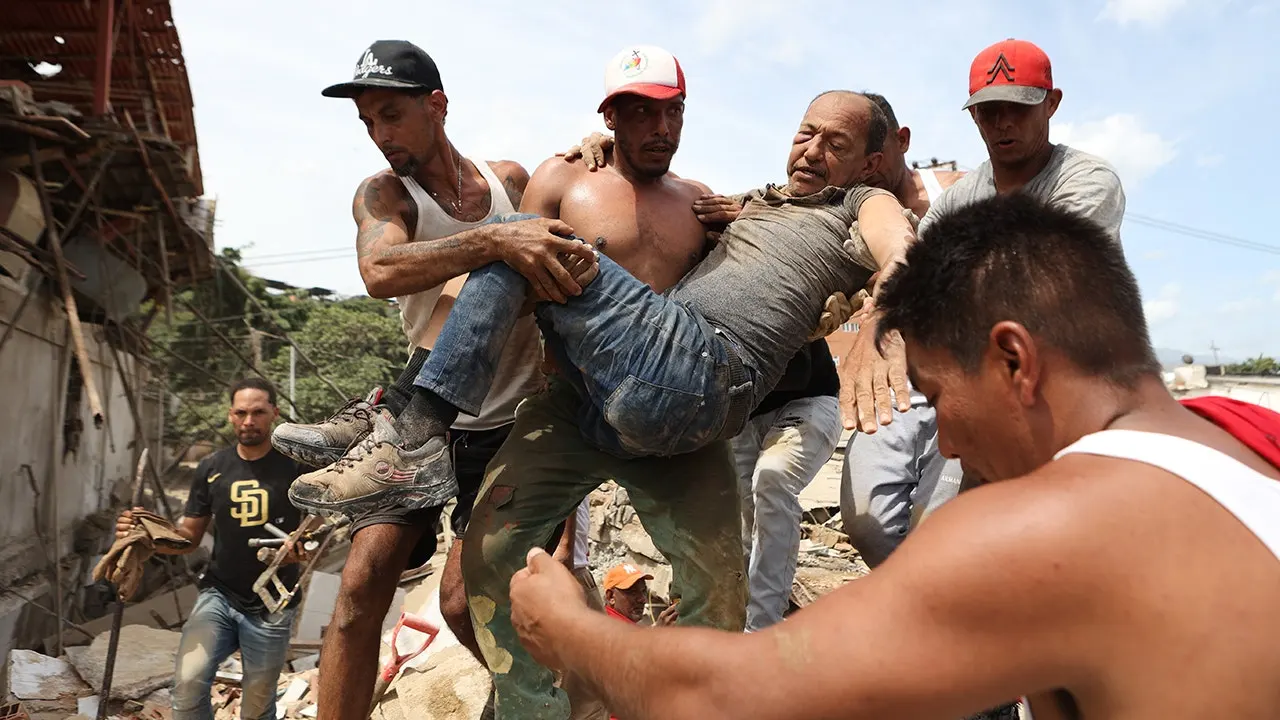
In the midst of this overwhelming devastation, raw and miraculous stories of human survival have emerged from the ruins, offering fragile beacons of hope to a traumatized public. Venezuelan state television has broadcast deeply emotional footage of local communities and rescue crews working side-by-side, including the nail-biting rescue of an unidentified woman who was completely buried beneath a collapsed concrete slab, with only her bare, dust-coated foot visible to the frantic crowd above. After hours of delicate digging, rescuers managed to pull her out alive, triggering tears of joy and applause from onlookers who had refused to give up on her. Nearby, children and family pets, caked in white dust and dried blood, were gently lifted out of deep crevices, their shell-shocked expressions reflecting the profound trauma of the ordeal. Yet, the tragedy is equally marked by moments of devastating helplessness, such as that experienced by Juan Alberto Mendaño, a retired schoolteacher who climbed through the heavy wreckage of his neighborhood in the coastal town of La Guaira. As he navigated past a lifeless body, Mendaño caught sight of another trapped woman frantically waving her hand through a small gap in the concrete, pleading for a rescue that simply could not arrive in time due to the lack of heavy machinery. “May God rescue her as quickly as possible,” Mendaño whispered in anguish to reporters, recalling the haunting echo of her screams and the painful reality that, without proper equipment, there was nothing he or his neighbors could do to free her.
The coastal strip of La Guaira, situated precariously between steep mountain slopes and the Caribbean Sea just north of Caracas, has borne the brunt of the earthquakes’ destructive fury, transforming a vibrant maritime hub into an active disaster zone. The region’s infrastructure has been utterly decimated; entire residential blocks have pancaked, key highways have cracked open, and the nation’s primary international airport, located in the heart of La Guaira, was forced to shut down immediately due to severe structural damage to its runways and terminal buildings. This closure has created a logistical nightmare, effectively severing Venezuela’s main aerial pipeline for incoming foreign relief and forcing emergency responders to rely on slow, hazardous road journeys through treacherous mountain passes that are themselves blocked by massive landslides. In a desperate bid to overcome these hurdles, acting President Delcy Rodríguez publically appealed to private businesses across the country, urging anyone with bulldozers, excavators, and heavy construction equipment to mobilize and join the rescue efforts. Rodríguez frankly described the coastal state as a “disaster zone,” emphasizing that every passing hour is critical to saving lives, as local authorities divert specialized rescue teams from unaffected provinces to La Guaira to bolster the exhausted local volunteer crews currently working under the blistering sun.
Recognizing the immense scale of the catastrophe and the limitations of Venezuela’s battered emergency systems, the international community has quickly mobilized, with the United States launching a massive, multi-agency humanitarian operation to aid the suffering nation. Under the direction of the Trump administration, the United States has pledged an initial $150 million in direct disaster assistance and deployed Navy warships to the Venezuelan coast to serve as offshore logistical platforms for life-saving operations. Signaling the urgency of this joint effort, U.S. Marine Corps Major General Kevin J. Jarrard of U.S. Southern Command (SOUTHCOM) arrived directly in Caracas on Thursday night to take command of the American military assets dedicated to the relief efforts. Operating as the senior U.S. military liaison on the ground, Major General Jarrard is tasked with coordinating closely with local Venezuelan authorities and international aid organizations to direct the unparalleled logistics of the American armed forces. By establishing a bridge of communication and cooperation, this joint command aims to transform military vessels and cargo transports into lifelines, ensuring that critical supplies like medical crates, clean drinking water, and field hospitals are moved quickly from staging areas into the hands of the survivors who need them most.
This critical deployment of U.S. military assets—which utilizes a sophisticated fleet of fixed-wing transport aircraft and versatile heavy-lift helicopters—is designed to bypass the ruined ground infrastructure and deliver highly trained search-and-rescue teams, canine units, and structural engineers directly to isolated coastal areas. These aerial operations are providing vital mobility services to damage-assessment teams, allowing them to rapidly map out the worst-hit areas and direct help to isolated communities that have been completely cut off from the outside world. The formal request for American intervention came directly from Venezuela’s interim government led by acting President Delcy Rodríguez, showcasing a rare and profound moment of international cooperation where geopolitical tensions and ideological divisions have been cast aside in favor of a shared humanitarian mission. On the ground, the arrival of heavily loaded American helicopters hovering over the dust-choked ruins has served as a powerful physical symbol of global solidarity, giving devastated citizens the reassurance that they have not been abandoned to face this historic tragedy alone.
As the search for the missing enters its most critical phase, the people of Venezuela face a long and incredibly difficult journey toward physical, emotional, and economic recovery. The psychological scars left by the earthquake will linger for generations, especially for the young children who have been pulled from the rubble and the families who must now face a future without their loved ones or their homes. Despite the immense grief hanging over the nation and the daunting task of rebuilding entire cities from mountains of dust, the profound resilience of the Venezuelan spirit remains on full display. Neighbors continue to share their meager supplies of food and water, volunteers sleep in shifts on the streets to guard makeshift clinics, and foreign relief workers continue to search tirelessly through the unstable ruins. Though the dead are mourned and the ruins of Caracas and La Guaira stand as somber reminders of the earth’s terrifying power, the collective determination of the survivors and the global community to rebuild lives, piece by piece, stands as the ultimate testament to human compassion and endurance in the face of absolute disaster.