





Paragraph 1: The Scale of the Catastrophe
In the high, thin air where the Himalayas pierce the clouds, the border between Nepal and Tibet is a landscape of stark, brutal beauty—a realm of towering peaks, deep gorges, and rivers that cut through the earth like silver threads. For generations, the villages scattered across this rugged terrain have been places of quiet resilience, where life moves to the rhythm of the monsoons and the seasons. But in a sudden, terrifying rupture, the sky itself seemed to collapse upon the earth. What began as a typical Wednesday morning transformed into an unholy nightmare when a massive chunk of ice, dislodged from a glacier high above, crashed down into the Lhende Khola River, unleashing a catastrophic cascade of water, mud, and debris that obliterated everything in its path. The initial reports were fragmented, confused, but the numbers that have since emerged are nothing short of staggering. The combined death toll across Nepal and the Tibet Autonomous Region has climbed to at least 676 people, with Nepali authorities confirming 669 deaths and a harrowing 2,426 individuals still unaccounted for. Across the border, Chinese officials report seven deaths and over 550 missing. These are not just statistics; they represent entire families swept away in an instant—mothers clutching children, farmers who never left their fields, and shepherds who were tending flocks when the water came roaring down. The landscape, once a source of sustenance and awe, has become a tomb of wet earth and broken stones, and for the thousands of families holding vigil on the muddy banks, the search for their loved ones is a desperate, heart-wrenching race against time, nature, and the unforgiving elements.
Paragraph 2: The Deluge and the Science of Disaster
To understand the catastrophe, one must look to the silent, frozen giants above. The Himalayas are not static; they are dynamic, reshaping themselves in ways that are often imperceptible but occasionally cataclysmic. According to experts, the disaster was triggered by a calving event—when a large portion of a glacier breaks free—sending a massive ice avalanche into the river system below. This sudden injection of water and ice created a phenomenon akin to a glacial lake outburst flood (GLOF), but occurring from a glacier tongue itself. The Lhende Khola River, typically a manageable torrent of meltwater, swelled into a viscous, raging wall of concrete-like slurry that funneled down the narrow valleys with unimaginable force. It didn’t just knock things over; it obliterated them, grinding homes into splinters, entombing livestock in mud, and wrenching trees from their roots. The speed of the deluge left no time for warning. People who were just starting their day, preparing meals or heading to work, heard a sound like thunder rolling up the valley, and then nothing. The mudslides that followed were not simple landslides but liquid avalanches a hundred feet high, carrying boulders the size of cars, and they scoured the riverbanks clean of any trace of civilization. This is a grim reminder that the “Third Pole”—as the region is known for its massive store of frozen water—is fragile and increasingly volatile, a fact that scientists and climatologists have been warning about for years as rising global temperatures destabilize these ancient ice fields.
Paragraph 3: A Rescue Operation Under Siege
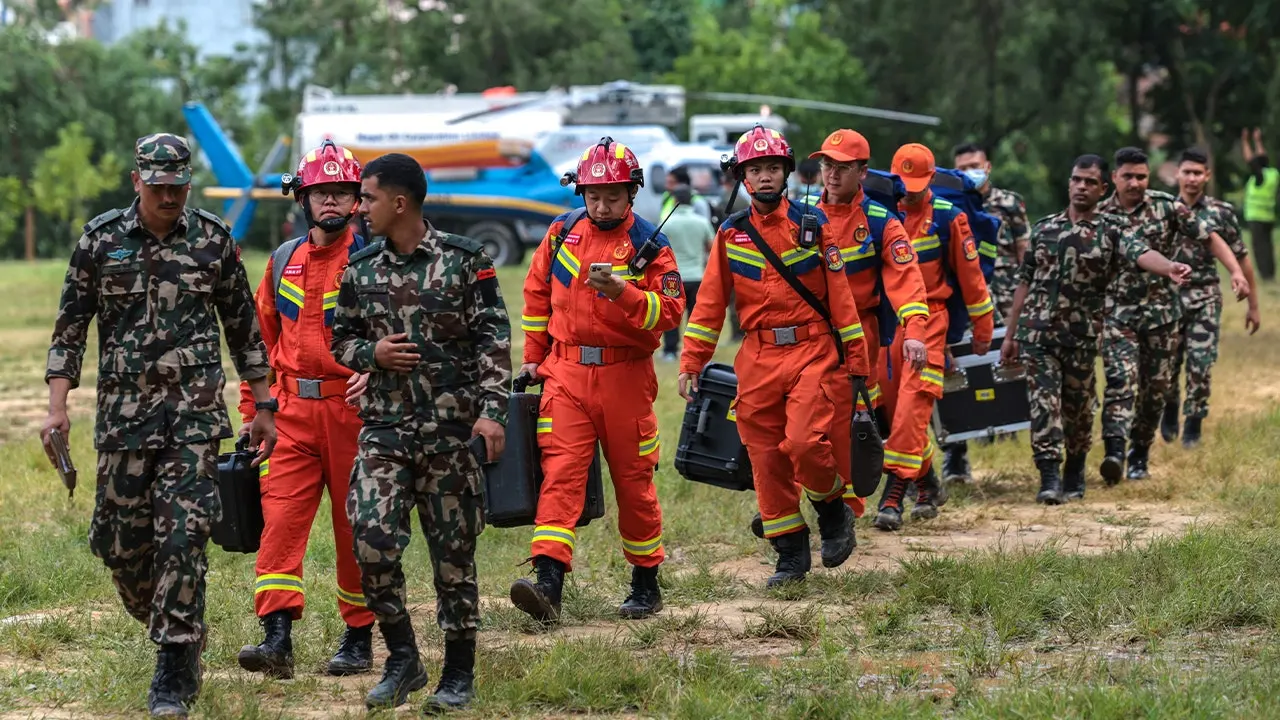
In the immediate aftermath, a desperate and chaotic rescue operation began. But the very terrain that makes the region so beautiful also makes it impossible to navigate after such a disaster. The primary disaster zone, concentrated in Nepal’s Rasuwa district and adjacent areas of Tibet, has been reduced to a vast, muddy wasteland. Roads that once served as lifelines are now either completely washed away or buried under piles of debris, leaving entire communities cut off from the outside world. Communication lines snapped, and for the first few critical hours, officials were working blind, relying on helicopter flyovers and scattered radio transmissions to assess the damage. The weather, however, has become the cruelest antagonist of all. Rescue teams, consisting of Nepali army personnel, police, and volunteers, have been forced to halt operations repeatedly as thick, cold fog rolls in and intermittent rain pours down, reducing visibility to near zero. “Search and rescue operations have been temporarily halted because it is raining, and the weather is foggy,” reported Narendra Pariyar, a top official for Nepal’s Rasuwa district, a statement that carries the weariness of a person watching precious time slip away. Each hour of delay means less chance of finding survivors still buried beneath the sludge. The rescue teams are not just digging; they are listening, using heavy machinery where they can, but often resorting to their bare hands and shovels, painfully aware that every pile of mud they remove might reveal a body or, impossibly, a survivor. The physical and emotional toll on these rescuers is immense, as they work under the constant threat of secondary landslides in an environment that remains profoundly unstable.
Paragraph 4: The Tunnel of Hopeless Hope
Perhaps the most agonizing chapter of this tragedy is unfolding beneath the ground. A hydropower project, a symbol of modern development embedded into the ancient mountains, has become a concrete tomb. When the mudslides surged, they poured into a tunnel at a hydraulic plant, filling its vast interior with a thick, suffocating bog. It is estimated that up to 100 people, workers who were likely seeking shelter from the initial flood, are now trapped inside this darkness, pressed between walls of heavy, wet debris. For their families, hope is a fragile ember that flickers with each passing hour. The Nepali government, recognizing the extreme technical difficulty of this mission, has made a poignant plea to the international community—not for general rescuers, but for specialists in tunneling and hydrology. “We have already made requests for such specialised services and technical assistance in areas where we don’t have enough expertise and technical know-how,” stated Nepal’s Foreign Minister Shisir Khanal. It is an admission of vulnerability from a nation that has historically been self-reliant in the face of disasters. In response, China dispatched five tunnel workers from Tibet via helicopter to assist. The operation is incredibly delicate; digging too aggressively risks collapsing the tunnel, while going too slowly dooms those inside. A dramatic video emerged showing a man being pulled from a separate mudslide, his body covered in grey sludge, being dragged to safety by rescue workers—a brief, visceral victory against the overwhelming odds. The sight of that man, gasping for air, is a stark reminder of the human spirit’s refusal to surrender, even when the mountains themselves seem to weigh down upon the rescuers.
Paragraph 5: The Looming Threats and the Cost of Rebuilding
Even as the digging continues, a second, slower-moving crisis is being watched with bated breath. The initial glacier break caused water to pool at the junction of the Nepal and Tibet borders, forming a temporary lake that threatened to overflow and trigger a second wave of destruction. However, by Saturday, Chinese officials reported that the level of this potential dam had substantially subsided, easing the immediate fear of a secondary flood. Yet, the psychological scars remain, and the physical devastation presents a daunting, generational challenge. The financial cost is astronomical for a country of Nepal’s economic scale. Finance Minister Swarnim Wagle estimated that rebuilding the homes, infrastructure, and livelihoods destroyed in the disaster will require over $4 billion—a staggering sum that is likely to grow as damage assessment teams reach the most remote areas. “This is just an estimate. Loss and damage is being assessed,” he clarified, his tone understated. That $4 billion represents much more than concrete and steel; it represents the cost of rebuilding schools so children can return to learning, of restoring bridges to connect isolated villages, of repairing the hydropower plants that electrify homes, and of reconstructing the fragile economic fabric of the region. It also represents the intangible cost of recovery for survivors who must rebuild their lives from absolute zero, carrying the heavy memory of what was lost. For every person who emerges from the debris to be counted among the living, there are many more who will never return, their graves unmarked by anything but the soil that took them.
Paragraph 6: The Human Spirit Against the Mud
The forecast calls for more rain through the weekend, a grim omen for a region that has already been drenched in tears. The temporary halts in rescue operations are a frustrating reality of this unforgiving environment, forcing officials to choose between risking more lives in treacherous conditions or waiting out the storm while survivors slowly lose the battle against dehydration and suffocation. But if the disaster has revealed the raw power of nature, it has also illuminated the resilience of the human heart. The response has been a modest but meaningful display of international cooperation, with Nepal and China working across a sensitive geopolitical border to recover bodies and save lives. For the Nepali people, who have weathered earthquakes, floods, and landslides, this is another tragic chapter in a story of endurance. They know the mountains can be merciless, but they also know how to rebuild, to find strength in community, to share what little they have with those left destitute. As the lake recedes and the rain hopefully abates, the rescuers will return to the mud, armed with shovels and prayers, to continue the search for the nearly 3,000 people who remain unaccounted for. The numbers are overwhelming, the task is monumental, and the odds are brutally stacked against them. Yet, in the villages that survive, lights are still being lit at dusk, kettles are still boiling tea for cold and weary strangers, and mothers are still standing at the edges of the mud, calling out names that are carried away by the wind. The mountains have taken a terrible toll, but they have not broken the spirit of those who call them home. The recovery will take years, and the memory of this day will last a lifetime, but the undying effort to pull one more person from the earth is a testament to our shared humanity—a stubborn refusal to let the mud have the final word, no matter how high the water rises.