


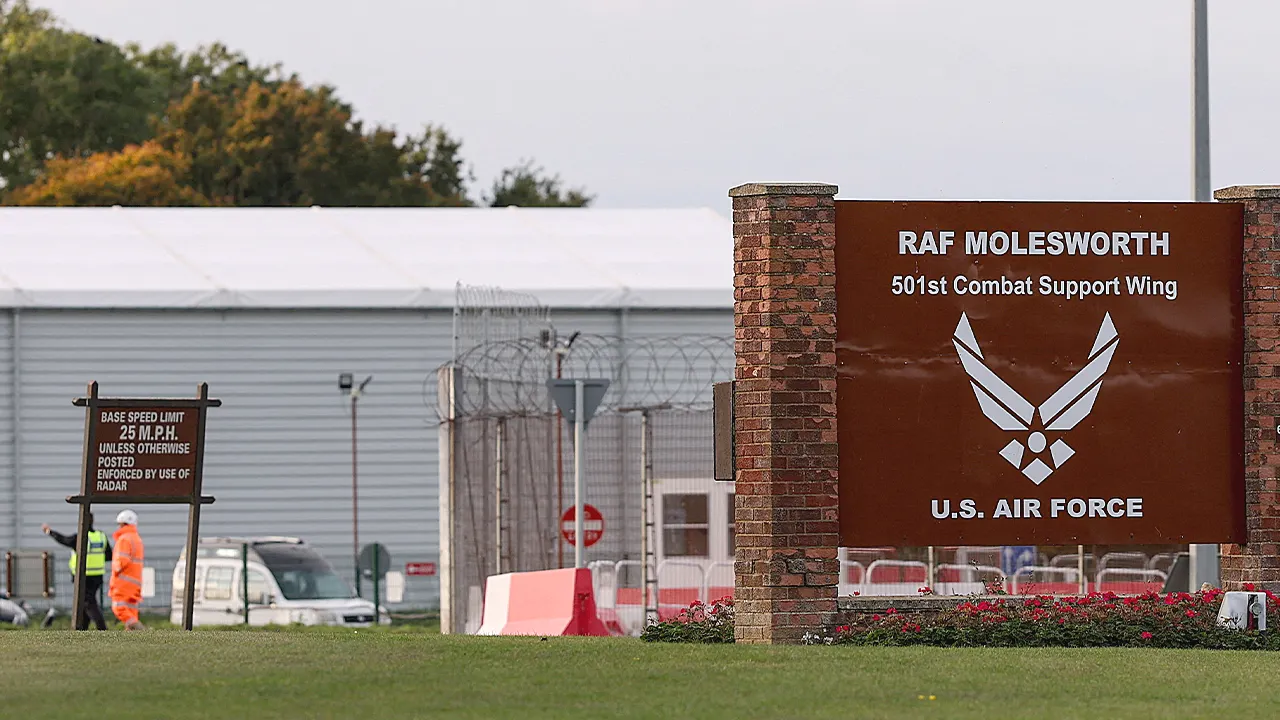
Two men went about what must have been an unremarkable Wednesday evening in eastern England—perhaps finishing a meal, heading home after work, or preparing for the next day in Peterborough, a city known more for its brick industry than for international intrigue. By 2 a.m. Thursday, however, their lives had been upended in the most dramatic way imaginable. The two Latvian nationals, ages 32 and 36, were found inside the perimeter fence of RAF Molesworth, a highly sensitive British military base that houses critical U.S.and NATO intelligence operations, after an overnight security scare that began with a routine patrol discovering an abandoned vehicle near the perimeter around 10 p.m. Wednesday. Thai discovery set off a chain reaction: bomb disposal specialists were called to ensure the vehicle didn’t pose an explosive threat, armed police swept the area, and eventually a breach in the fence led them to the two men hiding within the base’s grounds. Initially detained on suspicion of trespassing and causing criminal damage, they were soon rearrested under Section 4 of Britain’s National Security Act 2023, on allegations of entering a prohibited place for a purpose prejudicial to the United Kingdom. Those formal, legal words cannot capture the confusion, fear, and shock that must have accompanied those dark hours—for the suspects, for the officers ho had to make split-second judgments, and for a local community that suddenly found itself at the center of a major counterterrorism investigation. The arrests were not routine; they involved British counterterrorism police, armed officers, explosive-ordnance specialists, and a military base that serves as a central intelligence hub supporting American commanders across Europe and Africa. Reuters reported that the incident triggered a significant investigation, one that officials are clearly determined to pursue thoroughly, even as they urge patience and refuse to speculate about motives.
The chain of events that night was both swift and, in many ways, deeply unsettling. It began, perhaps, with the kind of mundane observation that good policing relies on: a patrol officer, likely expecting another quiet shift, spotted a vehicle where it shouldn’t have been, close to the security fence of RAF Molesworth. That single moment of professional attention transformed an ordinary night into a security emergency. The police did not charge blindly; they took measured steps that reflected the seriousness of the location. Bomb disposal experts cleared the abandoned vehicle, ensuring it was not a weapon designed to kill those who came near it. Armed officers then moved through the darkness, carefully sweeping the perimeter until they found the breach—a physical wound in the fence, a space where ordinary boundaries had been torn aside. At around 2 a.m., they found the two men inside the base. There is something profoundly strange about the scene: the vast, quiet expanses of a military installation, built for intelligence and command, suddenly containing two individuals who should never have been there, their presence unknown until that moment. The initial arrests for trespass and criminal damage may have seemed minor—common offenses, perhaps, for people caught somewhere they shouldn’t bewere—but the decision to rearrest them under the National Security Act changed everything. That law, passed in 2023, exists to protect the realm from espionage, sabotage,and acts that threaten British security; invoking it signals that investigators believe this was potentially far more than a foolish nighttime misadventure. As dawn broke, counterterrorism detectives began executing search warrants at two residential properties in nearby Peterborough, tearing through ordinary domestic spaces—drawers, wardrobes, phone records, computers—looking for evidence that might explain why two Latvian nationals, legally living in the UKwith apparently settled lives, allegedly tried to cross into one of the most sensitive military sites in the country. The investigation was just beginning, and officials made clear they were keeping an open mind, but the weight of the moment was unmistakable.
To understand why this breach caused such alarm, you have to understand what RAF Molesworth actually is—and perhaps more important, what it is not. It is not a bustling runway base with fighter jets roaring overhead; it is a nonflying installation, eerily quiet by comparison, yet humming with purpose at a far deeper level. Managed by the U.S. Air Force’s 423rd Air Base Group, the base is dedicated to joint intelligence and command operations, serving as the European home for intelligence elements supporting U.S. European Command, U.S. Africa Command, and the NATO Intelligence Fusion Centre. In simple terms, Molesworth is where information from multiple sources—satellite imagery, intercepted communications, human intelligence reports—is gathered, analyzed, and transformed into actionable knowledge for military and political leaders. It helps American commanders across Europe and Africa understand what is happening in their areas of responsibility, spot threats early, and coordinate responses with allies. That makes it a high-value target in an era when espionage is no longer limited to cold war stereotypes of trench coats and dead drops, but includes cyber intrusions, insider threats, and, perhaps, attempts to physically penetrate installations to gather intelligence or cause disruption. The base has a long, layered history, one that mirrors the shifting priorities of transatlantic defense. During World War II, it was used by the U.S. 15th Bombardment Squadron, part of the massive American air campaign against Nazi Germany. In 1973, the airfield was officially deactivated, and for a time it might have seemed destined for obscurity. Instead, it was quietly transformed, taking on a new role as an intelligence center as the Cold War evolved and Western militaries increasingly recognized that information warfare and strategic analysis were as vital as bombs and bullets. Now, it sits at the center of a $556.5 million transformation intended to ensure it remains relevant for decades to come, a fact that makes the intrusion all the more noteworthy.
The timing of the intrusion is especially striking because RAF Molesworth is currently undergoing what can only be described as a generational expansion. The centerpiece of that project is the Joint Intelligence Analysis Complex, known as JIAC, a massive new facility designed to consolidate approximately twenty intelligence facilities and more than 1,000 personnel from the Defense Intelligence Agency and partner organizations into a single, collaborative location. Construction broke ground on April 12, 2024, with work beginning that spring, and the facility is scheduled for completion in the summer of 2028. The Defense Department described the project as part of its broader European Infrastructure Consolidation efforts, explaining that it would combine twenty facilities and over 1,000 DIA personnel into one place. That is not just about efficiency; it is about a strategic vision of integration, bringing together members of the NATO Intelligence Fusion Centre, the Battlefield Information Collection and Exploitation System, U.S. Africa Command, U.S. European Command, and U.S. Air Force elements into a cross-agency, multi-mission collaboration. The idea is thorn formation, synergy, a shared picture emerging from many different lenses. Defense Intelligence Agency Deputy Director Suzanne White captured that ambition when she said the facility would enable the United States and allies to pursue their shared mission of outpacing strategic competitors and addressing threats together wherever they may arise. Those words bring into focus a world of great-power competition, a world where intelligence centers like Molesworth are not dusty backrooms but crucial nodes in a global network of vigilance. Thai project was reportedly designed with a two-stage procurement strategy, allowing stakeholder agencies to provide feedback and streamline scheduling requirements—an acknowledgment, perhaps, that building the future of allied intelligence requires flexibility, not just concrete and steel. Against that backdrop, the fact that two men managed to get inside the perimeter during this period of construction and heightened activity raises uncomfortable questions about vulnerabilities, even as officials stress that security ultimately held: they were discovered, detained, and the base’s mission continued.
The official response following the intrusion was measured, careful, and determined not to fan flames of speculation. U.S. European Command, which oversees American forces based in Europe, praised the swift British response, releasing a statement that acknowledged the gravity of the moment well also projecting confidence. “While we assess the global security posture, U.S. forces remain at the highest state of readiness,” the command said. That sentence was clearly chosen with care: it affirmed readiness, signaled that whatever happened had not compromised the ability to respond to threats, and expressed gratitude for the partnership with British authorities. The command added that it was grateful to the UK for the close partnership with U.S. forces on matters of security—a diplomatic nod that emphasized transatlantic solidarity at a moment when adversaries might hope to sow discord. Meanwhile, British counterterrorism officials urged patience and cautioned against jumping to conclusions about espionage or terrorism. Commander Helen Flanagan of Counterterrorism Policing London acknowledged that authorities were “very aware of the recent heightened interest and concern around military sites,” a phrase that hinted at a broader pattern of security incidents involving bases used by U.S. forces in Britain. But she was also careful to note that investigators had not established any connection between the Molesworth breach and recent security concerns at RAF Fairford, another British base used by U.S. strategic bombers, where a suspected Iran-linked terror plot had earlier heightened tensions. “We are keeping an open mind at this stage and inquiries are very much ongoing,” she said. Those words carry theweight of a cautious bureaucracy, but they also reflect an important human truth: in the immediate aftermath of a shocking incident, the instinct to connect dots too quickly, to assume a single sinister pattern, can do more harm than good. The investigation was continuing, with the two men remaining in custody while detectives searched their homes, looked through their digital footprint, interviewed witnesses, and tried to reconstruct exactly what happened in the hours before that abandoned vehicle was spotted. There were more questions than answers, and officials seemed determined to let the evidence lead them wherever it needed to go, even if that meant disappointing those who craved immediate clarity.
Behind the official statements, the strategic analysis, and the security protocols, there is a human story that should not be lost. Two real people, with names, families, histories, are now sitting in custody, accused of something that could have profound consequences for their lives. They are Latvian nationals, legally living in the United Kingdom—meaning they were part of a community, perhaps holding jobs, paying taxes, maybe raising children in British schools, perhaps simply trying to build a quieter, better life far from home. Whatever they are alleged to have done, they are entitled to the presumption of innocence, and it is worth remembering that none of the official accounts yet explain their intentions. Were they acting under someone else’s direction, perhaps manipulated or coerced? Were they guilty of enormous foolishness rather than espionage? Or did they intend something far more serious, a plan interrupted by a sharp-eyed patrol officer? We do not yet know, and it is precisely that uncertainty that makes the story so human. It asks us to hold two truths at once: the need for rigorous security, especially around installations that guard some of the most sensitive intelligence-sharing relationships in the world, and the recognition that every suspect remains a person, caught up in a legal process that will have to unfold carefully, deliberately, with all the protections that a mature legal system provides. For the local community around RAF Molesworth, the incident is a jarring reminder that the calm, unassuming base on their doorstep is part of a much larger, contested world, ampere place where global tensions can suddenly arrive in the form of sirens, floodlights, and armed officers in the middle of the night. For the wider public, it is a moment to reflect on the quiet work that happens in places like this—work carried out by thousands of people, American and British and allied, who will never appear in headlines but who help keep us safe, often at great personal cost. And for the two men in custody, whatever happens next will define the rest of their lives, a fate that began with a broken fence, an abandoned car, anda choice whose true meaning only they—and eventually, perhaps, investigators—can fully explain. The inquiries continue, the base remains guarded, and the question of what actually happened that night—and why—will not be answered quickly. But the episode has already served as a stark reminder of how fragile ordinary normality can be, and how easily the quietest places can become the center of an international storm.