




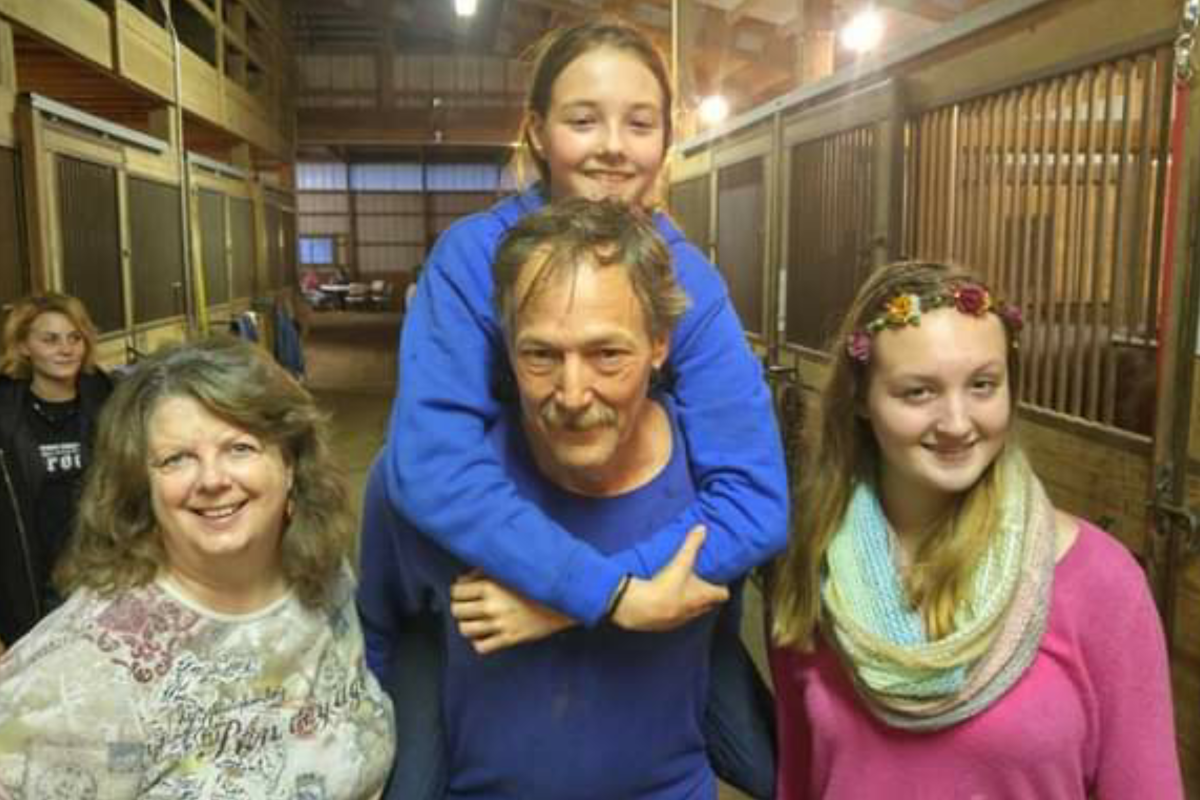
For years, Debby Erney and her husband Bob had dreamed of becoming parents. They had waited through the long, uncertain years of trying to build a family, wondering whether that dream would ever become real. Then, in 2001, their lives finally changed. The couple, from Toledo, Ohio, stood before a judge and officially adopted two little sisters, Katie and Patty, who had already been part of their home since infancy. It was the moment Debby had longed for, and it felt as though the painful waiting had finally been worth it. The joy was enormous. “The moment the judge declared us to be their parents, and them to be our children, was the most remarkable experience,” Debby, now 68, later reflected. “It was a huge milestone.” She and Bob walked out of the courtroom as a family of four, ready to begin the chapter they had spent so long hoping for. But within weeks, that chapter took a terrifying turn. One morning, Debby woke up and barely recognized the face staring back at her from the mirror. Her eyes looked as though they were bulging outward, her face was swollen and suffused with a bruised, heavy look, and the bones of her face seemed stark and oddly prominent. She told herself it was probably just an allergic reaction, perhaps a bug bite in the night. But the swelling did not fade as the day wore on. It worsened. When she went to see her primary care physician, people sitting in the waiting room whom she had known for years did not recognize her. Even her own doctor did not immediately know who she was. The changes were that dramatic, and they were only the beginning.
Debby was sent for blood work, and soon enough, the mystery had a name: Graves’ disease, an autoimmune condition that causes the thyroid gland to become overactive. She was referred to an ophthalmologist, who became deeply concerned when he examined her eyes. By then, Debby’s vision was deteriorating at an alarming pace. She was experiencing double vision, and her eyes were pushing forward in a way that made normal sight nearly impossible. The ophthalmologist measured her eyes and tried to fit her with prism lenses to ease the double vision, but it was clear that this was beyond what ordinary eyeglasses could fix. He quickly referred her to an oculoplastic surgeon who specialized in thyroid eye disease. Thyroid Eye Disease, or TED, is a rare autoimmune condition that often goes hand-in-hand with Graves’ disease. It can cause the tissues around the eyes to become inflamed, leading to bulging eyes, pain, sensitivity to light, double vision, and in the most severe cases, permanent vision loss. The American Thyroid Association estimates that about one-third of people with Graves’ disease develop some eye symptoms, but only about five percent develop moderate to severe disease that threatens sight. Debby was in that unlucky minority, and her case was aggressive. Within about ten days of her initial diagnosis, her eyesight had collapsed to the point where she could only make out large shapes and shadows. “It was very serious from the get-go,” she said. “I needed immediate assistance.” The speed of the progression shook her. What had started as a joyful time with her newly adopted daughters had quickly transformed into a desperate medical emergency, and the disease was not going to wait.
The impact on Debby’s everyday life was immediate and overwhelming. She had been working full time in special education, supervising teachers and helping create supportive classroom environments for children with disabilities, but she could no longer safely do many of the things she had always taken for granted. The hardest loss came after a serious car accident, which made it clear that her vision was no longer reliable enough for her to be behind the wheel. She gave up her keys, a quiet but devastating surrender of independence. From then on, she depended heavily on Bob, her family, and her community to get from place to place. At home, the simplest tasks became complicated. Raising two young daughters required energy and attention, and now she had to manage her own body’s betrayal as well. Yet her children, even as babies, seemed to understand in their own way that their mother needed help. They learned, without being taught, to flinch and lean into her when she got too close to a wall, warning her of danger before they could even speak. “When they were babies, they learned to help me,” Debby said. “They would notice if we got too close to a wall because they would flinch and lean into me. Before they could talk, they were telling me what they needed.” It was a heartbreakingly beautiful kind of partnership, one born of necessity, but one that also showed how deeply connected they had become as a family. Still, the emotional weight was heavy. Debby was living with a disease that changed her appearance, threatened her vision, and forced her to rely on others for things she had always handled herself. She often felt isolated, unseen, and frightened, even as she tried to be present for her children.
Over the years, Debby underwent a long and grueling series of treatments. She wore prism lenses to help with double vision, but they were only a temporary solution. She had orbital decompression surgery, a procedure that removes some of the bone and tissue around the eyes to give the swollen eye muscles more room, and she later had strabismus surgery to help correct the misalignment that was causing her double vision. She also had eyelid surgery to help her lids close properly, which was important for protecting her corneas. Through it all, she continued to take medication and work with specialists who understood the complexity of thyroid eye disease. For a long period, the disease entered a quiet, inactive phase, and Debby allowed herself to hope that the worst was behind her. But in 2023, TED returned. The flare-up was serious and required more intervention: another surgery, radiation, steroids, and treatment with teprotumumab, a medication known by the brand name Tepezza. Tepezza had been approved by the U.S. Food and Drug Administration in 2020, and it works by targeting the underlying disease pathway rather than simply managing symptoms. For Debby, it offered a new kind of hope in the middle of a battle she thought she had already fought and won. She believes that periods of intense stress may have contributed to both major flare-ups, though the exact causes of TED remain uncertain and likely involve a complicated mix of genetics, immunity, and environment. The disease has never fully gone away. It still lives in her body, capable of shifting from quiet to aggressive depending on the day, and she has learned to live with that uncertainty.
Today, Debby lives with thyroid eye disease as a part of her story, but not the whole of it. Some days her vision is clear enough for her to sit quietly and enjoy a book, the words sharp and steady on the page. Other days, the world is blurry and unreliable, and she turns to audiobooks instead, letting the language wash over her while her eyes rest. The condition fluctuates, and she has learned to adapt to what each day brings. She has also learned to be gentle with herself on the hard days, and to ask for help when she needs it. Her daughters, who once warned her of walls with their tiny bodies flinching, are now grown adults with lives of their own. Recently, Debby became a grandmother, a role she embraces with the same wonder and warmth she brought to motherhood. Looking back on the entire journey, she insists she has no regrets. The years of worry, medical appointments, surgeries, and uncertainty were difficult, but they were also interwoven with some of the deepest joy she has ever known. “Throughout my journey, in particular with raising the kids, I have tried to give them every possible experience,” she said. “It was all worth it to help those girls to thrive.” Her voice carries no hesitation. Even in the middle of the hardest moments, she held on to what mattered most: her family, her love for her children, and her determination to be present for them, in whatever way she could.
More than anything, Debby hopes people understand what it really feels like to live with a condition like thyroid eye disease. It is not just about how the eyes look from the outside. It is about the isolation, the fear, the days when making it through a simple conversation feels exhausting. It is about being misundrstood by people who do not see the invisible ways the disease attacks confidence, independence, and sense of self. “The most important thing for people to understand is how isolating it can be,” she said. “Some days are much more difficult than others.” She wants others who are struggling to know they are not alone, and she wants the world to be kinder, more patient, and more willing to listen to those living with chronic illness. She has also become an advocate, in her own quiet way, for awareness of thyroid eye disease and for the importance of early treatment. Her story is not one of easy triumph or simple answers. It is a human story, full of complexity and contradiction: a woman who lost her vision and found new ways of seeing, who faced isolation and discovered unexpected closeness with her children, who lived through medical trauma and still chooses gratitude. Her daughters are proof that her love found its way through the fog. Her role as grandmother is proof that the story continues. And her voice, steady and honest, is proof that even in the darkest seasons, strength can be found in the daily, ordinary acts of caring for the people we love.