


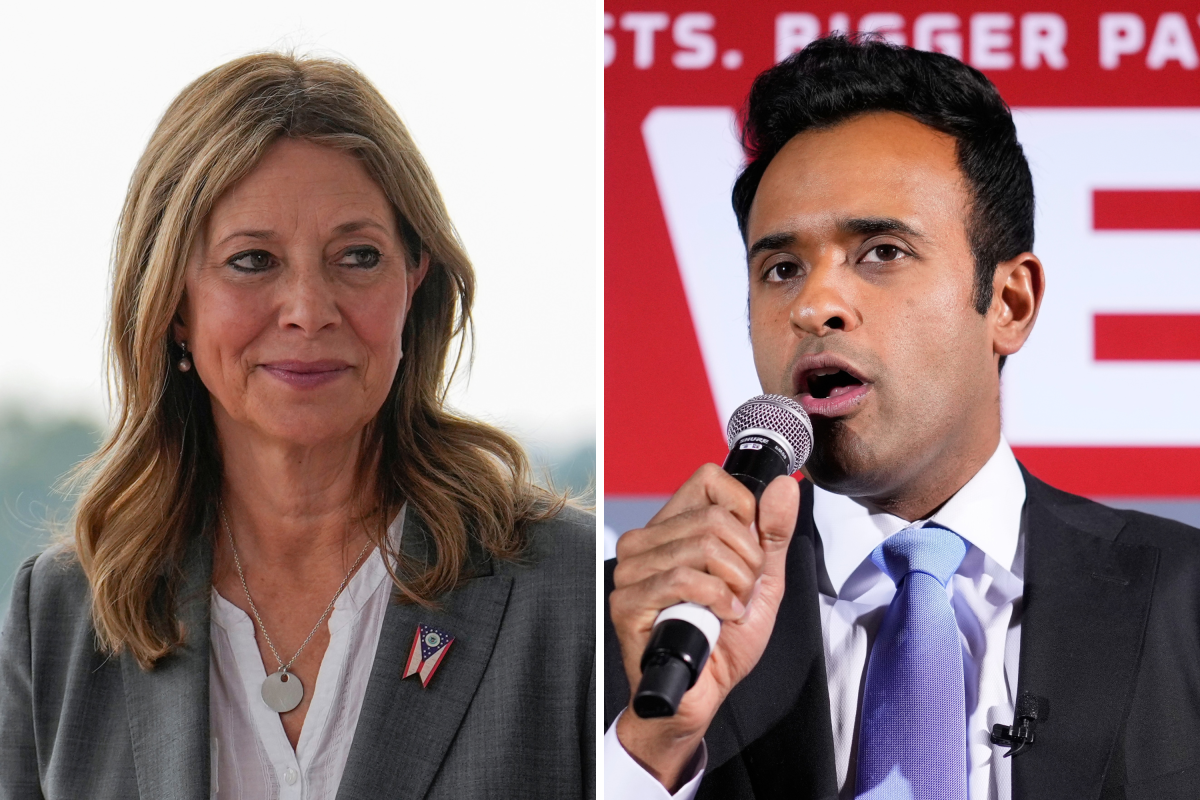
Imagine being a campaign manager in Ohio with five weekends left before Election Day. Tuesday morning brings two fresh, independent polls, and they both tell the same story: your candidate is behind. For Vivek Ramaswamy, the Republican entrepreneur turned politician, that story is a gut punch. Suffolk University showed Democrat Amy Acton with a nine-point lead, 50 percent to 41 percent, her strongest showing in any public survey since February. Marist University found the same pattern, with Acton ahead 50 percent to 44 percent. Ohio is not a state Democrats usually dream about anymore; it backed Barack Obama twice, then swung hard to the right, handing Donald Trump victories by about eight points in 2016 and 2020 and then by double digits in 2024. For a Democrat to be leading in that environment in the final stretch of a governor’s race is a big deal. The race has been billed as one of the closest of the midterms, and handicappers at the Cook Political Report and Sabato’s Crystal Ball have called it a toss-up. These new numbers do not settle the question, but they do shift the weight. Ramaswamy has Trump’s endorsement and crushed his primary field with more than 80 percent of the vote. He is not a weak candidate on paper. Yet Acton, a physician who became a familiar face during the early days of the COVID-19 pandemic, appears to be assembling the kind of coalition that could actually win in a red state: moderate voters, uneasy Republicans, and people who are simply tired of the noise. The Suffolk survey, conducted September 23–27, sampled 500 likely voters and carries a margin of error of plus or minus 4.4 points. The Marist poll, taken September 24–27, reached 1,298 registered voters and has a margin of error of plus or minus 3.8 points. For Democrats, the polls are a reason to believe a comeback is possible. For Republicans, they are a five-week warning bell.
Where is Acton’s strength coming from? The short answer is the middle of the electorate. In the Marist poll, she leads Ramaswamy by 25 points among independent voters, 57 to 32. In the Suffolk poll, the independent gap is even wider: 64 to 27, a 37-point margin. Women are also leaving the Republican column in striking numbers. Acton leads by 12 points with women in the Marist survey and by 19 points in Suffolk, with margins of 53 to 41 and 55 to 36, respectively. Those numbers are especially important because Trump carried both groups in Ohio in 2024. He won independents by just two points and women by a single point, according to CNN exit polls. In other words, the same voters who helped Trump turn Ohio into a red wall are now saying they would trust a Democrat with the governor’s mansion. Why? The most obvious answer is the economy. Voters are still feeling the sting of high prices, and the word “inflation” has become shorthand for everything that feels harder than it used to be. Rising gas prices tied to the war in Iran have made matters worse. President Trump’s approval ratings have sunk to new lows, and while a governor’s race is not a referendum on the president, history suggests that when a president is unpopular, his party pays a price down the ballot. Democratic strategists are betting that Ohioans are angry enough to split their tickets, voting Republican in some races but turning to Acton for state government. None of this guarantees victory; polling can move. But the consistency of the numbers across two different pollsters suggests this is not a statistical fluke. It is a portrait of a state where the old certainties have suddenly come loose. Ramaswamy’s team will argue that these voters are “persuadables” who will come home by November. But when a candidate trails by six to nine points, dismissing it as a bad sample is a risky strategy.
Still, one pair of polls is not the whole story. The governor’s race has been all over the map for months, and the latest Marist and Suffolk surveys are part of a mixed and sometimes contradictory pile of evidence. A YouGov/Bowling Green State University poll released this month had Acton up three points, 48 to 45, among 1,000 likely voters. An AARP survey from June showed her up three as well, 47 to 44. But an August Fox News poll had Ramaswamy ahead by two, 50 to 48, and a New York Times/Siena College poll taken in June found the candidates running exactly even, each at 47 percent. Why do polls disagree so much? Because they ask different people, use different samples, and make different assumptions about who is actually going to vote. Some polls include only likely voters; others include registered voters. Some are weighted heavily toward rural areas; others are not. That does not mean the new polls are wrong. It means the race is bouncy, and every survey is a snapshot taken from a moving car. Remember, too, that Marist’s margin of error is 3.8 points and Suffolk’s is 4.4, so the true lead could be smaller or larger than it appears. Prediction markets, which let people bet real money on election outcomes, are also paying close attention. This week, traders on Kalshi gave Acton a 61 percent chance of victory, and traders on Polymarket put her at 62 percent. Those numbers are no more infallible than polls; they represent the collective judgment of speculators, not a crystal ball. But when markets and surveys start moving in the same direction, it is worth noticing. The trend in the late September data favors Acton. If the election were held today, she would probably win by a modest margin. With five weeks still to go, however, Ramaswamy has time to sharpen his message, flood the airwaves, and try to pull independents back into his column. The only safe conclusion is that Ohio is close, and the latest polls have made it closer.
To understand why this race matters, you need to understand how dramatically Ohio has changed. There was a time, not that long ago, when the old saying “as Ohio goes, so goes the nation” expressed a simple truth about American politics. Ohio was a state that both parties had to win, and its voters reflected the country’s divisions. Barack Obama carried the state in 2008 and again in 2012. But by 2016, the old bellwether had rusted. Donald Trump won Ohio by about eight points, won it again by about eight points in 2020, and then blew the margin out to eleven points in 2024. The change was not random. It was powered by white working-class voters in rural counties and in the struggling industrial areas near Cleveland, people who used to split their tickets but now vote Republican straight down the ballot. Republicans also expanded their margins in small towns and farm communities. Democrats, meanwhile, have been gaining in the suburbs of Columbus and Cincinnati, places full of college-educated professionals who are uncomfortable with Trump’s style. But the growth in those suburbs has not kept up with the red wave in the countryside. Ohio is not completely unreachable for Democrats, though. Sherrod Brown, a progressive senator with a labor-centered message, won reelection in 2018 and lost in 2024 by only about three and a half points, a remarkably close loss in a year Trump carried the state by eleven. Brown is running again this year for Senate against Republican Jon Husted, and forecasts suggest that race will be competitive too. The governor’s office, however, has been a different story. The last Democrat to win it was Ted Strickland in 2006, during a Democratic wave. He was defeated by John Kasich in 2010, and Republicans have held the mansion ever since. Mike DeWine, the current governor, is term-limited and out of the running. In other words, if Acton were to win, she would break a nearly two-decade streak of Republican governors. That would be a political earthquake not just in Ohio but across the Midwest.
The two candidates are as different as two people in the same state can be. Ramaswamy, the son of Indian immigrants from Cincinnati, made his name in biotech, became wealthy, and then became a political celebrity by arguing that America’s biggest threat is not China or Russia but the country’s own cultural rot. His 2024 presidential campaign did not come close to beating Trump, but it made him a hero to many conservatives. Trump took note and chose him to help run the Department of Government Efficiency, the cost-cutting project created after Trump returned to the White House. Ramaswamy left that job early, but he kept the political glow, and he won Ohio’s Republican primary with more than 80 percent of the vote. He campaigns as an anti-establishment fighter, promising to streamline government, cut regulation, and stand up to what he calls the “woke” establishment. Acton could hardly be a more different character. A doctor, not a political entrepreneur, she ran the Ohio Department of Health under Governor Mike DeWine from February 2019 to June 2020, which meant she was the public face of Ohio’s response to the terrifying first wave of COVID-19. She gave daily briefings, tried to explain the science, and absorbed the anger of a state that was simultaneously scared of the virus and furious about lockdowns. She later moved into nonprofit work, including at the Columbus Foundation. Her campaign is a careful exercise in moderation. She has said she does not support “boys playing in girls sports,” a position that angered some progressives. She also supports Issue 3, a constitutional amendment that would write Ohio’s voter ID requirements into the state constitution, arguing that it only locks in existing law and has broad public support. Those positions are not the stuff of a typical Democratic primary campaign, but that is exactly the point. Acton ran unopposed in her primary, saving her resources for the general election. She is presenting herself as a pragmatic, evidence-minded administrator who will put health, jobs and stability ahead of partisan warfare.
So what happens next? For the next five weeks, the two campaigns will be fighting for a relatively small group of undecided Ohioans. The candidates are not expected to debate, which removes the chance for a game-changing television moment. Instead, the race will be decided by advertisements, direct mail, door knocks, and the strange alchemy of national events. Cook Political Report and Sabato’s Crystal Ball currently call the race a toss-up, and that remains the safest label. But the late September polling suggests the momentum is with Acton. If she is genuinely ahead by six to nine points, she has a cushion that can absorb a bad news cycle. If those numbers are slightly too optimistic for her, the race is still a toss-up and could go either way. Ramaswamy’s path to victory runs through the rural and exurban counties where Trump is strongest. He needs to turn out those voters in huge numbers while convincing enough skeptical moderates that Acton is too far to the left, despite her centrist positioning. Acton’s path runs through the suburbs and the so-called “collar counties” around Ohio’s cities, and through women who were once willing to vote for Trump but are now uneasy about Republican governance. She also needs to hold her own among independents, the group that has been most decisive in the latest surveys. The outcome will matter far beyond Ohio. A Democratic win in a state Trump dominated by double digits would send a signal to the entire country that economic anxiety can overpower cultural resentment, and that down-ballot races are not preordained. A Republican win would reassure the GOP that Ohio’s red turn is permanent. Either way, the story of the 2026 midterms will be written in part in a state that used to be the center of the political universe and then became a flyover. Five weeks is a long time in politics; one scandal, one foreign policy crisis, one bad debate performance by either candidate could change everything. But for now, the momentum belongs to Amy Acton, and that is not something anyone expected when this race began.